In this article
- 1Which Package for Which Garment
- 2Four Questions That Decide the Package
- 3Poly Mailers
- 4Paper Mailers
- 5Mailer Boxes
- 6Weight, Size and Shipping Cost
- 7How to Fold and Pack Clothing for Mailing
- 8Protecting Clothing From Moisture, Creases and Marks
- 9Branding and the Unboxing Experience
- 10Returns
- 11Sustainability Choices for Mailing Clothing
- 12Common Mistakes When Mailing Clothing
- 13A Checklist Before You Choose
- 14Next Step
For most clothing, a poly mailer is the lightest and lowest-cost way to mail it, a paper mailer gives a natural look, and a mailer box protects structured, delicate or premium pieces. The right choice depends on the garment, its weight, your climate and the experience you want the customer to have.
This guide explains how each option works, which garments suit which package, how to fold and protect clothing, how packaging affects shipping weight, and how to handle branding and returns. It is about mailing clothing to customers, not about retail boxes. If you also want boxes for display or gifts, read our guide to where to buy clothing boxes.
For the choice between a bag and a box in general, our guides to custom poly mailers and to choosing the right box for your product go further.
Key takeaways
- Poly mailers suit basics. Tees, leggings and other soft items travel well in thin film, which is light and sheds water.
- Boxes suit structure. Dresses, silk, jackets and gift pieces need a box that stops crushing and creasing.
- Weight and size drive postage. A lighter, smaller package can cost less to send, so right-size the packaging.
- Protect the fabric. Fold neatly, wrap in tissue or a clean bag and keep the garment dry.
- Plan returns. A resealable mailer and a clear return card make returns easy and cut waste.
Which Package for Which Garment
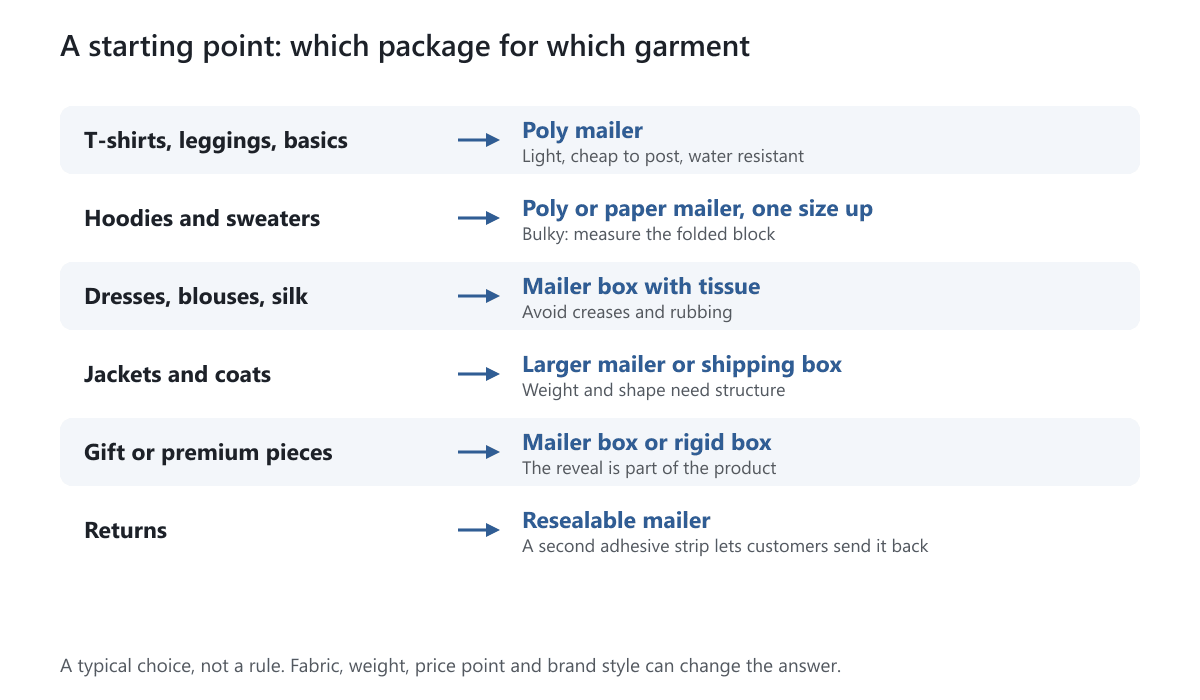
Start with the garment, because fabric and shape decide what protection it needs.
| Garment type | Good first choice | Why |
|---|---|---|
| T-shirts, leggings, socks, underwear | Poly mailer | Light, low postage, sheds water |
| Jeans, joggers, shorts | Poly mailer or paper mailer | Fold flat, no need for structure |
| Hoodies and sweaters | Poly or paper mailer, one size up | Bulky, so allow for the folded block |
| Dresses, blouses, silk, linen | Mailer box with tissue | Avoids creases and rubbing |
| Jackets and coats | Larger mailer box or shipping box | Weight and shape need structure |
| Gift or premium pieces | Mailer box or rigid box | The reveal is part of the product |
| Items that may be returned | Resealable mailer | A second adhesive strip reseals it |
These are starting points. A thick wool coat can sit in a large poly mailer for a cost-focused brand, and a cotton tee can go in a box for a premium brand. Decide using the four questions in the next section.
Four Questions That Decide the Package
- What does the garment need? Protection from water, crushing, dirt or creases.
- How heavy and bulky is it? Bulk raises size, and size can raise postage.
- What does the customer expect? A basics brand and a luxury brand set different expectations.
- What will it cost you per order? Count the package, filler, labor and postage together.
Answer those and the choice is usually clear. The rest of this guide goes through each option.
Poly Mailers
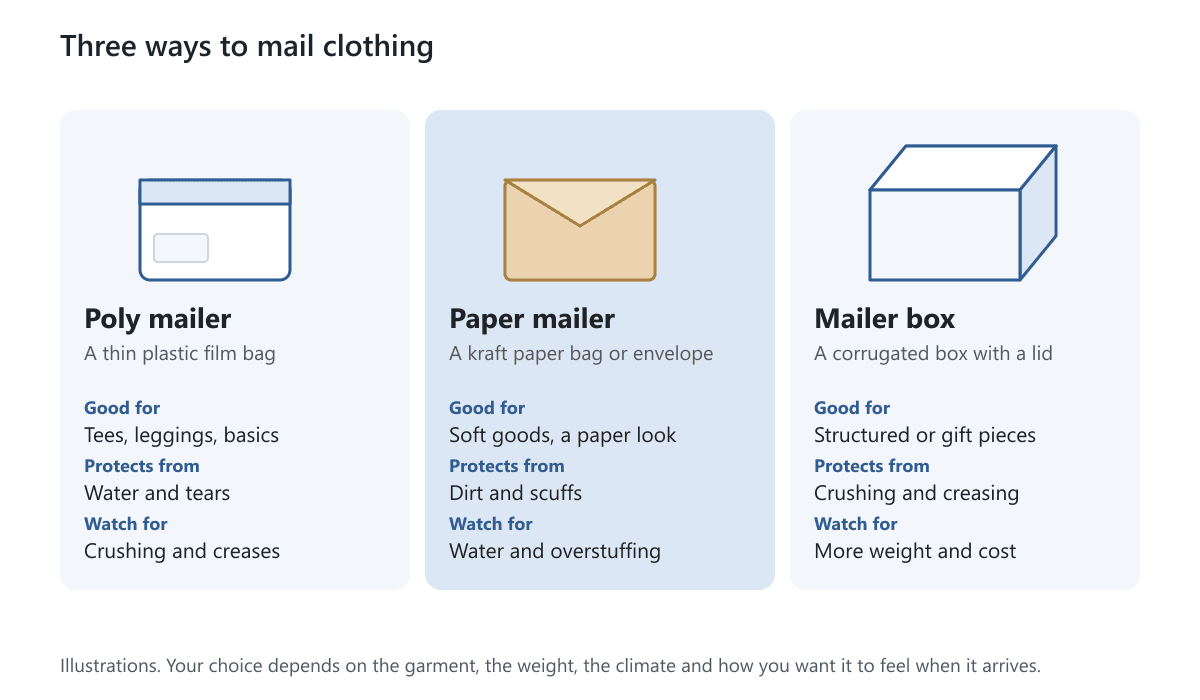
A poly mailer is a bag made of thin plastic film with a peel-and-seal strip. It is the standard for apparel e-commerce.
Why Brands Use Them
- Low weight. They add almost nothing to the parcel weight.
- Small and flexible. They take little storage space and ship flat before use.
- Water and tear resistant. The film sheds rain and resists scuffs.
- Printable. You can print a logo or pattern on the outside.
Watch For
- No crush protection. A heavy parcel on top can crease or flatten the garment.
- Creasing. Clothing arrives folded, so structured fabrics can crease.
- Thickness and size. A thin film can tear on sharp edges, and a bag that is too small splits at the seal. Ask for the film thickness and the sizes.
- Plastic concerns. Many customers care about plastic. Ask us about the film options for poly mailers, or consider a paper mailer.
For a seller who takes returns, a resealable return mailer has a second adhesive strip so the customer can reuse the bag. For delicate pieces, a padded bubble mailer adds cushioning, though padded mailers are harder to recycle. See are bubble mailers recyclable for the details. Poly mailers start at 500 units with us.
Paper Mailers
A paper mailing bag is a kraft paper bag or envelope that seals with adhesive. It gives a natural, brown-paper look that suits many brands.
- Good for: soft goods such as knitwear, accessories and folded basics.
- Protects from: dirt, scuffs and light handling.
- Watch for: water, since paper takes in moisture, and tearing if the bag is overstuffed.
- Recycling: paper is widely collected for recycling where facilities accept it. Plastic windows, liners and heavy coatings make recycling harder.
If your parcel may sit in rain, put the garment in a clean plastic bag or choose a film mailer. Paper mailers are best when the route is short and dry.
Mailer Boxes
A mailer box is a one-piece corrugated box with an attached lid. It arrives flat, folds up in seconds and can be printed inside and out. It is the most protective and the most presentable choice.
- Good for: structured garments, delicate fabrics, gift pieces and subscription boxes.
- Protects from: crushing, creasing and rubbing.
- Watch for: more weight, more space and a higher cost per parcel than a bag.
Our apparel pages note that E-flute board, about 1.2 to 2 mm thick, is the common choice, and B-flute, about 2.5 to 3 mm, suits bulkier or heavier garments. Mailer boxes start at 100 units. See our apparel boxes for styles and sizes.
Shipping Boxes for Bigger Orders
For several garments in one parcel, wholesale shipments or heavy coats, a shipping box is the sturdy choice. They start at 50 units with us. Our guide to what boxes are good for shipping helps you choose the style.
Weight, Size and Shipping Cost
Carriers charge by weight or by size, whichever is larger. The size-based figure is dimensional weight, worked out from length x width x height divided by a number called the divisor. The divisor depends on the carrier and changes over time, so check the current one.
Here is an example with an example divisor of 139. A folded sweater weighs 1.5 pounds. In a mailer box of 13 x 11 x 4 inches the volume is 572 cubic inches, which gives about 4.1 pounds of dimensional weight. In a poly mailer that is 14 x 11 x 2 inches when filled, the volume is 308 cubic inches, which gives about 2.2 pounds. The garment is the same, but the box would bill at about twice the weight.
That does not make bags better for every product. Boxes protect, and they can raise the perceived value of an item. It does mean you should right-size whichever package you use. Our guide to measuring a box correctly explains dimensional weight in more detail.
How to Fold and Pack Clothing for Mailing
- Check the garment. Make sure it is clean, dry and tagged.
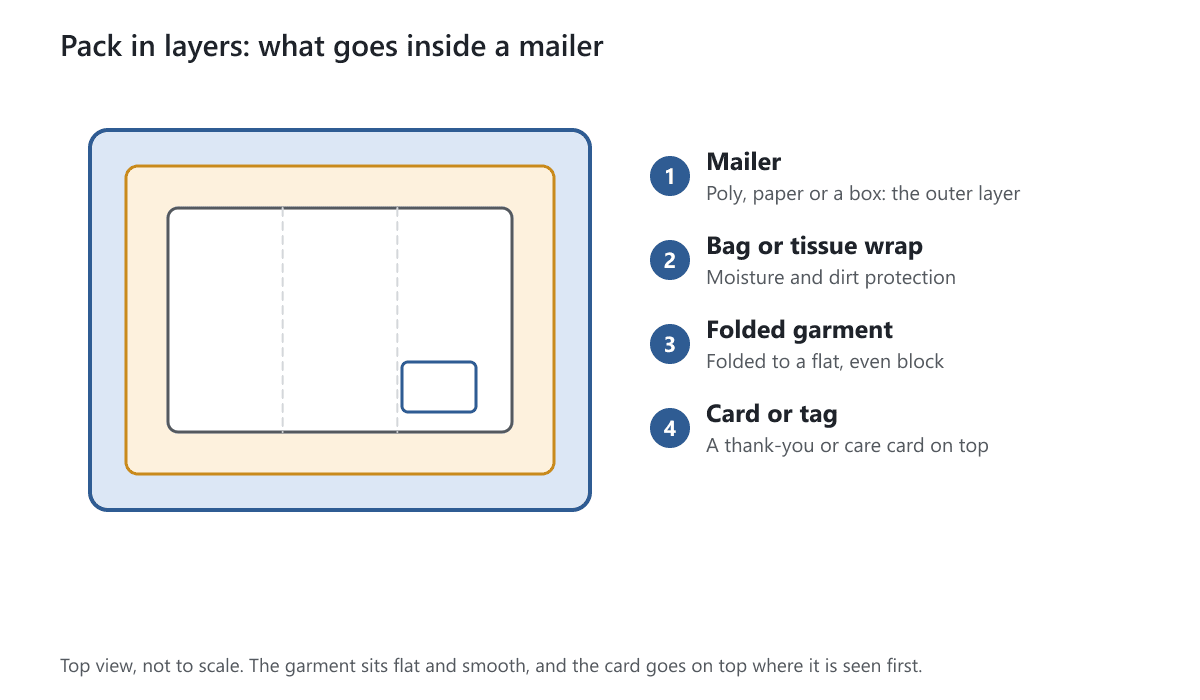
- Fold it flat and even. Use the same fold for every order, so you know the folded size.
- Wrap it. Use tissue paper or a clean bag, which also keeps dirt and moisture off the fabric. Tissue paper adds a nicer reveal.
- Add a card or tag. Put a thank-you card or care card on top, where it is seen first. Hang tags can carry the brand story.
- Choose the right size. The package should fit snugly without forcing the garment in.
- Seal firmly. Press the strip down along its whole length. For a box, tape or use a branded sticker.
- Label clearly. Put the label on a flat area, not across a seam or a fold. See where to place a shipping label on a box.
Protecting Clothing From Moisture, Creases and Marks
- Moisture. Pack garments in a clean plastic bag or tissue sealed with tape if the route can be wet. Paper and corrugated absorb water.
- Creases. Tissue paper in the folds and a box help delicate fabrics hold their shape.
- Dye transfer. Separate dark and pale items, and pack new dark denim apart from light fabrics.
- Marks. Wrap pale items so kraft fibers and handling marks do not touch them.
- Odors. Store packaging in a clean, dry place before use.
Branding and the Unboxing Experience
The package is the first thing a customer touches. You can brand any option, with a different effort and cost.
- Poly mailers. A printed logo or pattern, with a sticker or card inside.
- Paper mailers. One-color print on kraft looks deliberate and simple.
- Mailer boxes. Print outside and inside, so opening the lid is part of the brand.
- Extras. Branded tissue, a thank-you card, a sticker seal or a hang tag. Stickers and labels start at 500 units and make a stock mailer feel like yours.
Keep it proportionate. A low-priced basics brand does not need a rigid box, and a premium brand should not hide a delicate garment in a thin bag.
Returns
Returns are a real part of apparel selling, so plan for them in the package.
- Resealable mailers. A second adhesive strip lets the customer send the item back in the same bag.
- Return instructions. A printed card with steps and an address cuts confusion.
- Return-friendly boxes. A mailer box can be refolded and reused if it is not damaged.
- Return labels. Decide whether to include a pre-paid label or send one by email.
Sustainability Choices for Mailing Clothing
Customers pay attention to packaging waste, and apparel brands can make real choices. These are practical points, not slogans.
- Right-size the package. A package that fits uses less material and lowers weight.
- Know the options. Paper and corrugated are widely collected for recycling where facilities accept them. Plastic film is often not accepted at the curb, and rules differ by town, so check local programs. Ask us about the film options for poly mailers.
- Skip extra layers. Bubble wrap, extra plastic and mixed materials make recycling harder.
- Make reuse easy. A resealable mailer or a sturdy box can serve for returns.
- Ask about recycled stock. Recycled stock options are available on request for our paper-based packaging.
For more on materials, see our guide to eco-friendly packaging materials.
Common Mistakes When Mailing Clothing
- Using a package that is too small, which splits the seal or crumples the garment.
- Using a package that is too large, which adds weight and lets the garment move.
- Skipping moisture protection on routes that can be wet.
- Sending silk or tailored pieces in thin film with no tissue.
- Ordering a box that is too heavy for a low-priced item.
- Forgetting returns.
- Not testing one sample package before ordering a large quantity.
A Checklist Before You Choose
- Garment types listed, with their folded sizes and weights.
- Package type chosen for each: poly, paper, mailer box or shipping box.
- Moisture and crease protection planned.
- Dimensional weight checked with your carrier.
- Branding level chosen: print, tissue, card, sticker.
- Returns plan ready.
- Sample ordered and tested.
Next Step
Tell us what you sell, the folded size and the quantity, and we will recommend a package: get a free quote. Our Standard Sample Kit costs $50 with shipping included, so you can handle box types before you order (it may not include rigid boxes or boxes that ship assembled). The samples page lists other sample types.
Frequently Asked Questions
What is the best packaging for mailing clothing?
It depends on the garment. Poly mailers suit basics such as tees and leggings, paper mailers give a natural look for soft goods, and mailer boxes suit delicate, structured or premium pieces. Choose by protection needed, weight, cost and the customer experience.
Are poly mailers good for shipping clothes?
Yes for most basics. They are light, low in cost to post and shed water. They give no crush protection, so use a box or a stiffer mailer for structured or delicate garments. Ask us about film options.
Should I use a box or a bag to ship clothing?
Use a bag for soft, durable items where low weight matters most. Use a box when the garment must stay uncreased, when the item is delicate or premium, or when the unboxing is part of your brand.
How do I stop clothes getting wet in the mail?
Use a poly mailer, or put the garment in a clean plastic bag or sealed tissue wrap inside a paper mailer or box. Paper and corrugated absorb moisture, so add a barrier if the route may be wet.
Does packaging size affect shipping cost?
Yes. Carriers bill the higher of the real weight and the dimensional weight, which comes from the package size. A package that fits the garment closely can bill at a lower weight. Check your carrier's current divisor.
How can I make returns easier for customers?
Use a resealable mailer with a second adhesive strip, include a printed return card and decide whether to add a pre-paid label. A mailer box can also be refolded and reused if it is undamaged.
How many custom mailers do I need to order?
Minimums depend on the product. Our poly mailers start at 500 units, mailer boxes at 100 and shipping boxes at 50. For smaller quantities, buy stock mailers and add a branded sticker, tissue or card.
Written by the PacksDo Team
We make custom printed packaging, from boxes and mailers to bags, labels and inserts. Questions about this guide? Ask us.