In this article
To choose eco-friendly packaging materials, start with what the product needs, then pick the simplest paper-based material that does the job, size the box to fit, and ask your supplier for specifics before you believe any green claim. The greenest pack is rarely the one with the most impressive label. It is the one that protects the product, uses no more material than needed, and ends its life in a way your customers can actually follow.
This guide is for buyers who have to make a decision: how to weigh protection, weight, shipping, shelf look, budget and end of life, what greener options cost, how to spot greenwashing, and what to ask a supplier. If you are new to the topic, begin with our beginner's overview of what eco-friendly packaging materials are. For the exact meaning of terms such as compostable, see our guide to biodegradable packaging materials.
Key takeaways
- Protect first. A pack that fails causes a return, a replacement and a second shipment, which is the opposite of green.
- Right-size the box. A box that fits needs less board, less filler and often costs less to ship.
- Keep it simple. One paper-based material with light finishes is easiest to recycle.
- Know the trade-offs. Recycled or specialty materials can change strength, look, minimum order and price.
- Ask for evidence. A real claim comes with a material name, a recycled share, a disposal note or a certificate you can check.
- Test before you commit. A sample shows fit, strength and look in your hands.
Start With Protection, Not the Material
Every eco choice sits on top of one question: will the product arrive in good condition? Damaged goods are the biggest source of wasted packaging. They create a replacement, a return shipment and a refund, all on top of the original pack.
Write down what the product needs before you look at materials. Is it heavy or light? Fragile or tough? Does it leak, scratch or get crushed easily? Will it be carried through a shop, shipped in a parcel network, or sit on a shelf? The answers narrow the choice quickly. A shirt in a paper mailing bag needs little. A glass jar candle needs a firm box and something to hold it still. If you want help matching a box to a product, see our guide to choosing the right box for your product.
Match the Material to the Job
Once protection is clear, match the material to the job. The table shows common needs, the paper-based options that often fit, and what to watch for. These are general guides, not rules: ask for samples when it matters.
| Need | Options to consider | What to watch for |
|---|---|---|
| Retail shelf box for a light product | Paperboard carton in kraft or white | Plastic windows, foil and hot melt adhesives can make recycling harder at some mills |
| Shipping a product in a parcel | Corrugated mailer box or shipping box | Thicker walls take more room; size carefully |
| Holding a product still inside the box | Cardboard or molded pulp insert | Molded pulp has a rough surface; test the fit |
| Wrapping or padding | Tissue paper, packing paper, paper void fill | Plain paper recycles with paper; paper with plastic or wax coatings or foil may not |
| Carrying a purchase | Paper bag in kraft or white | Handle type and weight capacity |
| Soft goods in the mail | Paper mailing bag or poly mailer | Paper takes up moisture; film options need a disposal note |
| Premium gift or keepsake | Rigid box made to be reused | Heavier; reuse is what justifies it |
You can find these products on our pages for tuck boxes, mailer boxes, box inserts and paper bags. Our eco-friendly packaging page collects the paper-based options in one place.
Weight and Shipping
Carriers bill the greater of actual weight and dimensional (size-based) weight. USPS, for example, applies dimensional weight to Priority Mail parcels over 1 cubic foot. A heavier board adds weight, and an oversized box adds size. Choosing the lightest board that still protects the product, and the smallest box that fits, helps on both counts. Our measuring guide explains how size and dimensional weight work.
Shelf Look and Brand
Brown kraft has a natural, simple look that suits many handmade and natural goods. White board takes bright color well. Soft touch and foil add a premium feel, but they add layers that can make recycling harder. Decide whether the finish is worth that trade-off for your brand. Our guide to varnish and lamination explains the options.
Right-Size the Box and Use Less Filler
The easiest sustainability win also saves money: fit the box to the product. A box that is too big needs more board, more filler and more space in a truck. It also lets the product move, which raises the risk of damage.
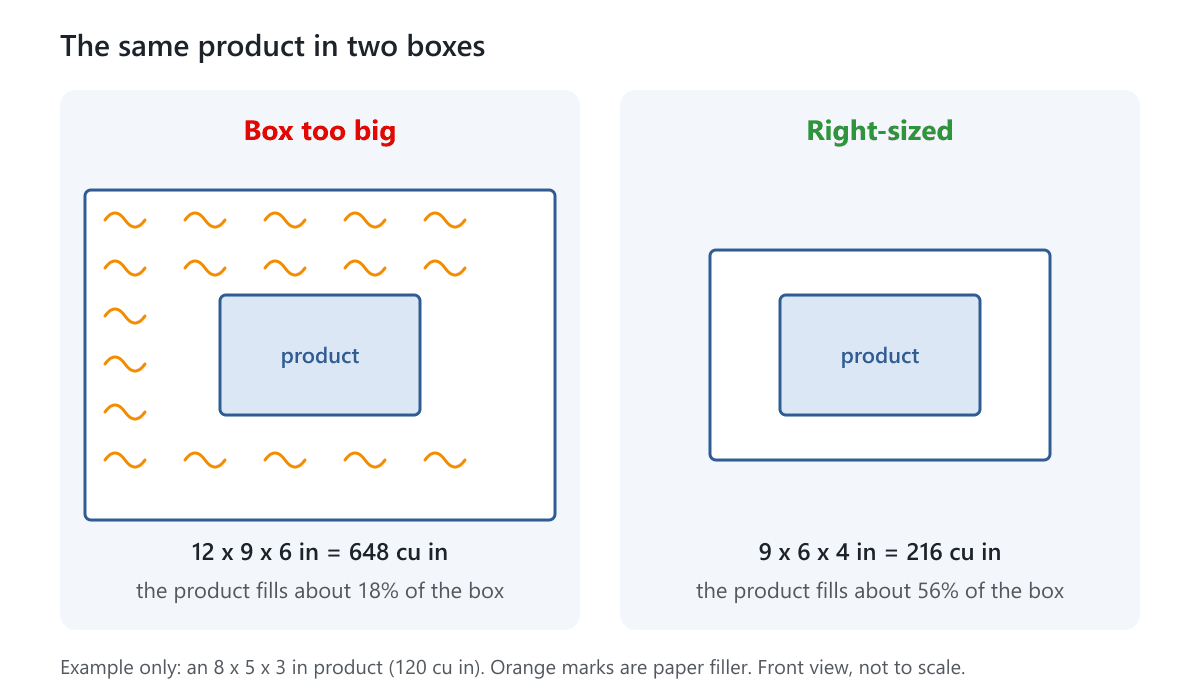
In this example, an 8 x 5 x 3 inch product takes up 120 cubic inches. In a 12 x 9 x 6 inch box (648 cubic inches) it fills about 19 percent of the space. In a 9 x 6 x 4 inch box (216 cubic inches) it fills about 56 percent. The smaller box uses less board and needs far less filler. The numbers are an illustration, not a promise of savings.
Here are practical ways to use less material.
- Measure before you order. Use the product's real size and add a little clearance. Our free dieline templates let you check proportions.
- Hold the product with the box. A tight fit, a tuck flap or a fitted insert can replace loose fill.
- Use fill that is paper. When some fill is needed, packing paper or paper void fill goes in the same bin as the box.
- Ship flat before assembly. Folding cartons and many mailers ship flat, which cuts freight space for the empty boxes.
- Skip the extra layer. An outer shipper plus a retail box plus a bag is three layers. Ask whether one layer can do two jobs.
What Eco-Friendly Choices Cost
Greener packaging does not always cost more, and it does not always cost less. These factors usually decide the price.
- Material. Common paperboard and corrugated are standard. Recycled stock, specialty fibers or unusual films can cost more or have higher minimums.
- Size and weight. A smaller, lighter pack costs less to make and to ship.
- Printing and finishes. A one-color print on kraft is simpler than full coverage with several finishes.
- Quantity. Unit price falls as quantity rises. Minimum orders depend on the product, and each product page states its own.
- Damage and returns. A slightly better pack that prevents damage can pay for itself.
Our guide to the impact of packaging costs on product pricing explains how size, board and finishes affect the cost per unit. The starting price on each product page is a good reference, and a quote gives the exact figure for your project.
What You May Give Up
Every choice has a trade-off, and it helps to know them in advance.
- Paper fibers can be recycled about 5 to 7 times, and recycled board may be slightly less strong or less smooth than board from new fibers.
- Natural kraft can make colors look more muted than on white board.
- Skipping lamination can leave a surface that scuffs more easily or resists moisture less.
- Paper bags and mailers are less water-resistant than plastic film.
- Compostable films may have shorter shelf life and need different storage.
How to Spot Greenwashing
Greenwashing is when a pack or a brand sounds greener than it is. It is common because the words are cheap and the rules vary. In the United States, the Federal Trade Commission's Green Guides say environmental claims must be truthful, supported by evidence and not misleading, and should not overstate a benefit. Use these checks when you read a claim, whether it is from a supplier or on your own label.
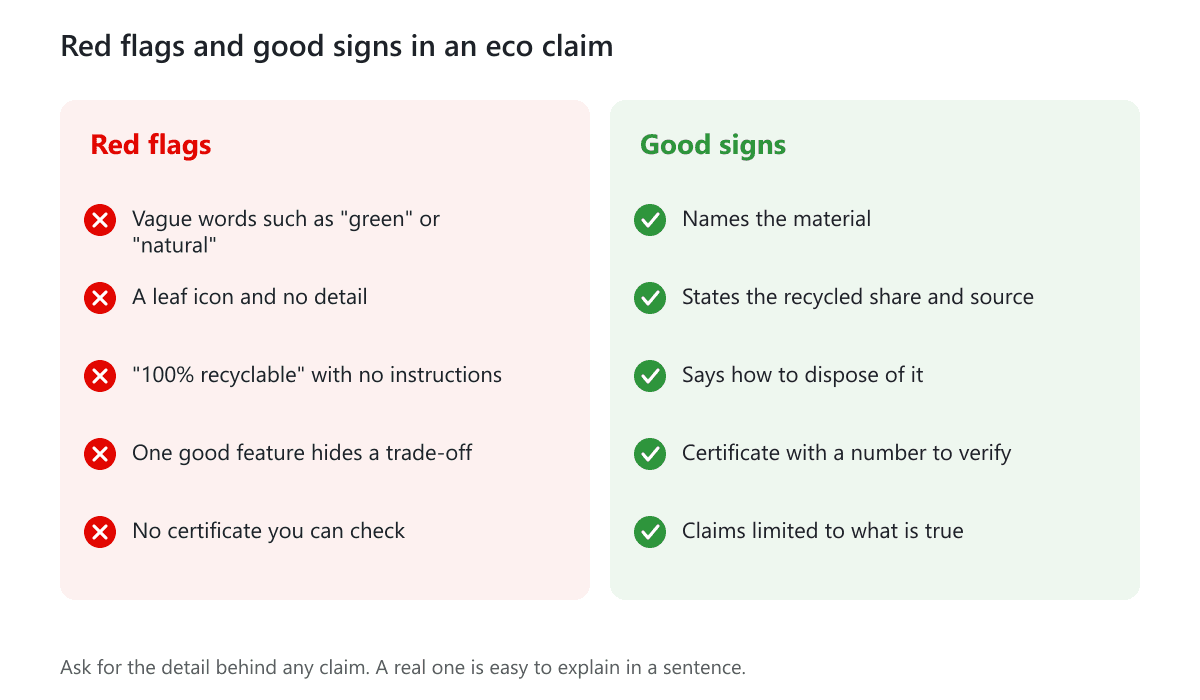
- Vague words. The FTC says marketers should not make broad, unqualified claims such as "green" or "eco-friendly". Words like "natural" and "earth-friendly" also need detail behind them.
- Imagery instead of information. A leaf, a globe or a green color is not evidence.
- An unqualified "recyclable". Recyclable depends on what local programs accept. A good claim says how to recycle it. The FTC says an unqualified recyclable claim needs recycling facilities that are available to at least 60 percent of the consumers or communities where the product is sold.
- A single feature in the spotlight. A pack can use recycled paper and still ship in an oversized box.
- Certificates you cannot check. A real certificate has a name, a number and a scope you can look up.
- Claims about the whole pack from one part. A recycled-paper box with a plastic window may not be recyclable everywhere, so a blanket "recyclable" claim for the whole pack can mislead.
Be careful with your own wording, too. Say what is true and no more, such as "Box made from paperboard. Please flatten and recycle with paper." Some US states, including California, also set rules for words and symbols such as the recycling arrows, so check the rules where you sell.
What to Ask a Supplier
A good supplier is happy to answer specific questions. Here are ones worth asking before you order.
- What exactly is this made of: the board, the inks, the coatings and the adhesive?
- Is any of it recycled content, and if so how much and what kind? Can I get that in writing?
- If I need certified fiber, such as FSC, SFI or PEFC, can you supply it and give me the certificate? (These schemes are about how the wood fiber was sourced.)
- Can the finished pack go in a normal paper recycling bin? What would stop it?
- What are the minimum order quantity, the lead time and the sample options?
- Can I see a structural sample before a full run?
We make paper-based packaging. Tell us your goals when you get a free quote, and we will confirm what is possible. If you need a certificate, name the one you need and we will say whether we can supply it. Recycled stock options are available on request.
Examples by Product
These are examples, not case studies. They show how the same thinking leads to different choices.
Candles
A glass jar candle is heavy and breakable. A good plan is a firm paperboard or corrugated box that fits the jar, with a cardboard or molded pulp insert for support instead of plastic foam. Keep the print simple and skip a plastic window. See our page on candle packaging.
Cosmetics
Small bottles and tubes suit a paperboard carton, often a tuck box. Choose one color of print on kraft, or white board for bright color. Foil and lamination look rich but add layers, so use them where they matter. Our cosmetic packaging page lists the box styles.
Apparel
Folded clothing is light and not fragile, so it can ship in a paper mailing bag or a flat corrugated mailer. Use plain tissue paper instead of printed film, and keep the label simple. See apparel boxes and paper mailing bags.
Food
Food adds hygiene and grease to the mix. A paperboard box with a separate liner can protect the food while keeping the board simple, but the right choice depends on the food and the rules in your market. Tell us what the food is and how it is packed, and we confirm what is possible. See our food packaging range.
Electronics
Electronics need shock protection. A corrugated box with a cardboard or molded pulp insert replaces plastic foam, and a snug fit limits movement. Keep manuals and cables in one small paper sleeve. See electronics boxes.
A Buyer's Checklist
- I know what the product needs: weight, fragility, moisture and travel.
- I measured the product and chose the smallest box that fits.
- I picked one main paper-based material and kept finishes light.
- I asked the supplier what the box, inks and coatings are.
- I have a sample and tested it in real shipping.
- Any claim on my pack is true, specific and documented.
- I wrote a short disposal note that matches local rules.
Common Mistakes
- Choosing a material before deciding what the product needs.
- Paying for a premium eco material while shipping in an oversized box.
- Adding a plastic window, foil and lamination to a pack that is sold as recyclable.
- Assuming "compostable" works in any bin.
- Putting a claim on the box that the supplier has not documented.
- Skipping the sample and finding out about fit and strength after the full run.
Your Next Step
List your product, its size and how it ships. Then decide on one change that makes the biggest difference, such as a better fit, simpler finishes or a switch from foam to a paper insert. If you want to see the options in your hands, the Standard Sample Kit costs $50, shipping included. When you are ready, get a free quote.
Frequently Asked Questions
How do I choose eco-friendly packaging materials?
Start with what the product needs, then pick the simplest paper-based material that protects it. Right-size the box, keep finishes light, ask the supplier what everything is made of, and test a sample. Check that your customers can dispose of it where they live.
Is eco-friendly packaging more expensive?
Sometimes, but not always. Specialty materials and recycled stock can cost more or have higher minimums, while a smaller box, less filler and simpler printing can lower costs. Quantity, size and finishes drive the price most. A quote gives the exact figure for your project.
What is greenwashing in packaging?
Greenwashing is making a pack sound greener than it is, for example with vague words such as "natural", leaf icons with no detail or claims no one can check. Ask for the material, the recycled share, the disposal advice and any certificate.
Is recycled paper as strong as new paper?
Recycled board may be a little less strong or less smooth than board from new fibers, and paper fibers can be reused only about 5 to 7 times. For many boxes the difference is small, and a sample shows how it performs. Recycled stock options are available on request.
What can replace plastic foam inserts?
Cardboard inserts and molded pulp inserts hold a product in place and are paper-based. Our box inserts page lists them. Choose by product weight and fragility, and test the fit with a sample.
Should I choose compostable packaging?
Only if your customers have access to composting that accepts it. Many compostable materials need industrial composting, which is not available everywhere. If recycling is easier for them, a simple recyclable paper pack may be the better choice.
Are paper bags better than plastic bags?
It depends on how they are used. A paper bag is renewable and recycled with paper, but it uses more material and is less water-resistant than a thin plastic bag. A bag that is reused many times has the lowest impact either way.
Sources
- Federal Trade Commission: Environmental Claims: Summary of the Green Guides (opens in a new tab) (October 2012; clear, supported claims; "green" and "eco-friendly"; the 60 percent recyclable rule)
- Cornell Law School, Legal Information Institute: 16 CFR 260.12, Recyclable claims (opens in a new tab) (unqualified recyclable claims, mixed materials, components that limit recycling)
- CalRecycle: SB 343: Accurate Recycling Labels (opens in a new tab) (California rules for the recycling arrows symbol)
- American Forest & Paper Association: Design Guidance for Recyclability: A Resource for Paper-Based Packaging Designers (PDF) (opens in a new tab) (version 1.1, March 16, 2021; windows, foils, adhesives and coatings; paper fibers reused 5 to 7 times)
- US Environmental Protection Agency: Frequently Asked Questions about Plastic Recycling and Composting (opens in a new tab) (page updated October 31, 2025; compostable plastics and industrial composting)
- Forest Stewardship Council: What is FSC? (opens in a new tab) (forest management and chain of custody certification)
- USPS Postal Explorer: Domestic Mail Manual 223, Priority Mail (opens in a new tab) (section 1.4.2, page dated 7-12-26; greater of actual weight or dimensional weight, divisor 139)
Checked on October 7, 2026
Written by the PacksDo Team
We make custom printed packaging, from boxes and mailers to bags, labels and inserts. Questions about this guide? Ask us.