In this article
- 1Biodegradable, Compostable, Recyclable, Reusable: The Differences
- 2Why "Biodegradable" Alone Is Vague
- 3Home Composting vs Industrial Composting
- 4How Standards Work, in General Terms
- 5Common Biodegradable and Compostable Materials
- 6Why These Materials Matter, and Where They Fall Short
- 7What to Do in Practice
- 8Where Paper-Based Packaging Fits
- 9Common Mistakes
- 10Your Next Step
Biodegradable packaging is packaging that microbes can break down into natural substances over time. The word alone does not say how long it takes, where it has to be, or whether anything harmful is left behind, so it is much vaguer than it sounds. Compostable, recyclable and reusable are different promises, and a pack can meet one without meeting the others.
This guide explains the differences in plain words: what biodegradable, compostable, recyclable and reusable each mean, why "biodegradable" on its own tells you little, how home and industrial composting differ, what the common standards test, and what actually happens to this packaging after use. It also shows how to decide what to do in practice. For a wider view of materials, see our overview of eco-friendly packaging materials.
Key takeaways
- Biodegradable is vague. Almost everything breaks down eventually. The useful questions are how fast, where, and into what.
- Compostable is more specific. It means the material breaks down in a composting setting to a defined standard, usually in an industrial facility.
- Recyclable is a different promise. It depends on a local program that collects and processes the material.
- Home composting is harder than industrial composting. An item certified for industrial composting may not finish in a backyard bin.
- Disposal is the weak link. A compostable pack sent to landfill or placed in the plastic recycling bin does not do what its label promises.
- Paper is the safe default. Plain paper and paperboard are widely collected, and reuse beats both.
Biodegradable, Compostable, Recyclable, Reusable: The Differences
These four words are used as if they meant the same thing. They do not. Each one describes a different end of life and has its own conditions.
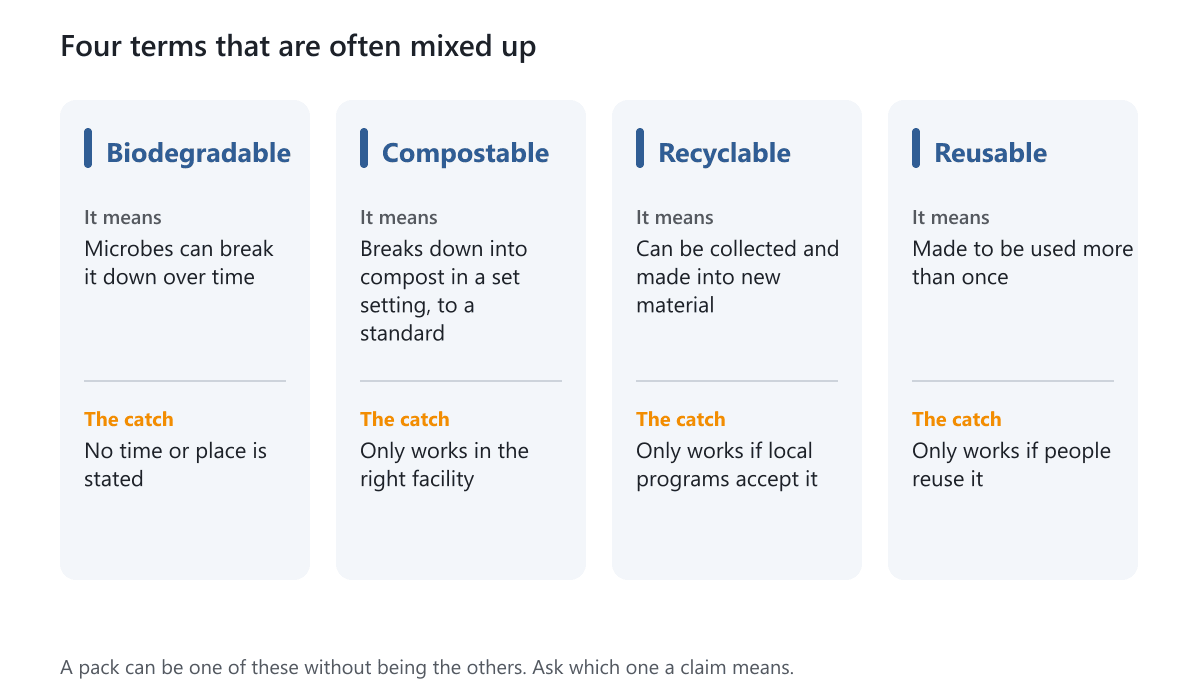
| Term | What it means | What has to be true | Common example |
|---|---|---|---|
| Biodegradable | Microbes can break the material down | Time, moisture, oxygen and the right microbes | Paper, food scraps, some plant-based plastics |
| Compostable | Breaks down into compost, to a standard | A composting setting, often industrial | Certified compostable films and trays |
| Recyclable | Can be turned into new material | A local program that accepts it | Paper, cardboard, metal tins, many plastics |
| Reusable | Made to be used again and again | People who actually reuse it | Cotton bags, rigid boxes, tins, glass jars |
Notice that none of these means the same as "harmless" or "gone in a few weeks". Each depends on conditions outside the pack itself.
Why "Biodegradable" Alone Is Vague
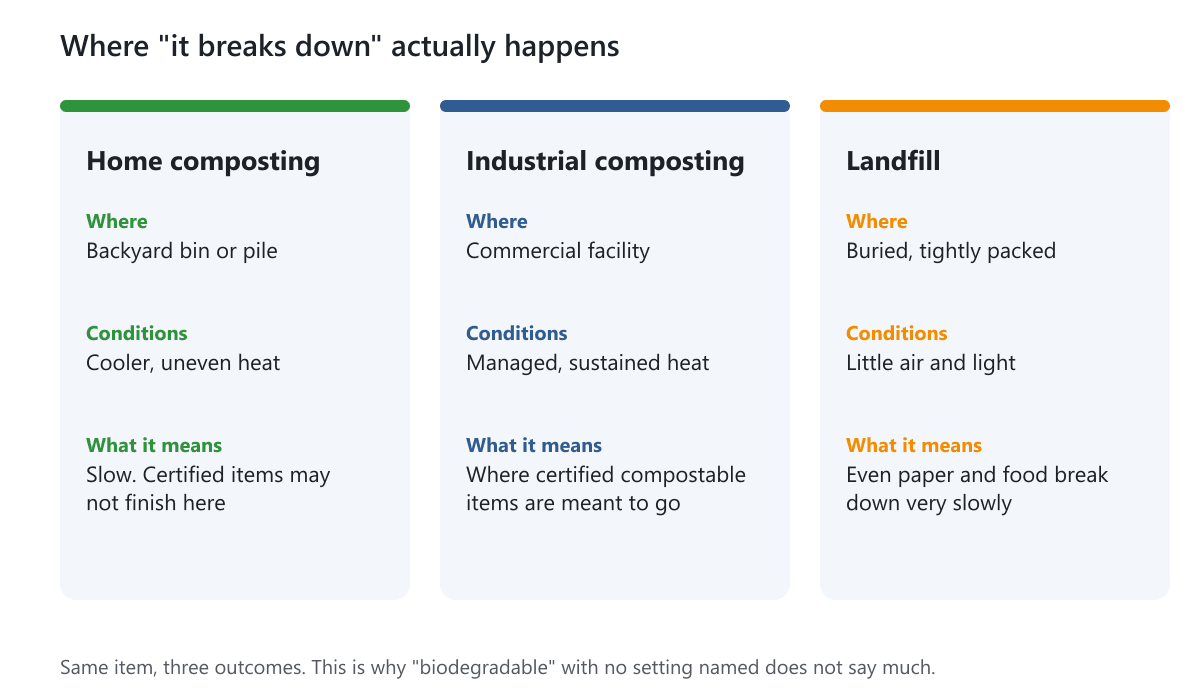
In a technical sense, a banana peel, a sheet of paper and a PLA cup are all biodegradable. They break down at very different speeds, and the same item can last a long time in the wrong place. In a landfill, the material is buried and tightly packed with little air or light, so even paper and food scraps degrade very slowly.
That is why the word without detail is a poor guide. A useful claim answers three questions: how long does it take, in what setting, and what is left? In the United States, the Federal Trade Commission's Green Guides warn that unqualified claims such as "biodegradable" can mislead when the item will not break down in a reasonably short time in the way customers will dispose of it. Other countries have their own rules, and some places restrict the use of these terms on packaging. Check the rules where you sell.
A Note on "Oxo-Degradable" Plastics
Some plastics are sold as "oxo-degradable" or "degradable". They contain additives that make the plastic break into small pieces when exposed to air, light and heat. The pieces do not necessarily biodegrade, and they can remain as microplastics. Several regions restrict these products. Treat the word with caution and ask for evidence.
Home Composting vs Industrial Composting
Composting is the controlled breakdown of organic material into a soil-like product. It needs warmth, moisture, air and microbes. How well it works depends on the setting.
Industrial Composting
Industrial or commercial composting happens in managed facilities that keep the material warm, turned and moist. Temperatures are typically well above what a backyard pile reaches, often in the range of 130 degrees Fahrenheit or higher. Most certified compostable packaging is designed for this setting. The catch is access: many towns do not collect food and compostable packaging at all, and a facility has to be willing to accept the item.
Home Composting
A backyard bin is cooler and less predictable. It handles food scraps, leaves and paper well, but many items certified for industrial composting break down slowly or only partly there. Some products are tested and labeled specifically for home composting. If a pack makes a home composting claim, ask which standard it was tested to.
What Happens in a Landfill
Compostable and biodegradable items placed in a landfill do not behave like they do in a compost pile. With little oxygen, they break down slowly, and some may release methane. This is why the label "compostable" is only useful when a composting route exists.
How Standards Work, in General Terms
A standard gives a claim a definition and a test, so it can be checked. For compostable plastics, well-known examples are ASTM D6400 and D6868 in the United States and EN 13432 in Europe. There are others, and some are written for home composting. Without naming any one product, here is what they generally look for.
- Biodegradation. A large share of the material must convert into carbon dioxide, water and biomass within a set time in a lab test.
- Disintegration. The item must break into small pieces in a set time, so no large fragments are left in finished compost.
- Safety. The compost must not carry heavy metals or other substances above limits, and plants should grow normally in it.
Certification bodies issue certificates for specific products and test conditions. When someone tells you a pack is certified, ask for the certificate, check the product named on it, and read the scope: industrial or home, and which standard. A logo alone does not prove the claim. If you need a certificate for a product, tell us which one you need and we will confirm whether we can supply it.
Common Biodegradable and Compostable Materials
| Material | What it is | Usual condition to break down | Watch for |
|---|---|---|---|
| Paper and paperboard | Plant fiber | Compost or paper recycling | Coatings and plastic layers change the outcome |
| Molded pulp | Molded paper or plant fiber | Paper recycling or composting if uncoated | Some are treated for water or grease resistance |
| PLA | Plastic from plant starch, such as corn | Industrial composting | Can contaminate normal plastic recycling |
| Starch-based blends | Starch mixed with other polymers | Varies by blend | Ask for the certificate |
| PHA | Polyester made by microbes | Varies; some break down in several settings | Less common and costlier |
| Cellulose film | Film from plant fiber | Varies by thickness and coating | Coatings can stop it breaking down |
| Bagasse | Sugarcane fiber, molded | Industrial composting or paper stream | Some types have coatings |
The common thread is that the details matter. Two items with the same name can behave differently, so a general label is not a replacement for the certificate.
Why These Materials Matter, and Where They Fall Short
People look to biodegradable and compostable materials because plastic waste is a real problem. Thin plastic films and foam are hard to collect, and they linger. Replacing them with a material that is made from plants and can be composted is a reasonable goal.
The difficulty is the system around the material. A compostable cup in a trash bin ends up in the same landfill as a plastic cup. A PLA item in the plastic recycling bin can spoil a batch. Food-soiled compostable packaging may not be accepted by a facility that wants only certain items. In places with no composting collection, a compostable label has no practical effect.
That is not an argument against these materials. It is an argument for matching the material to the real disposal route. For some uses, such as an event where all waste is collected and composted, compostable packaging makes sense. For a parcel mailed to thousands of homes, a plain paper pack that goes in the paper bin often works better.
What to Do in Practice
These steps help whether you are a seller choosing packaging or a customer deciding what to do with it.
If You Sell Products
- Choose the route first. Ask where your customers will dispose of the pack: paper recycling, plastic recycling, compost or trash.
- Pick the material that fits that route. If most customers have paper recycling, a paper pack is the safer choice.
- Use claims you can prove. Say what the pack is made of and how to dispose of it. Avoid "biodegradable" alone.
- Ask for documents. Request the certificate and read its scope.
- Put disposal advice on the pack. One short line, such as "Flatten and recycle with paper", is useful if it is true locally.
If You Are Throwing a Pack Away
- Check the label for instructions, and your local waste authority's website for what it accepts.
- Remove plastic windows, tape and labels where you can, and flatten boxes.
- Do not put compostable plastics in the recycling bin unless your program says so.
- Reuse first. A box that holds something else has not become waste yet.
Where Paper-Based Packaging Fits
We make paper-based packaging: paperboard boxes, corrugated mailer boxes, paper bags and inserts. A paper pack can be recyclable where local facilities accept it, depending on the board, the inks, the coatings and the adhesives. We do not describe our boxes as biodegradable or compostable. For poly mailers, compostable film options are available, made to order, and you can ask us for the material and certification details with your quote. Recycled stock options are available on request.
If you want paper-based options, see our eco-friendly packaging page, our paper bags and our poly mailers. Our buyer's guide to eco-friendly packaging materials shows how to compare them, and our guide on whether cardboard gets recycled covers the paper route.
Common Mistakes
- Putting "biodegradable" on a pack with no detail about the setting or the time.
- Assuming a compostable pack can go in the recycling bin.
- Assuming industrial compostable means home compostable.
- Choosing a compostable material when no composting service exists for your customers.
- Believing a plant-based plastic is automatically better than a recyclable one.
- Showing a certification logo without a certificate to back it up.
Your Next Step
Decide how your customers will dispose of the pack, then choose the material that suits that route. If you want to compare paper-based options, the Standard Sample Kit costs $50, shipping included. If you have questions about materials, get a free quote and tell us your product and your goals.
Frequently Asked Questions
What is the difference between biodegradable and compostable?
Biodegradable means microbes can break a material down over time, with no promise about speed or setting. Compostable means it breaks down into compost in a composting setting and meets a defined standard. Compostable is the more specific claim.
Is biodegradable packaging better than recyclable packaging?
Neither is better in every case. Recyclable packaging needs a local program, and biodegradable or compostable packaging needs a composting route. The better choice is the one your customers can actually dispose of properly.
Can compostable packaging go in a home compost bin?
Only if it is tested and labeled for home composting. Many compostable items are certified for industrial composting, where the heat is higher and more consistent. In a backyard bin they may break down slowly or only partly.
Can I put compostable packaging in the recycling bin?
Usually not. Compostable plastics can contaminate plastic recycling. Follow the label and your local program, and put the item in compost only where a composting service accepts it.
How long does biodegradable packaging take to break down?
There is no single answer. It depends on the material, the thickness and the setting. A thin paper sheet breaks down much faster than a thick plastic item, and the same item breaks down slowly in a landfill. Ask for the time and the conditions in the claim.
Is paper biodegradable?
Yes, paper is made from plant fiber and breaks down in the right conditions, but it is usually better to recycle it. Coatings, plastic layers and heavy inks change how it behaves. Plain paper and paperboard are widely collected for recycling where facilities accept them.
How can I check a compostable claim?
Ask for the certificate, check that it names the exact product, and read what standard it covers and whether it is for industrial or home composting. A logo alone is not proof. If you need a certificate for one of our products, tell us which one and we will confirm what is available.
Written by the PacksDo Team
We make custom printed packaging, from boxes and mailers to bags, labels and inserts. Questions about this guide? Ask us.