In this article
- 1Start With the Product, Not the Box
- 2Length, Width and Height: The Standard Order
- 3Inside Dimensions vs Outside Dimensions
- 4How Board Thickness Changes the Size
- 5Add Clearance Around the Product
- 6What to Keep in Mind When Choosing a Box Size
- 7How to Measure a Box You Already Have
- 8Shipping Size and Dimensional Weight
- 9Common Measuring Mistakes
- 10Check the Size Before You Order
To measure a product for a custom box, find its longest, widest and tallest points, add a little clearance, and give us the result as the inside size of the box, written length x width x height. The box is then built around those inside dimensions, and the thickness of the board decides how big it ends up on the outside.
That is the short version. This guide shows how to measure your product, why inside and outside dimensions differ, how board thickness changes the size, and what to think about when you choose a size for your use case and material. It also covers how to measure a box you already have, and how carriers use box dimensions for shipping.
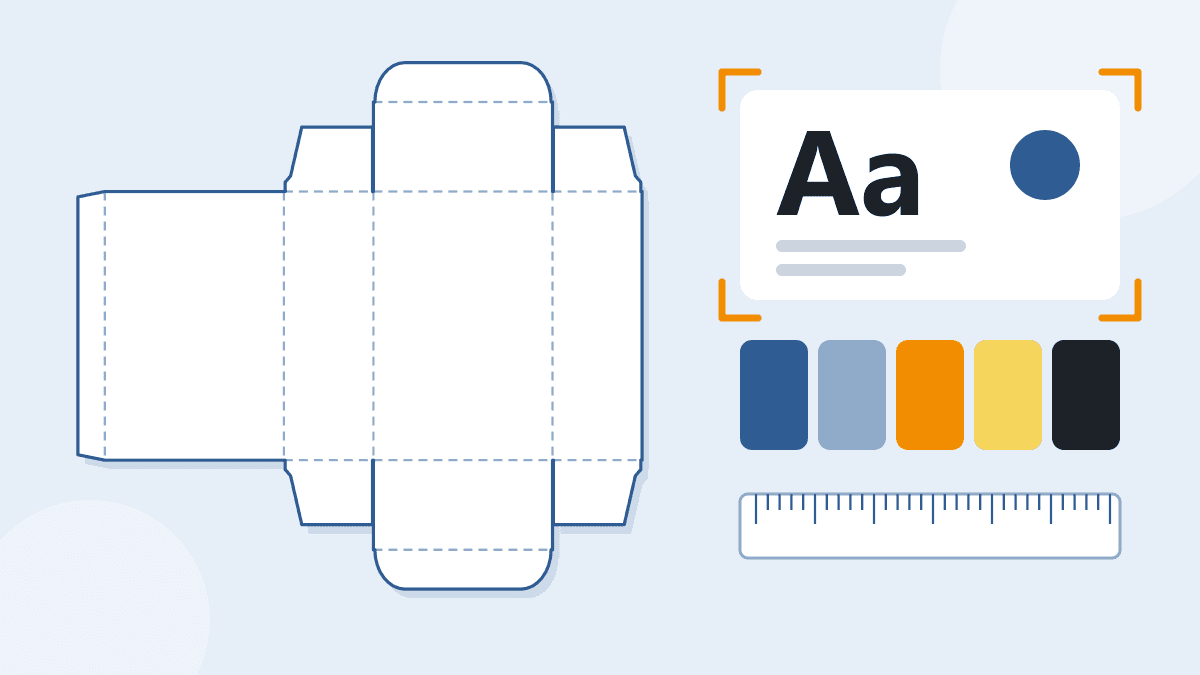
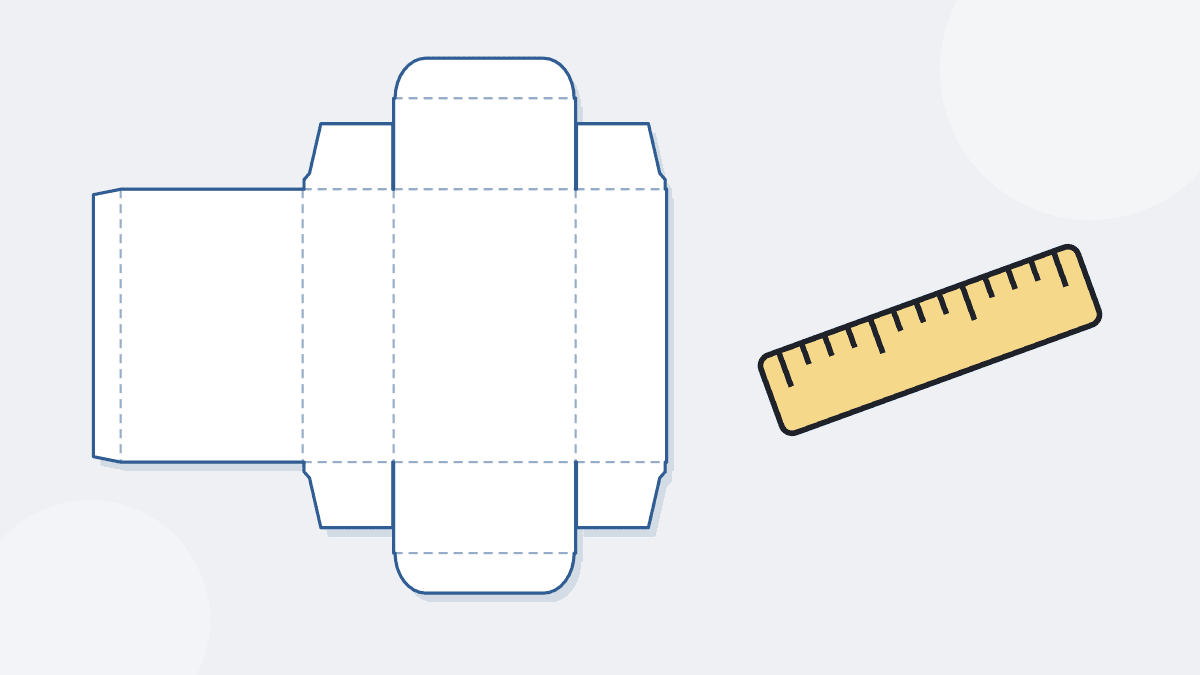
You can check any size against a flat pattern with our free dieline templates, and our short measuring guide explains the order we use for orders.
Key takeaways
- Measure the product, not the box, as it will be packed, with its wrap, cap and any insert.
- Give inside dimensions and say that they are inside dimensions.
- Write sizes as length x width x height, where length and width describe the opening.
- Board thickness changes the outside size: for length and width, outside = inside + twice the wall thickness.
- Leave a little clearance, about 1/8 inch per side as a starting point, and test the fit with a sample.
- Carriers use the outside size to work out dimensional weight.
Start With the Product, Not the Box
A custom box has to fit what goes in it, so the product is your starting point. Measure the product as it will actually be packed: with its own wrapping, tag, cap or pouch, and with any insert or protective layer you plan to use.
- Place the product the way it will sit in the box. Decide which side faces up. A bottle that stands and a bottle that lies flat give different height and length numbers.
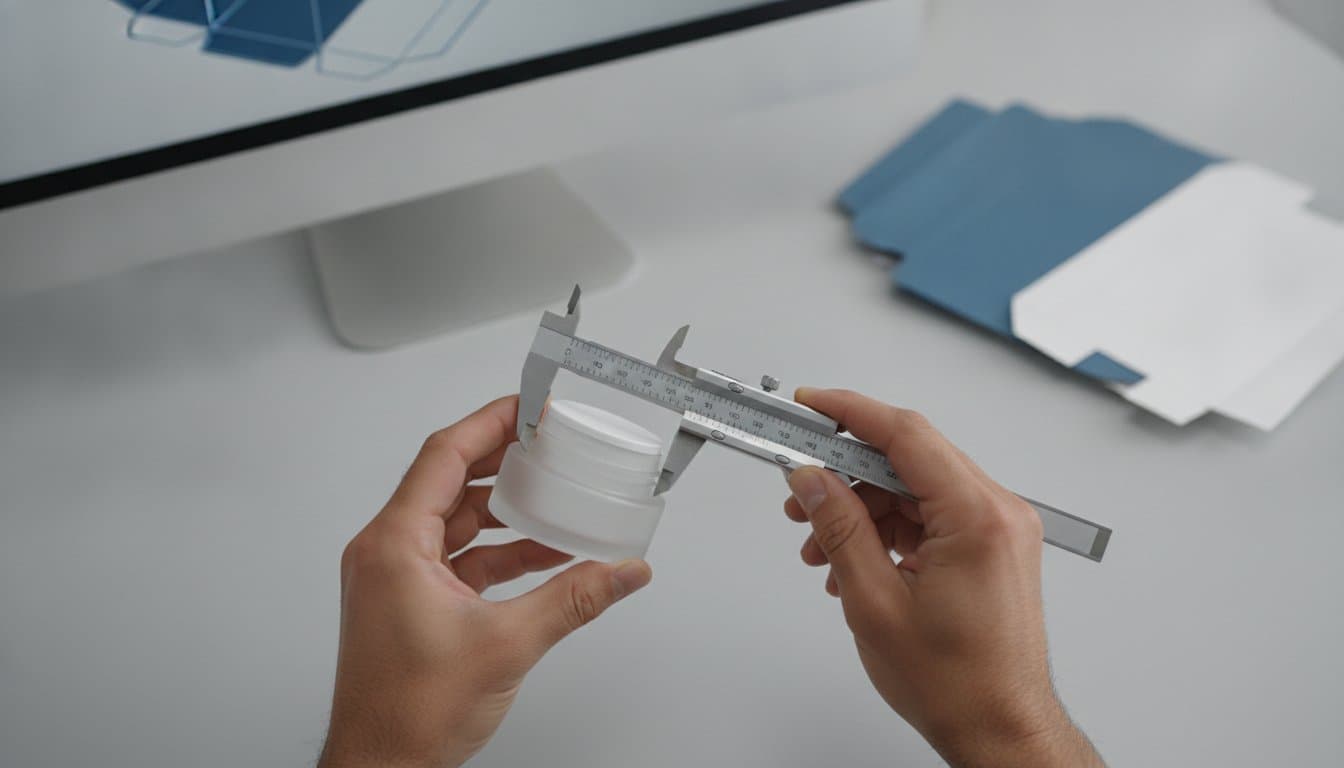
- Measure each dimension at its widest point. Use a ruler or calipers and measure the longest, widest and tallest points, including caps, handles, labels or anything that sticks out.
- Use one unit. Pick inches or millimeters and stay with it. Millimeters are easier for small products.
- Measure more than one unit. Products vary a little from one to the next. Measure three and use the largest number for each dimension.
- Note the weight. A heavy product may need stronger board or an insert, and that changes the structure.
Write the numbers down as length x width x height. For a box, length and width describe the opening and the height is the depth. The next section explains the order.
Length, Width and Height: The Standard Order
Box sizes are normally written in the same order: length, then width, then height (L x W x H). The order matters because 8 x 6 x 2 is a flat box and 2 x 6 x 8 is a different shape entirely, so a swapped number can give you a box that does not fit. Carriers use their own rule when they measure a packed box for shipping: the longest side counts as the length.
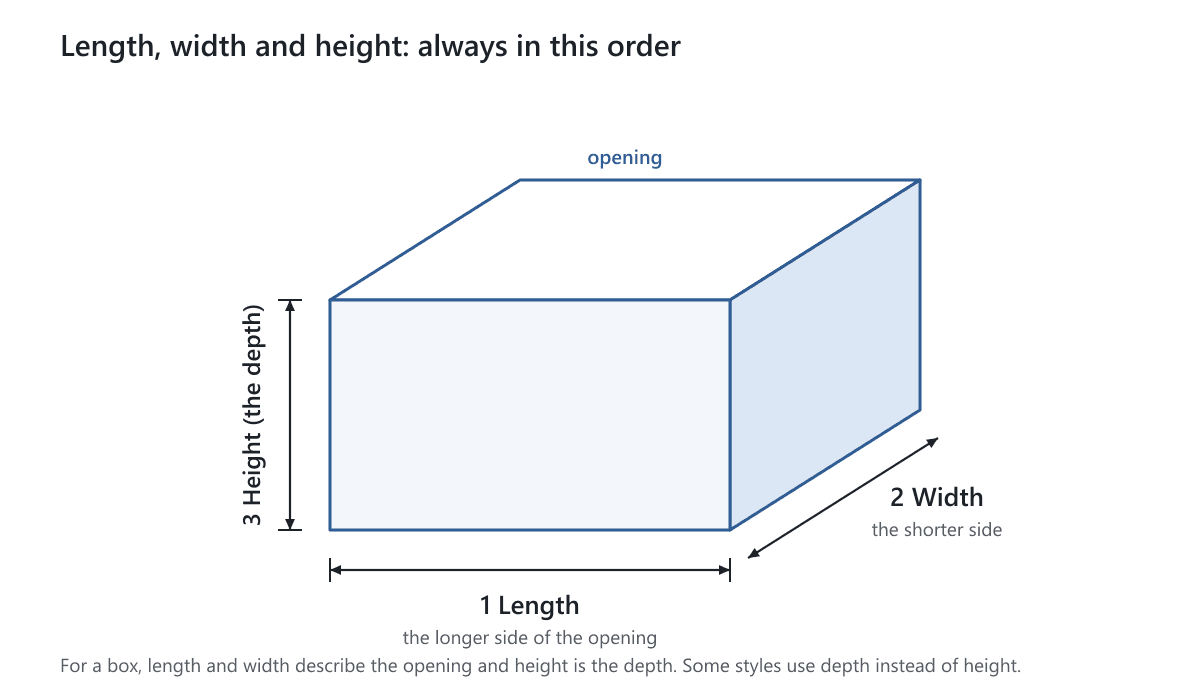
What Each Dimension Means
- Length: the longer side of the opening, the side that runs left to right as you look at the box.
- Width: the shorter side of the opening, measured from the front to the back.
- Height: the depth of the box, measured from the opening down to the bottom. On a box that stands up, it is the vertical size.
A box with an opening that is 8 inches from side to side and 6 inches from front to back, and that is 2 inches deep, is written 8 x 6 x 2.
On some boxes the names change. A pillow box or a counter display tray can use depth in place of height. Each of our dieline templates names the sides for its style, so read the labels before you type a number. This is the same order our measuring guide uses.
Inside Dimensions vs Outside Dimensions
Every box has two sets of sizes. The inside dimensions are the space available for your product. The outside dimensions are the size of the finished box, which is the inside size plus the thickness of the walls.
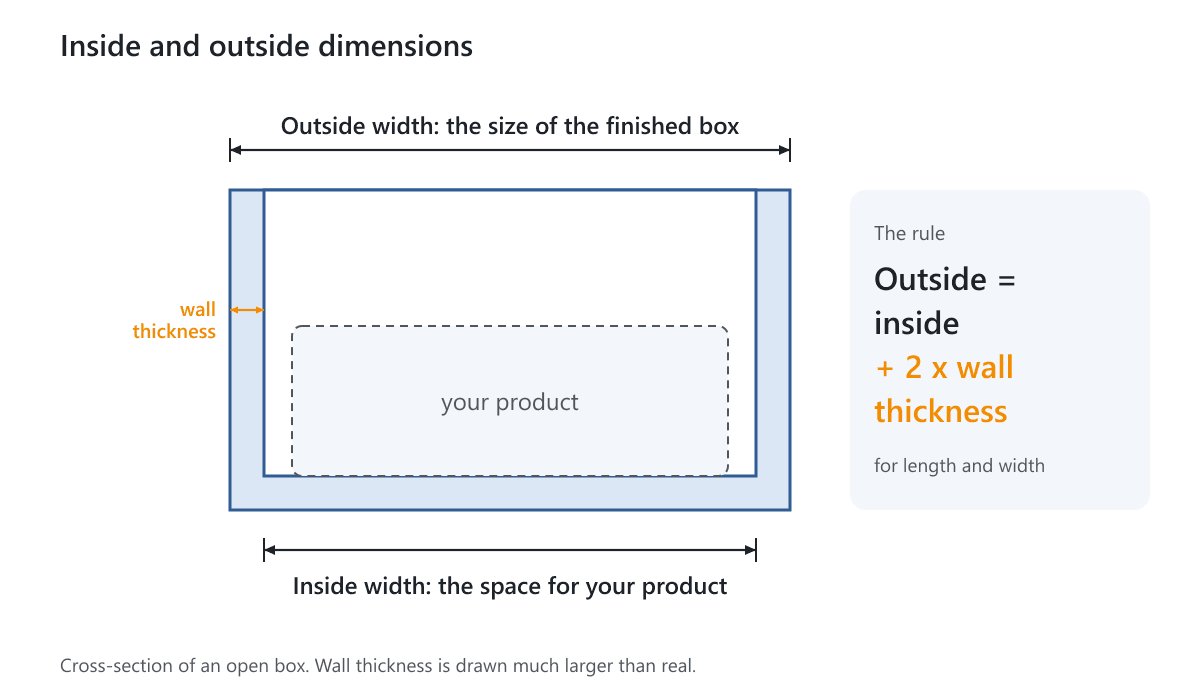
For custom packaging, give the inside dimensions. The inside size is what the product has to fit, so it is the number that matters most. If you send an outside size, the walls take space out of it and the product can end up too tight. Whichever you send, say which one it is.
Outside dimensions still matter in two places: storage and shipping. Carriers measure the outside of the package, and shelves, display fixtures and master cartons care about the outside size too. Keep both numbers in your notes.
The relationship is simple: outside = inside + the wall thickness on each side. For length and width that is two walls, so each outside number is the inside number plus twice the board thickness. Height adds one thickness for a box with a bottom only, and two when there is a lid as well.
How Board Thickness Changes the Size
Board thickness is the reason inside and outside sizes drift apart, and it is bigger than most people expect. Thin paperboard adds almost nothing. Corrugated and rigid board add enough to decide whether a box fits on a shelf or in a shipping carton.
| Box type | Typical board | What the thickness means for size |
|---|---|---|
| Folding carton (tuck, pillow, sleeve) | Paperboard, 300-400gsm | Usually well under a millimeter, so the outside is only slightly larger than the inside |
| Mailer or shipping box | Corrugated board | Roughly 1.3 to 4.2 mm for the common E, B and C flutes, so allow a few millimeters on each side |
| Rigid box | Rigid board, 800-2000gsm, wrapped in printed paper | Can be several millimeters, so the outside is clearly larger than the inside |
These figures are typical, not exact. The thickness depends on the board you choose, and we confirm it on the final dieline before printing.
Why Thickness Affects Accuracy
- Walls take room from the inside. If you size a box by its outside, a 3 mm wall removes 6 mm from the length and from the width of the space inside.
- Folds take board. Where board folds, the crease and the layers of board use a little extra space, so panels are not exactly the size of the numbers on the page.
- Double walls and wraps add more. A double-wall mailer, or a rigid box wrapped in printed paper, is thicker than the board alone.
- Lids need room. On a two-piece box the lid fits over the base, so the lid is slightly larger than the base. A lid that is too snug will not lift off easily, and one that is too loose will rattle.
- Coatings add almost nothing. Matte, glossy, satin or soft touch coating and varnish do not change the size you need to plan for.
One note about our tools: the free dieline templates draw the pattern at the size you type and do not compensate for board thickness. Use them to plan your artwork and check proportions, and we confirm the final dieline with you before printing.
The Same Product in Two Boxes
Here is a product that measures 100 x 70 x 30 mm. With 2 mm of clearance on every side, the inside needs to be 104 x 74 x 34 mm. The table shows what that means on the outside for two board types.
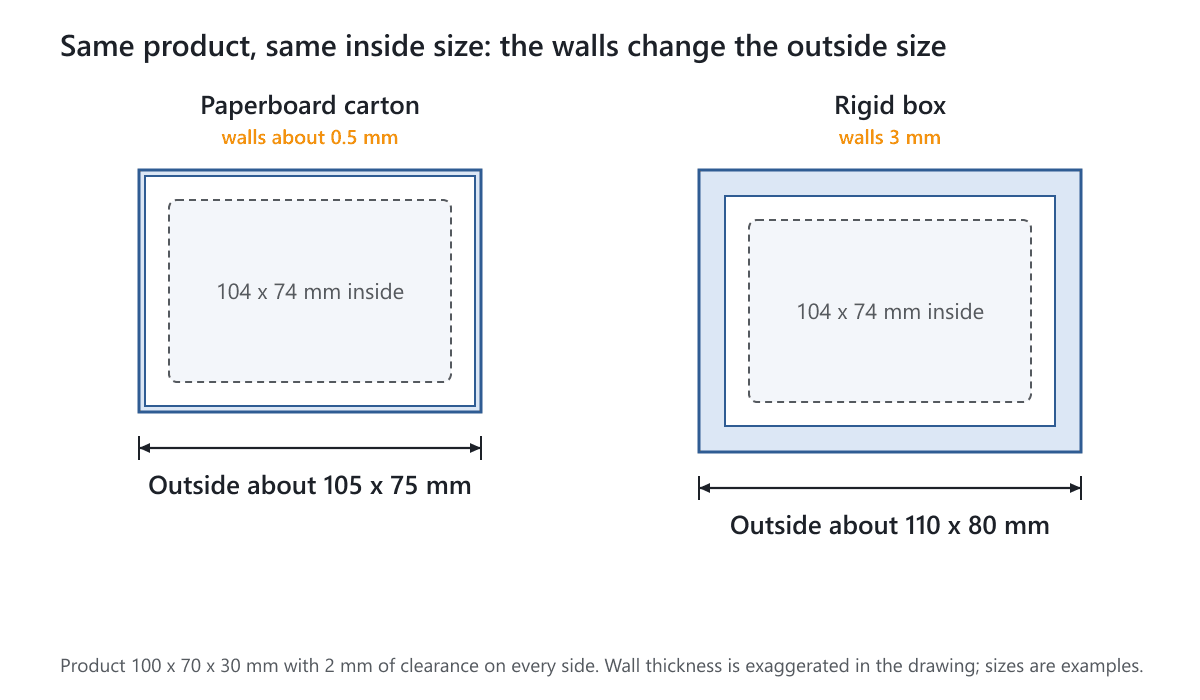
| Box | Wall thickness | Inside (length x width) | Outside (length x width) |
|---|---|---|---|
| Paperboard carton | About 0.5 mm | 104 x 74 mm | About 105 x 75 mm |
| Rigid box | 3 mm | 104 x 74 mm | About 110 x 80 mm |
The product and the inside size are identical, but the rigid box is 5 mm longer and 5 mm wider on the outside. If your master carton, shelf or display holds a set outside size, thickness decides whether it fits.
Add Clearance Around the Product
Clearance is the small amount of extra room between the product and the inside walls. Without it the product will not slide in, and it can scuff the print as it goes in and out. With too much, it moves around in transit.
- Snug retail cartons: a few millimeters, about 1/8 inch, on each side is a common starting point.
- Products in inserts or trays: size the box around the insert, and size the insert around the product.
- Shipping boxes: leave room for the cushioning you plan to use, such as paper or void fill, and measure the product with the cushioning on.
- Fragile items: allow more room and choose a stronger board. Box inserts hold items in place.
- Gift and rigid boxes: usually a little more room than a carton, because the product is placed by hand and the lid fits over a base.
These are starting points, not rules. Production has small tolerances, and soft products compress. The most reliable check is a sample. A structural sample is an unprinted prototype that shows the size and form of your box, so you can test the fit before a full run, and the Standard Sample Kit lets you hold different box types. See the samples page for every sample type.
What to Keep in Mind When Choosing a Box Size
Measuring gives you numbers, but choosing the size also means deciding how the box will be used. These are the things that shape the final size.
Use Case
A box that sits on a shelf can fit the product closely, because it only has to look good and hold the product. A box that ships to a customer needs room for cushioning and a stronger board. A gift box needs space for tissue or a card, and a subscription box may hold several items at once. Decide the job first, then the size.
Material
Paperboard suits lightweight retail products and ships flat before it is assembled. Corrugated board adds strength for shipping, at the cost of thicker walls. Rigid board gives a premium feel and the thickest walls. Our guide to choosing the right box for your product matches these materials to common products.
Thickness
Thickness changes the outside size and can change how much you can fit. If the outside size is fixed, for example a shipping carton or a retail shelf, size the box from the outside in: start with the outside limit, subtract the walls, and check that the inside is still big enough. If the product is fixed, size from the inside out.
Structure and Closure
The closure uses space too. A tuck flap needs a little room at the top, a lid needs overlap on the base, and a magnetic closure or a drawer adds its own parts. Ask for the style you want before you settle the numbers, and see the dimension fields on its dieline.
Inserts and Extras
Inserts, dividers, tissue paper and cards all take volume. Add them to your measurements, because an insert can use more room than the product it holds.
Storage and Shipping
The outside size drives freight and storage. A box that ships flat takes far less room until it is assembled, and the size of the flat pattern also affects price. Our packaging cost guide explains how the open size of a box changes cost.
How to Measure a Box You Already Have
If you want a new box to match an existing one, measure the old one the way a box is described, from the inside.
- Open the box fully and set it on a flat surface. Check that it is not crushed or bent.
- Measure the inside length of the opening, from the inner face of one wall to the inner face of the opposite wall, along the longer side.
- Measure the inside width the same way, along the shorter side.
- Measure the inside height, from the inside of the bottom to the top edge of the walls. For a box with a lid, measure the base.
- Measure the outside too, and write both sets down. The difference between them, divided by two, is the wall thickness.
- Check the board. Calipers give the thickness directly, and for corrugated board you can measure a cut edge.
- Record the order: length x width x height.
For boxes with a handle, a bulge, slanted sides or a curved shape, measure the longest point on each dimension and take more than one reading. When you copy a box, remember that the new one may use a different board, so the same outside size can give a different inside size. Tell us the inside size you need, not only a copy of the old outside.
Shipping Size and Dimensional Weight
Carriers bill the greater of the actual weight and the dimensional (size-based) weight. Dimensional weight, often called DIM weight, is worked out from the outside dimensions of the packed box: length x width x height, divided by a number called the divisor. The divisor depends on the carrier and the rate type, and it changes from time to time, so check the current figure with your carrier. As of October 2026, UPS lists 139 for Daily Rates and 166 for Retail Rates, FedEx lists 139 for U.S. and international packages, and USPS lists 139 for Priority Mail parcels over 1 cubic foot.
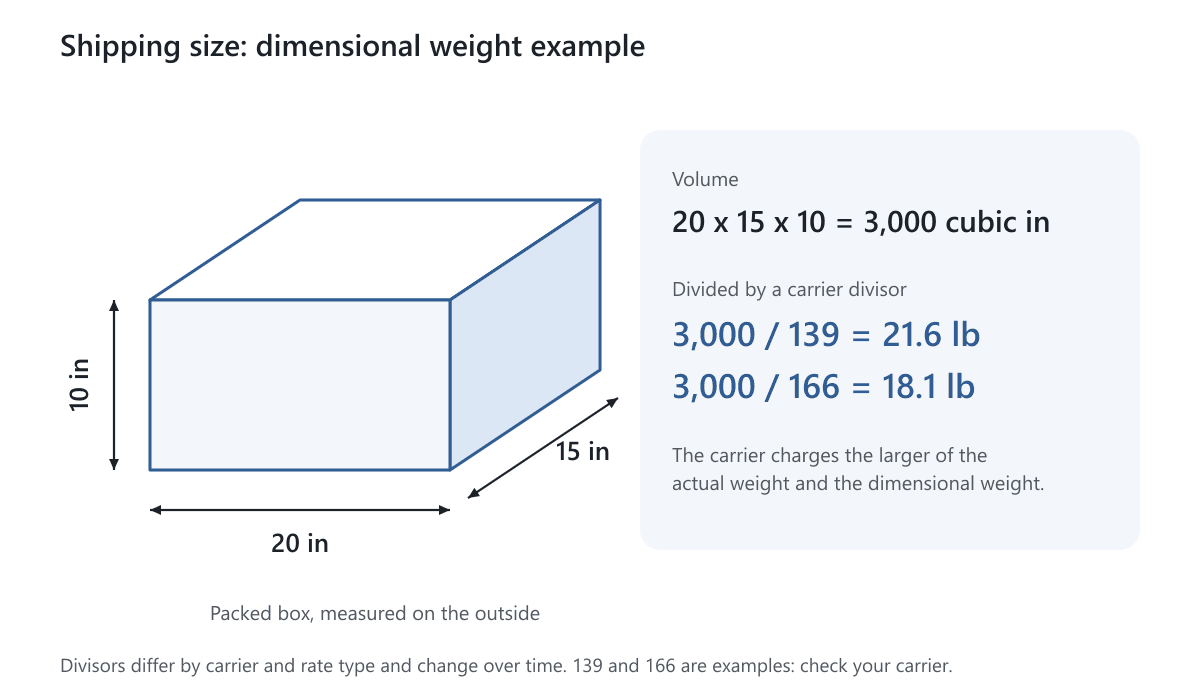
For a packed box of 20 x 15 x 10 inches, the volume is 3,000 cubic inches. With a divisor of 139 the DIM weight is about 21.6 pounds, and with 166 it is about 18.1 pounds. If the package actually weighs 8 pounds, the carrier charges for the larger DIM weight. UPS, for example, rounds the result up to the next whole pound, so these would bill as 22 and 19 pounds.
UPS and USPS round each side up to the next whole inch (UPS counts 1.01 inches as 2), while FedEx's page says to round each side to the nearest whole inch, so check how your carrier rounds. Carriers measure the outside of the packed box. A box that is a little too big costs more to ship, and a box sized from its outside can end up larger than planned once the walls are counted.
Common Measuring Mistakes
- Mixing inches and millimeters in one set of numbers.
- Giving an outside size when the box was designed from the inside, or the other way around.
- Measuring the product without its wrap, cap or tag.
- Forgetting the cushioning, insert or tissue that will go in the box.
- Leaving no clearance, so the product has to be forced in.
- Ignoring board thickness on a rigid or corrugated box.
- Writing the numbers in the wrong order.
- Measuring only one unit of a product that varies.
Check the Size Before You Order
Before you request a quote, write down the product size, the inside size you want, the box style and the quantity. Open the free dieline template for your style, type your size and look at the flat pattern. If you are unsure, tell us what you are packing, its size and how it will be used, and we will recommend a style: get a free quote. We offer free design support and confirm the final dieline with you before printing.
Frequently Asked Questions
Should I give inside or outside dimensions for a custom box?
Give the inside dimensions, the space your product has to fit, and say that they are inside dimensions. The outside size is the inside size plus the wall thickness, so a size measured from the outside leaves less room than you expect.
How much clearance should I leave around my product?
A few millimeters, about 1/8 inch, on each side is a common starting point for a snug carton. Leave more for fragile items, inserts, cushioning and rigid boxes, and test the fit with a sample before a full run.
How does board thickness change the size of a box?
Each wall adds its thickness to the outside size, so outside length and width equal the inside size plus twice the board thickness. Paperboard adds very little, corrugated adds a few millimeters and rigid board can add several millimeters.
In what order are box dimensions written?
Length, then width, then height (L x W x H). For a box, length and width describe the opening, with length the longer side, and height is the depth. Some styles use depth in place of height, so check the labels on your dieline template.
How do I measure a box I already have?
Open it fully and measure the inside of the opening for length and width, then the inside height. Measure the outside too, and half the difference is the wall thickness. Remember that a new box in a different board will have a different inside size.
What is dimensional weight?
Dimensional weight is the weight a carrier assigns to a package from its size: length x width x height divided by a divisor that depends on the carrier and rate type. The carrier charges the larger of the actual weight and the dimensional weight, so check the current divisor with your carrier.
Sources
- UPS: Shipping Dimensions and Weight (opens in a new tab) (longest side is the length, rounding up, divisor 139 for Daily Rates and 166 for Retail Rates)
- FedEx: What is Dimensional Weight? (opens in a new tab) (the greater of actual or dimensional weight, divisor 139)
- USPS Postal Explorer: Domestic Mail Manual 123, Priority Mail (opens in a new tab) (section 1.3, revision mark 7-12-26; parcels over 1 cubic foot, divisor 139, rounding up)
- Saxon Packaging, on BFBi member news: Corrugated Board & Material Grades (opens in a new tab) (E, B and C flute thickness (a supplier's figures))
Checked on October 7, 2026
Written by the PacksDo Team
We make custom printed packaging, from boxes and mailers to bags, labels and inserts. Questions about this guide? Ask us.