In this article
- 1What Discreet Packaging Means in Plain Words
- 2Why Brands Use Discreet Packaging
- 3What Discreet Packaging Looks Like
- 4Keep the Brand Experience Inside
- 5Do Not Try Too Hard
- 6Small Cues That Give a Parcel Away
- 7How to Tell Customers
- 8Returns and Replacements
- 9International Shipping and Customs
- 10How to Set Up Discreet Packaging
- 11Common Discreet Packaging Mistakes
- 12Discreet Packaging Checklist
- 13Who Discreet Packaging Is Not For
- 14Plan It With Us
Discreet packaging is an outer package that does not show what is inside, and sometimes does not show who sent it. For a small online brand the practical version is simple: a plain box or mailer on the outside, a neutral label, and your branding saved for the inside, where only the customer sees it.
This guide explains what discreet packaging looks like, why brands choose it, where your brand can still show up, the small cues that give a parcel away and how to set it up. It also covers returns, international orders and customs, and who should skip it. The advice is general and aimed at everyday products such as personal care and wellness items, gifts and valuables.
If you have not settled on the box itself yet, start with our guide to choosing the right box for your product. This article is about what the outside of the parcel should and should not say once you have.
Key takeaways
- Plain outside, branded inside. Keep product words, pictures and logos off the outer package, and put your brand on the inside of the box, on tissue and on a card.
- Shape and weight talk too. A bottle-shaped tube, a rattle or an oddly heavy parcel can give away the contents. Right-size the box and hold the product still.
- Do not overdo it. An odd blank box with strange markings draws more attention than an ordinary shipping box with a neutral label.
- Tell customers what to expect. One line on the product page and at checkout explains how the parcel will look and who it will say it is from.
- Declare contents honestly. Discreet never means mislabeling. Customs forms and carrier rules still need an accurate description.
- Test with a real sample. Ship one to yourself and look at it the way a neighbor, a coworker or a delivery driver would.
What Discreet Packaging Means in Plain Words
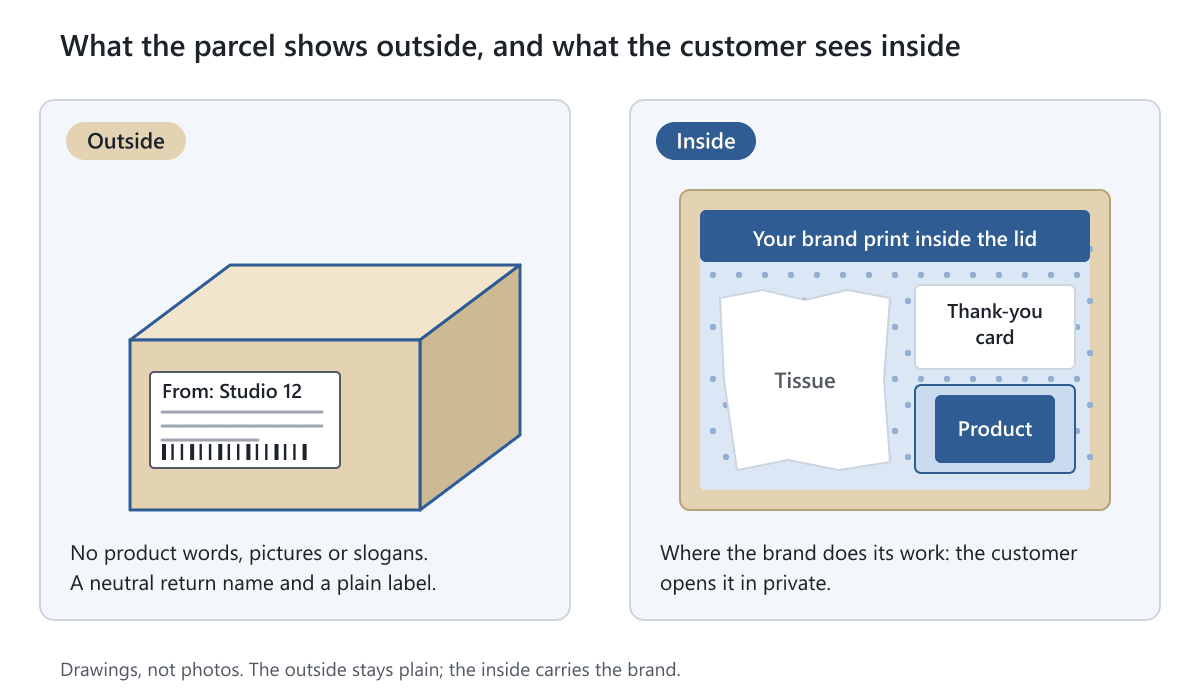
Discreet packaging means the outside of the parcel gives no clues about the product. It has two parts, and a brand can use one or both.
- What the parcel shows about the contents. No product name, no picture of the product, no words that describe it, and nothing about its shape that a glance would reveal.
- What the parcel shows about the sender. A neutral return name, such as a short company name or initials, instead of a name that describes what you sell.
It does not mean hiding the parcel from the carrier. The label still needs a correct delivery address and a scannable barcode, and your own records still need the real contents. Discreet is about what strangers can read from the outside, not about what you tell the carrier or customs.
It is also different from tamper evidence. A tamper-evident seal shows whether a package was opened on the way. That is a separate feature, and we have not confirmed it as an option, so ask us what is possible if you need it.
Why Brands Use Discreet Packaging
Most brands that ask for it sell something the customer would rather not advertise at the front door. Others simply want a quieter parcel. Common reasons include:
- Privacy for personal products. Health, wellness, intimate care and personal hygiene items are the best-known case. Customers often live with roommates, family or neighbors, or receive parcels at a shared mailroom or an office.
- Medical and care supplies. People may not want a condition or a treatment to be obvious to everyone who handles the parcel.
- Surprise gifts. A plain outer box keeps the surprise until the recipient or the giver opens it.
- Less attention for valuable goods. Some sellers use a plain outer box so a parcel looks less interesting on a porch. It helps at the margin. It does not replace tracking, insurance or a safe delivery option.
Whatever the reason, keep the claim modest. You can say the parcel is plain and the label is neutral. You cannot promise that nobody will ever guess what is inside.
What Discreet Packaging Looks Like
There is no single standard. Most discreet set-ups combine the same few ingredients.
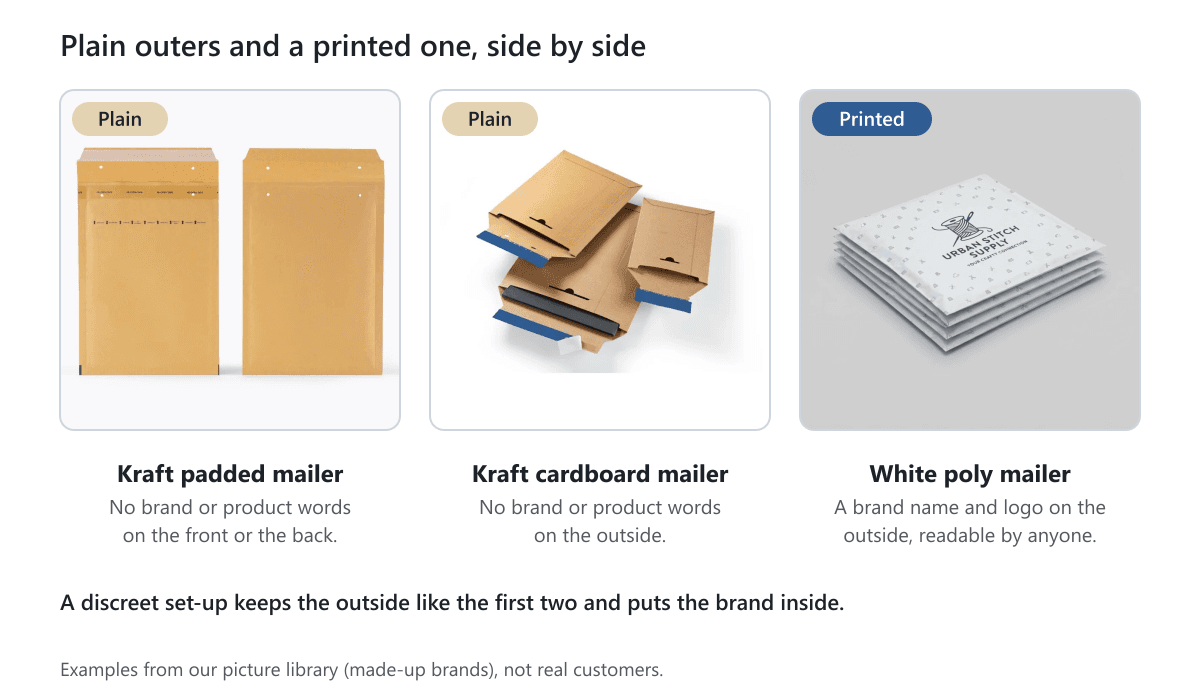
- A plain outer. A kraft or white shipping box or mailer box, or a mailer bag, with no product words or pictures on the outside. See our mailer boxes, shipping boxes, poly mailers and paper mailing bags.
- A single color or none. If anything is printed outside, keep it simple and neutral, for example a short company name or a small mark.
- A plain label. The delivery address, the barcode and a neutral return name. No product line in the sender field, and no product words on the packing slip if it is visible through a window pouch.
- Ordinary tape. Plain tape, not tape printed with your product name or slogan.
- The brand inside. Everything that tells your story is placed where only the customer sees it.
If you use a bag, look at it packed, not flat. Thin or light material can show the outline of what is inside. Ask us which bag and material options are possible for your product before you plan around one.
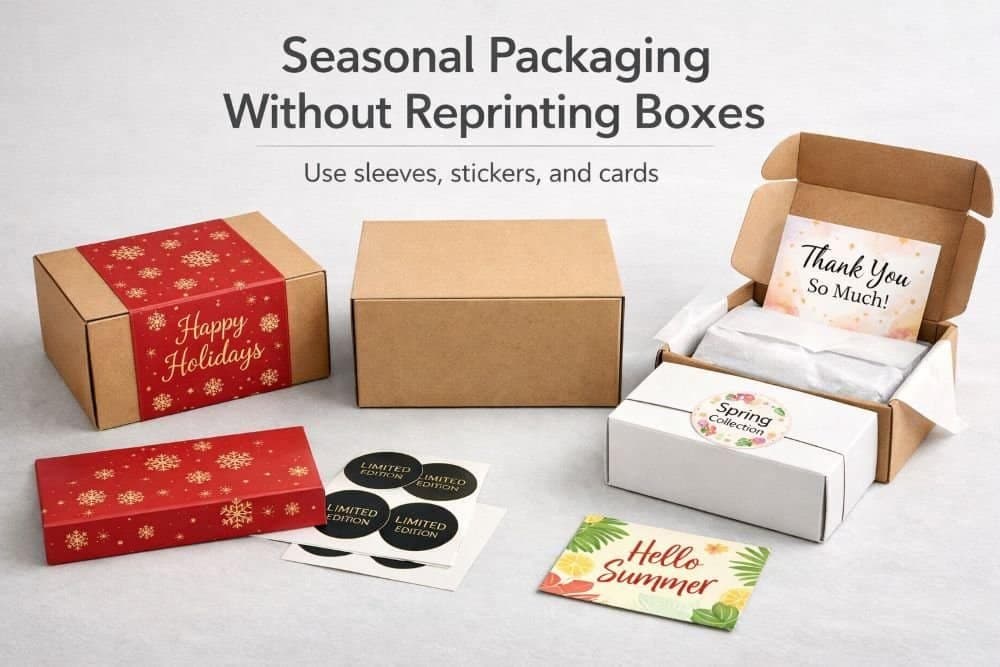
These examples from our picture library compare two plain outers with a printed one.
Keep the Brand Experience Inside
A plain outside does not have to mean a plain unboxing. The customer opens the parcel in private, so the inside is where your brand does its work. Printing on the inside of a mailer box is a good fit here: our mailer boxes can be printed outside, inside or both, in CMYK or Pantone.
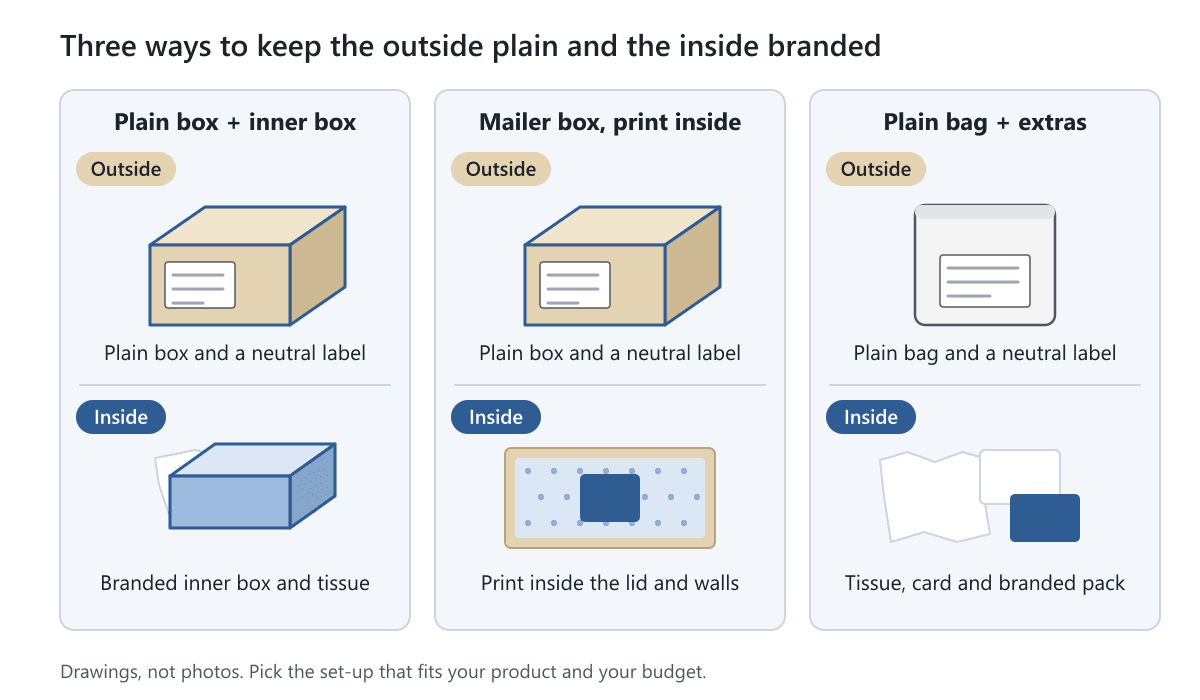
The table compares the common set-ups. Compare them by what a stranger can see and by where your brand appears.
| Set-up | What the outside shows | Where the brand shows up | Best for |
|---|---|---|---|
| Plain shipping box around a branded inner box | A plain box and a label | Inner box, tissue and card | Items that need extra protection and a premium opening |
| Mailer box printed inside only | A plain box and a label | Inside the lid and walls, plus an insert | Brands that want a full unboxing in one box |
| Mailer box with a small neutral mark outside | A short company name or mark | Outside and inside | Brands whose name does not describe the product |
| Mailer bag with tissue and a card inside | A plain bag and a label | Tissue, card and product packaging | Soft goods and light items |
| Your own plain outer, branded extras inside | A generic box and a label | Tissue, card and insert | Very small runs while you test the idea |
Inserts, Tissue and Cards
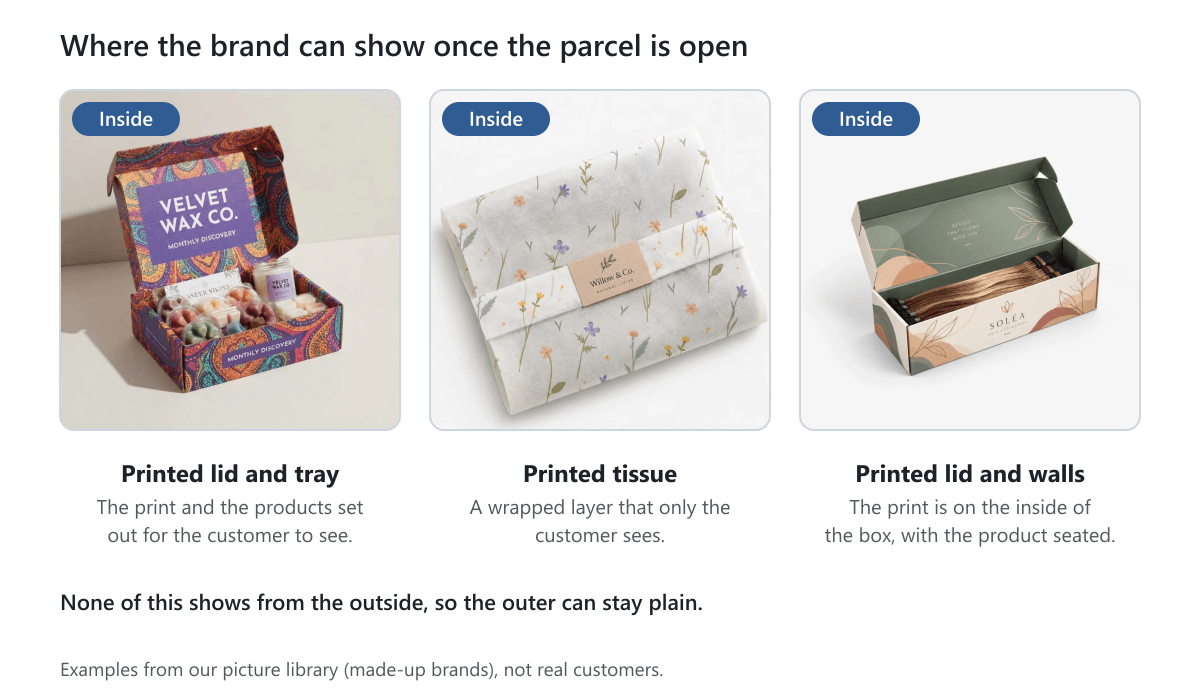
A printed box insert holds the product still, which also stops rattling. Tissue paper wraps it and gives the opening a finished look. A card can carry a thank-you, care tips and your contact details. For ideas on wrapping, see our guide to putting tissue paper in a gift bag.
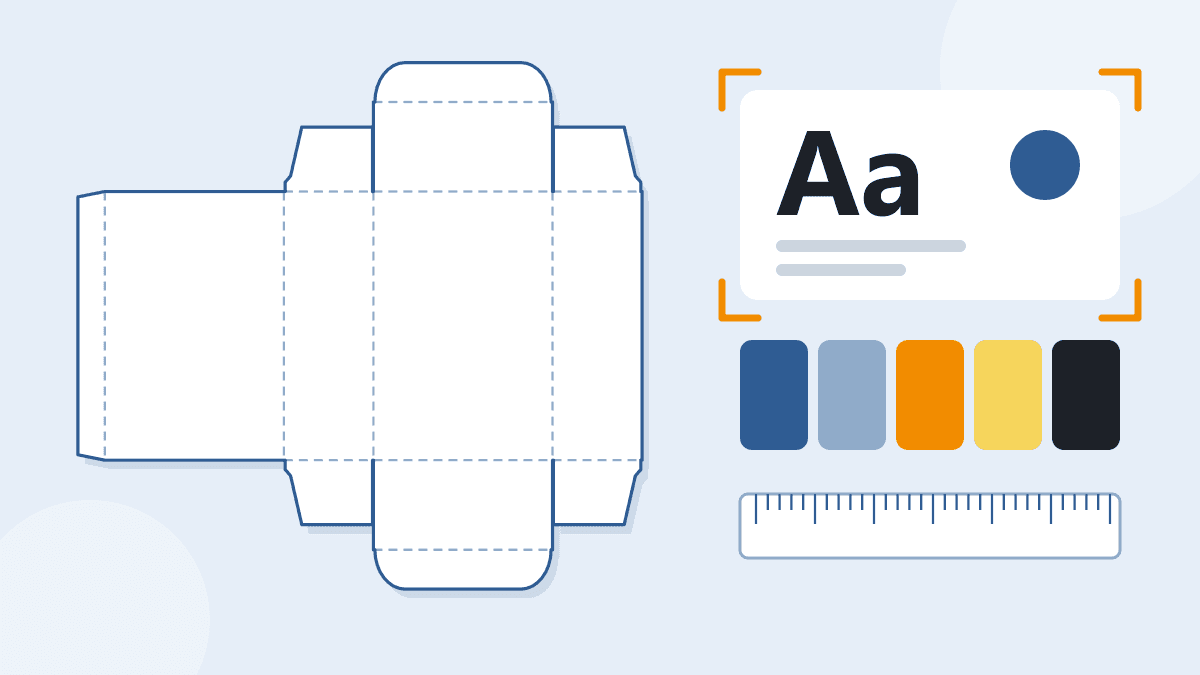
These three examples from our picture library show where a brand can appear once the parcel is open.
Our design support is free. We confirm your dieline and show a 3D preview with your artwork before printing, so you can see where each print area sits before it goes on press. Our artwork and proofs article explains the steps.
Do Not Try Too Hard
It is easy to overdo discretion. A blank box with no label markings, strange symbols or an unusual sender name can look more suspicious than an ordinary parcel, and it may catch the eye of a delivery driver or a mailroom clerk.
A better approach is to look ordinary. An everyday kraft or white box with a standard label blends in with the other parcels of a normal week. A short, believable company name or initials works better than a made-up name that has nothing to do with you.
- Look like a normal brand. A modest logo and a standard label say "ordinary online order" faster than a blank box.
- Use a real name. Return names that you cannot explain will cause trouble if a parcel is returned, lost or questioned.
- Match the carrier's rules. Do not cover barcodes, cover the label with extra markings or leave off required information to look plainer. Our guide to where to place a shipping label shows how to keep the label readable.
Small Cues That Give a Parcel Away
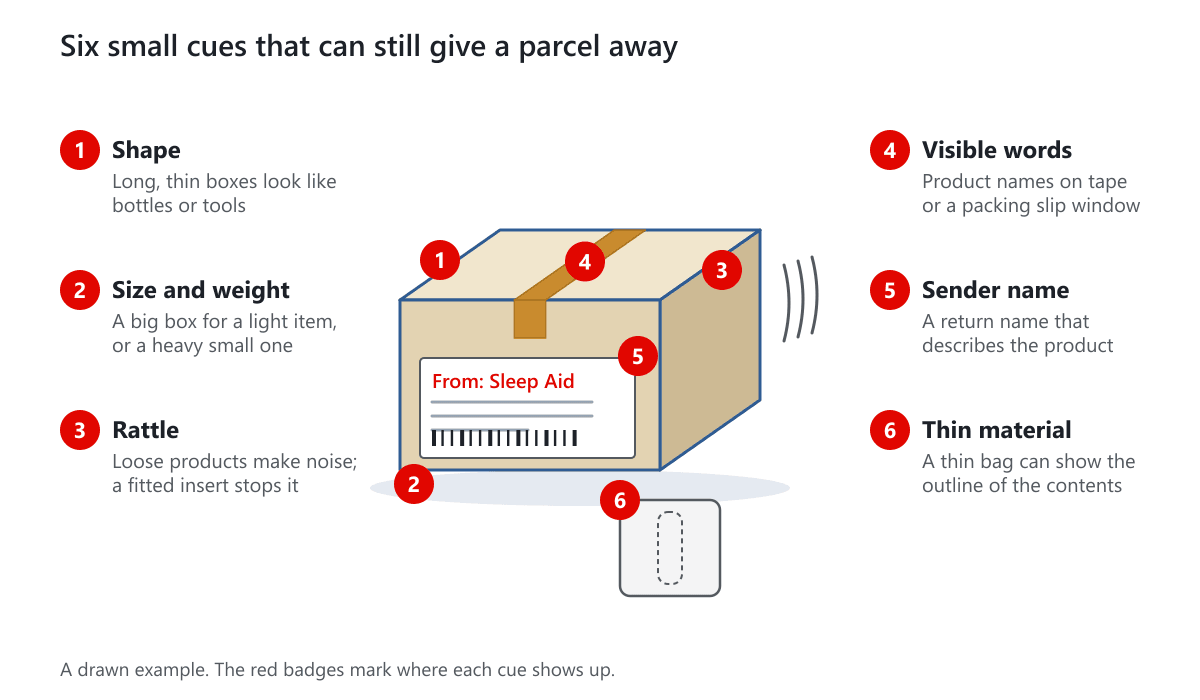
Even a plain box can tell a story. Before you print anything, check these cues on a real shipped sample.
- Shape. A long, thin box looks like a bottle or a tool. A small, flat box looks like a card or a small accessory.
- Size and weight. A big box holding a light item feels odd, and a small box that is heavy feels odd too.
- Rattle. A product that slides around in the box makes noise when carried. A fitted insert or tissue stops it.
- Visible words. Product names on tape, on a sticker, or on a packing slip in a window pouch.
- The sender name. A return name that describes the product undoes everything else.
- Material. A thin bag can show the outline of what is inside.
Right-Size the Box
A box that fits the product keeps it quiet and keeps the parcel from looking unusual. Measure the product and add a small clearance, as our guide to measuring a box correctly explains. Our free dieline templates let you test sizes before you order.
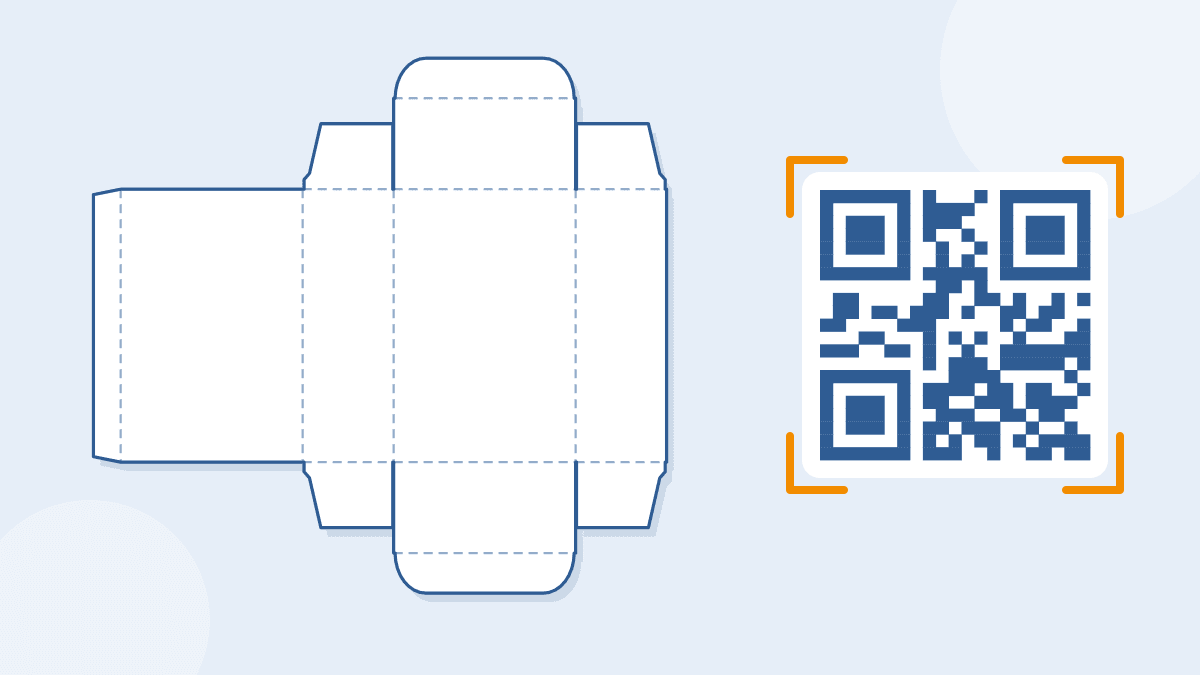
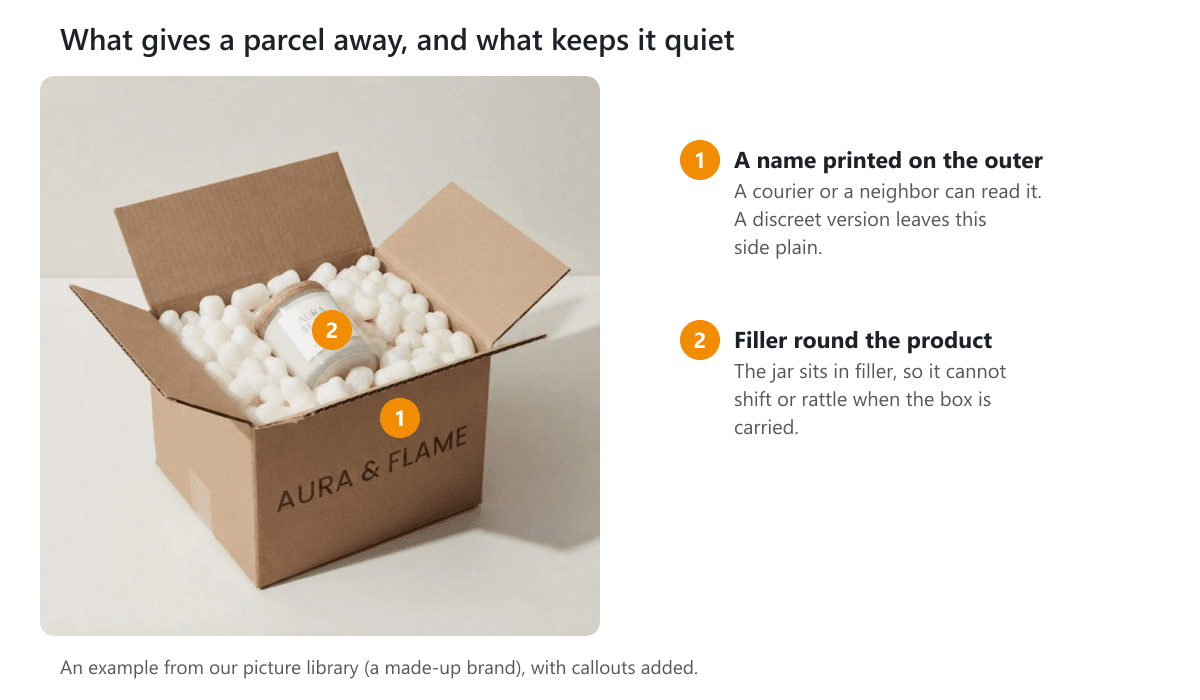
In this example from our picture library, the printed name on the outer is the part a discreet set-up would leave off, and the filler round the jar stops it shifting.
How to Tell Customers
Customers who want a quiet parcel often look for reassurance before they buy. A short, honest line does more than a long promise.
- On the product page. "Ships in a plain box with a neutral label."
- At checkout. Say what name the parcel will show as the sender, and offer a notes field for delivery instructions.
- In the order email. Repeat the same line and tell customers how to reach you if they have a question.
Keep the promise modest. You can say what is on the outside of your parcel. You cannot control who sees it on the way, and you cannot promise that nobody will guess. Customers trust a calm, accurate line more than a bold claim.
Returns and Replacements
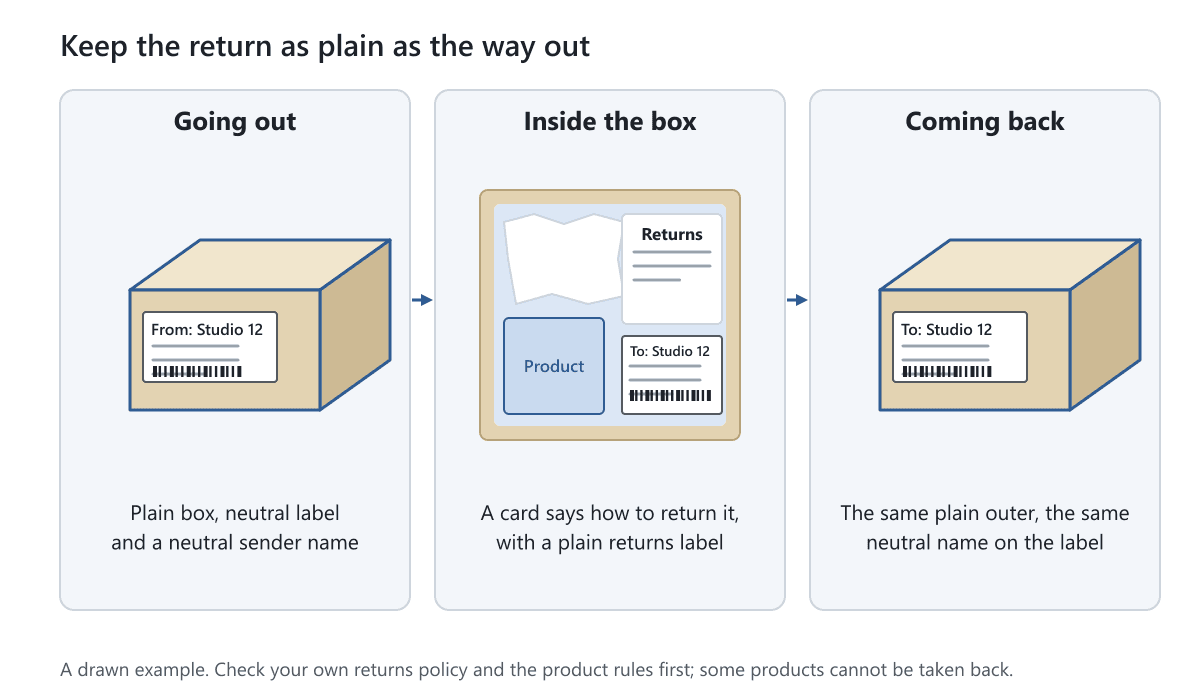
A discreet outbound parcel can be undone by an obvious return. If you include a returns label, keep it just as plain: a neutral name, a standard barcode and no product words.
- Reuse the same outer. A mailer box or bag that can be resealed lets the customer send the product back in the same plain package.
- Pack the return inside. Use the same insert or a plain inner bag so the product stays put.
- Say how returns work. One line in the box, on a card, tells the customer what to do.
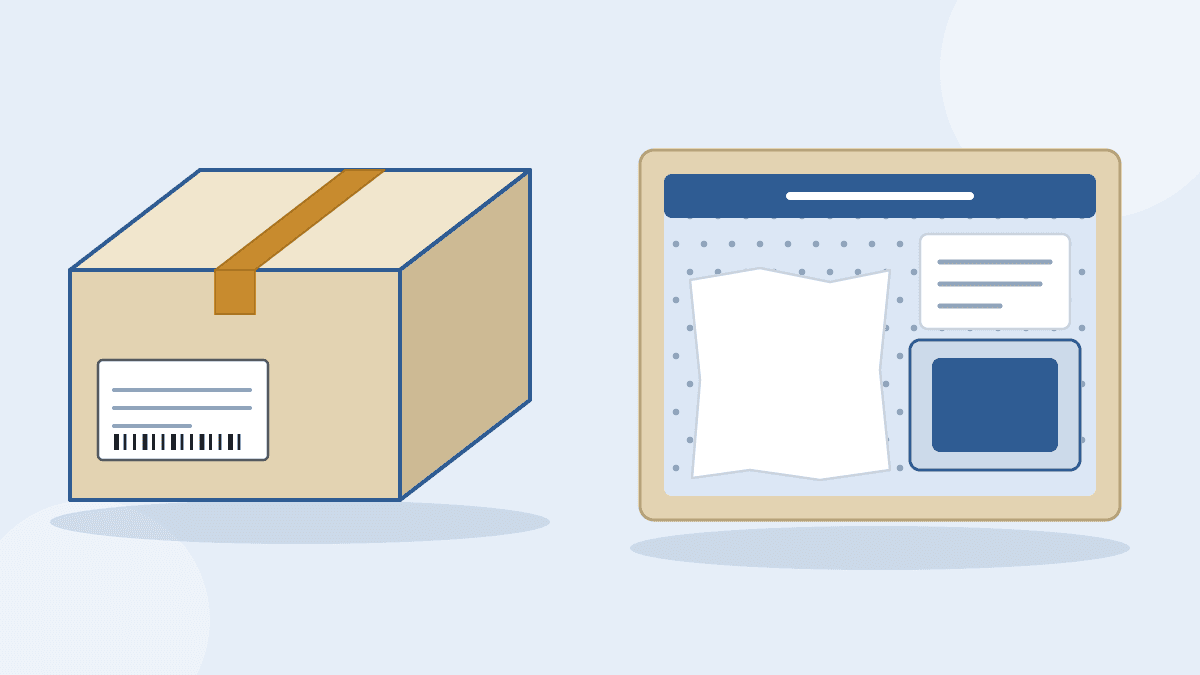
This drawing follows a plain parcel out, a returns card and label inside the box, and the plain return coming back.
Check your own policy and the product rules before you offer returns. Some products, for health or hygiene reasons, are not accepted back at all.
International Shipping and Customs
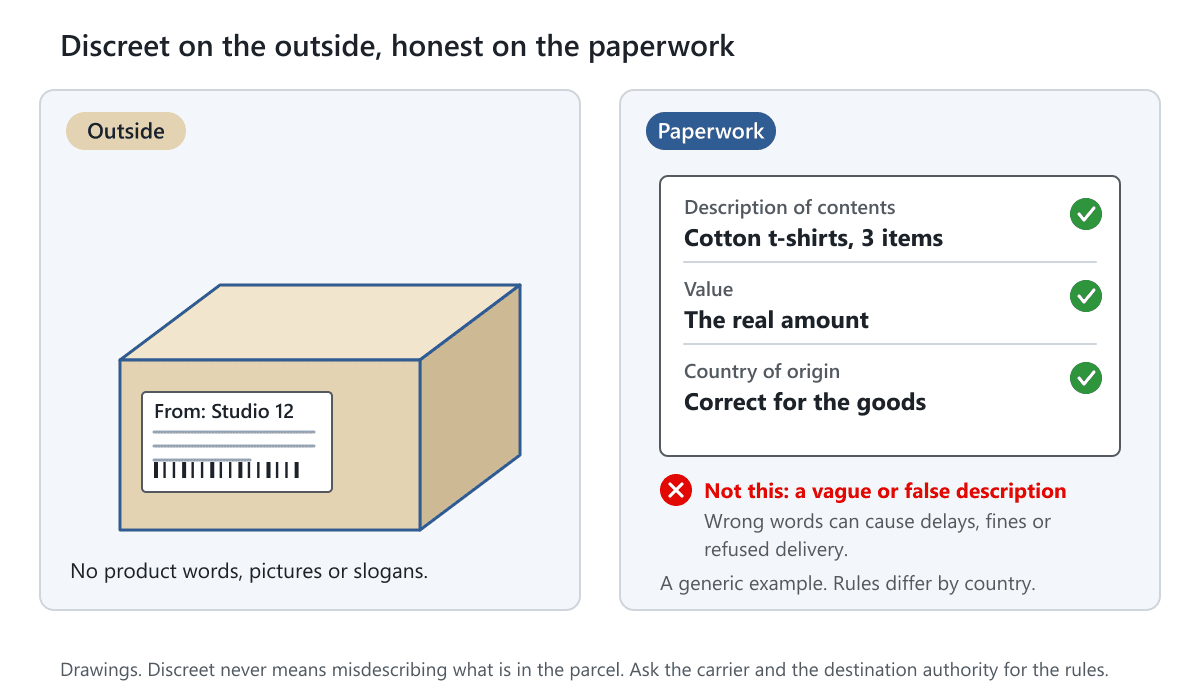
Discreet means not advertising the contents on the outside. It never means misdescribing them. Customs forms and carrier paperwork must describe the contents accurately, and the value must be right.
- Declare honestly. A false or vague description can cause delays, fines, seizure or refusal of delivery.
- Check the destination. Some products are restricted or need paperwork in some countries. A plain package does not change what is allowed.
- Know who pays duties. Taxes, import duties and delivery terms depend on the shipment and the country. Our help article on DDP packaging explains one common arrangement.
Our quotes include shipping within the United States and Canada, and taxes, duties and remote-area surcharges are not included. For other countries, ask the carrier and the destination authority for the rules, and ask us if you need a quote for a specific route.
This drawing shows a plain outside next to accurate paperwork, with a generic example of the details a customs form needs.
How to Set Up Discreet Packaging
Follow these steps in order. You can do the first four before you talk to a printer.
- 1. Decide what must stay private. The product, the sender name, or both. This sets how plain the outside needs to be.
- 2. Choose the outer. A kraft or white mailer box, a shipping box or a mailer bag, sized to the product. See our guide to what boxes are good for shipping.
- 3. Keep branding inside. Plan the print inside the box, an insert, tissue and a card, using the table above.
- 4. Choose a neutral sender name and label. A short, believable name, and a standard label with no product words. Our guide to labeling shipping boxes covers the details.
- 5. Test with a sample. Order a Standard Sample Kit ($50, shipping included, not credited toward an order) to compare box styles, then ship a filled sample to yourself. It may not include rigid boxes or boxes that ship assembled.
- 6. Explain it to customers. Add the one-line promise to the product page, checkout and order email.
When you are ready, get a free quote. We reply within 1 business day and quotes include shipping.
Common Discreet Packaging Mistakes
- Putting the product name or a picture on the outer box.
- Using a sender name that describes the product.
- Leaving the product loose so it rattles.
- Covering the barcode or leaving off required label information to look plainer.
Discreet Packaging Checklist
- A plain outer with no product words, pictures or slogans.
- A neutral return name that you can explain.
- A standard, readable label with the barcode uncovered.
- A box sized to the product, with an insert or tissue so nothing moves.
- Brand print, tissue, card or insert saved for the inside.
- Accurate customs forms for international orders.
- A sample shipped to yourself and checked before the full order.
Who Discreet Packaging Is Not For
It is not the right tool for every brand. Skip it, or think twice, in these cases.
- Brands that depend on a strong outer look. A bold printed box that people post about is a different strategy. You can still print the inside.
- Products that must be labeled by law. Some products need warnings or ingredients on the outside. A plain outer cannot replace required labeling, so check the rules for your product.
- Anyone hoping to avoid inspection. Discreet packaging does not hide contents from carriers or customs, and it should not be used to misdeclare them.
Plan It With Us
We make custom printed mailer boxes and shipping boxes, poly mailers, paper mailing bags, box inserts, tissue paper and cards. Mailer boxes can be printed outside, inside or both, and minimums depend on the product, so check each product page. Design support is free.
We have not confirmed special options such as opaque film, tamper-evident seals or unmarked labels, so tell us what you need and we will say what is possible. If you plan to ship soft goods, our guide to packaging for mailing clothing and our poly mailers guide cover the bag side.
Frequently Asked Questions
What is discreet packaging?
Discreet packaging is an outer package that does not show what is inside, and often does not show who sent it. It usually means a plain box or mailer, a neutral label and no product words or pictures outside. Branding stays on the inside, where only the customer sees it.
Is discreet packaging legal?
Yes, as long as the product is legal to ship, the label has the required information and any customs forms describe the contents accurately. A plain outer does not change what is allowed. This is general information, not legal advice, so check the rules of your carrier and destination.
Can I still put my brand name on the outside?
Yes, if the name itself does not reveal the product. A short company name or small mark is fine and looks more ordinary than a blank box. If your name describes what you sell, keep it off the outside and use it on the inside instead.
Can you print only the inside of the box?
Yes. Our mailer boxes can be printed outside, inside or both, in CMYK or Pantone. The minimum depends on the product and is stated on its page. Get a free quote and we reply within 1 business day.
How do I keep returns discreet too?
Use a plain returns label with a neutral name, and let the customer reuse the same outer box or bag. A fitted insert keeps the product still. Add one line inside the box that explains how returns work.
Can you add opaque film, tamper-evident seals or unmarked labels?
We have not confirmed those options, so we do not promise them. Tell us what you need and we will say what is possible for your project. You can also order a Standard Sample Kit to compare box styles first.
Written by the PacksDo Team
We make custom printed packaging, from boxes and mailers to bags, labels and inserts. Questions about this guide? Ask us.