In this article
- 1What Poly Mailers Are Good For
- 2Poly Mailer Sizes and a Size Chart
- 3How to Choose Your Size
- 4Film Thickness (Mil) Explained
- 5Closures, Strips and Returns
- 6Colors, Printing and Branding
- 7Types of Poly Mailers
- 8Shipping Weight and Cost
- 9Poly Mailer or Mailer Box?
- 10Recycling and Composting Claims
- 11Ordering Custom Poly Mailers
- 12Common Poly Mailer Mistakes
- 13Next Step
A custom poly mailer is a lightweight plastic shipping bag with a self-sealing strip, printed with your logo. To choose one, measure your product packed, make sure the mailer is at least as wide as the product's width plus its thickness, add room for the flap, and pick a film of about 2 to 3 mil for most clothing. Poly mailers suit soft, non-fragile products such as clothing, and they start at 500 units.
This guide covers sizes, with a size chart by product, film thickness explained, closures and returns, colors and printing, shipping cost, and when a mailer box or paper mailer is the better choice. It also covers what you can say about recycling and composting claims. Our poly mailers page lists the styles and our standard options.
Key takeaways
- Poly mailers are for soft, non-fragile goods. Clothing, soft accessories, towels, books and paperwork travel well in them. Glass and rigid items do not.
- Size from the packed product. Needed width is roughly the product's width plus its thickness, and length needs room for the flap.
- Thickness is measured in mil. A mil is 0.001 inch. Around 2 to 3 mil is common for clothing, and heavier or sharper items need more.
- Plan the label area. Keep a clear, flat zone for the shipping label and keep print off the seal strip.
- Know the alternatives. A mailer box, a paper mailing bag or a padded envelope can be a better fit for fragile or premium goods.
What Poly Mailers Are Good For
A poly mailer is a flat bag made of polyethylene film. It is light, thin, resists moisture and tearing, and takes up almost no storage space. The product goes in, the adhesive strip seals it, and the label goes on the outside.
These qualities make poly mailers a natural choice for e-commerce clothing and accessories, subscription items, documents and other goods that do not break. They also reduce shipping cost, because the package adds almost no weight or bulk.
Poly mailers are not a good choice for products that crush, scratch or snap. A mailer gives no structure, so a rigid or fragile item can be bent or broken by a stack of other parcels. For those, look at padded bubble mailers or a mailer box, which later sections compare.
If you ship clothing, our guide to the best packaging for mailing clothing compares more options.
Poly Mailer Sizes and a Size Chart
Poly mailers are described by width and length in inches. Stock sizes are widely used, and custom sizes are available. The chart shows common sizes drawn to the same scale, with what typically fits in each.
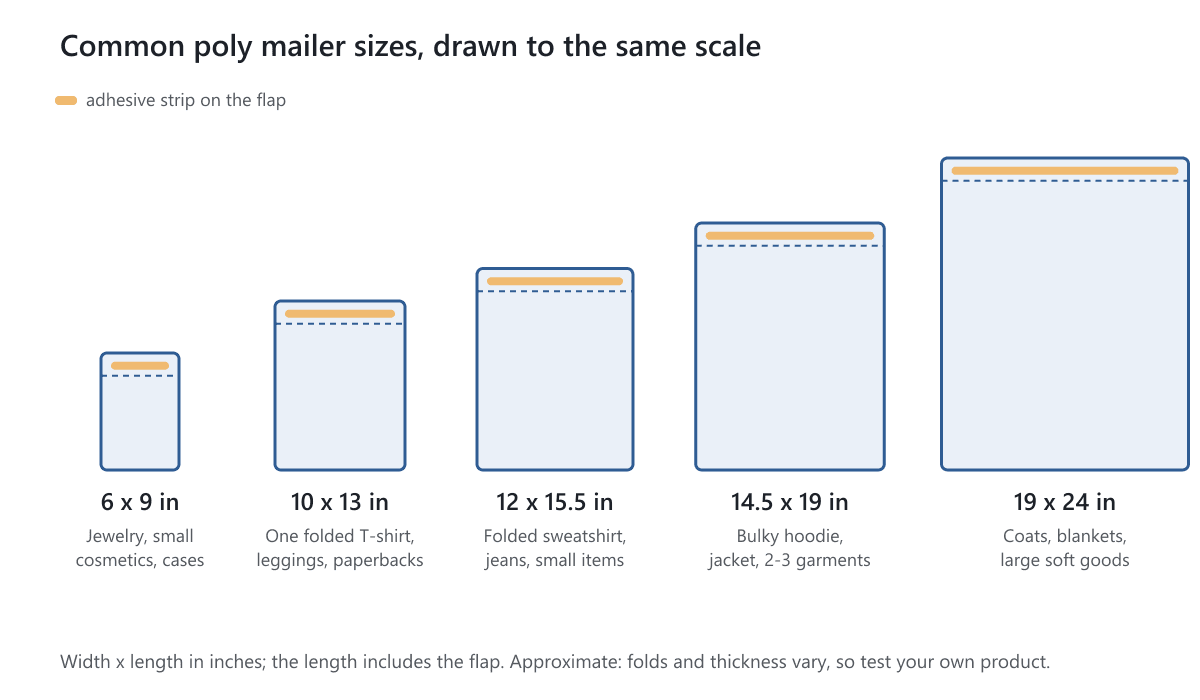
| Mailer size (W x L) | Typically fits | Notes |
|---|---|---|
| 6 x 9 inches | Jewelry, small cosmetics, phone cases | Small flat items |
| 10 x 13 inches | One folded T-shirt, leggings, paperbacks | The common first size for apparel |
| 12 x 15.5 inches | A folded sweatshirt, jeans, two or three small items | A popular all-round size |
| 14.5 x 19 inches | A bulky hoodie, a jacket, two or three garments | Check thickness of the stack |
| 19 x 24 inches | Coats, blankets, large soft goods | Large and light |
These are approximate. Garments fold differently and thickness varies, so test your own product. Also check whether the quoted length is the total length, which includes the flap, or the usable length inside the bag.
How to Choose Your Size
Follow these steps for each product you ship. It takes a few minutes with a ruler.
- Pack the product as you will ship it. Fold the garment, add the tissue, the card and anything else that goes in.
- Measure its width, length and thickness. Lay it flat and measure the width and length. Then measure how thick the pile is.
- Work out the width needed. A flat bag has to wrap around the thickness, so the mailer's width must be at least the product's width plus its thickness. Add about half an inch for ease.
- Work out the length needed. Add the product's length to the flap, which is typically about 1.5 to 2 inches, plus a little room.
- Round up to the next size. A slightly larger bag closes more easily and is gentler on the seal.
- Test with a sample. Pack, seal and shake it. If you have to force it, go up a size.
As an example, take a folded hoodie that measures 11 inches wide, 14 inches long and 2.5 inches thick. The width needed is about 11 + 2.5 = 13.5 inches, plus half an inch, so 14 inches. The length needed is 14 inches plus a 2 inch flap, plus a little room, so about 17 to 18 inches. A 14.5 x 19 inch mailer fits comfortably.
Do not go much larger than you need. A bag that is too big wastes film, flaps around, and can cost more to ship. A bag that is too tight strains the seal and splits. Our guide to measuring the dimensions of a box correctly covers the same habits for boxes.
Film Thickness (Mil) Explained
The thickness of the film is measured in mil. One mil is one thousandth of an inch, or about 0.025 mm. A higher number means a thicker, stronger film. It is the main reason one mailer feels flimsy and another feels sturdy.
| Thickness (typical range) | Feel | Suited to |
|---|---|---|
| About 1.5 to 2 mil | Thin and light | One soft, light item |
| About 2.5 to 3 mil | A common middle ground | Most clothing and accessories |
| About 3 mil and up | Thicker, more puncture resistance | Heavier items, or goods with corners or edges |
These ranges are common in the trade, not a promise of what is available, and we confirm the film options with your quote. Mil is only one factor. The film blend, the opacity and the seal strip also affect how the mailer performs. If you ship something with hard corners, a zipper or a sharp edge, say so, and test a sample.
Opacity matters too. A thin white film can show the color and shape of a dark garment inside. Ask whether the film is opaque, which keeps products and customer details out of view.
Closures, Strips and Returns
Most poly mailers close with a self-sealing adhesive strip. You peel the liner off the flap and press it down, so you do not need tape. The strip is the most important part of the mailer, because it holds the parcel shut in transit.
- Single strip. The simplest and most common closure.
- Tamper-evident strip. A closure that shows if the parcel has been opened. Some mailers have one, so ask.
- Dual strips for returns. A resealable return mailer has a second strip, so the customer can seal it again and send an item back in the same bag.
If returns are a big part of your business, such as with fashion, a resealable style saves the customer from finding a new bag and saves you from paying for one. See our page on resealable return poly mailers. Print a short note near the second strip, such as "peel here to return", so customers know which one to use.
Ask how well the strip holds in the conditions you ship in, such as cold, heat or humidity, and how well the second strip holds after the first use.
Colors, Printing and Branding
A mailer is the first thing a customer sees, so printing your brand on it turns every parcel into a small billboard. Tell us the film color and the print colors you want, and we confirm the printing method, the number of colors and a proof with your quote.
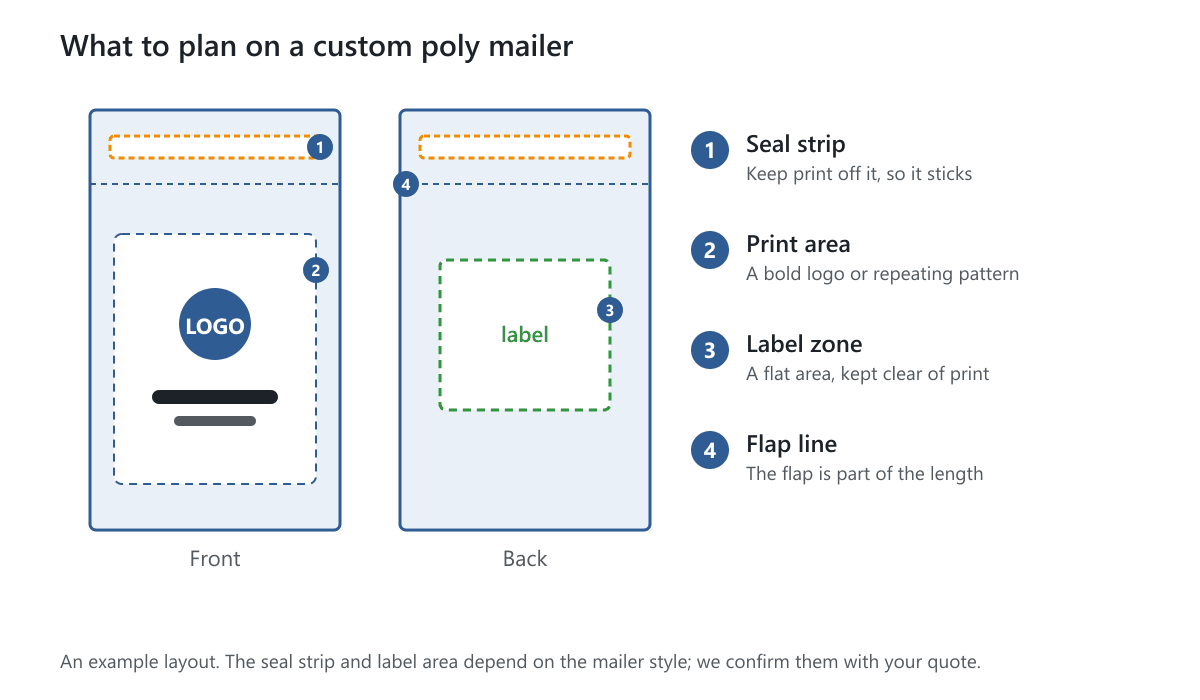
Tips for Poly Mailer Artwork
- Keep a clear label zone. Leave a flat area, usually on the back, for the shipping label. A label over a busy pattern is harder to scan and read. Our guide to where to place a shipping label explains why.
- Keep print off the seal strip. Ink on the strip can interfere with the adhesive.
- Use bold shapes. Logos and simple repeating patterns work better than fine detail on a flexible film that creases.
- Think about contrast. Light colors on a dark film look weaker than the same colors on a light film. Ask for a proof.
- Plan for curves. The bag bulges around the product, so a design that depends on straight lines looks distorted.
- Check the film color. Typical options include white, black and solid colors, and we confirm what is possible.
Use CMYK for full-color artwork, or Pantone for an exact brand color. See color systems in packaging. Our free design support can help prepare artwork.
Types of Poly Mailers
Standard poly mailers are the baseline, and there are several variations for different needs.
| Type | Best for | Trade-off |
|---|---|---|
| Standard | Soft, non-fragile goods | No cushioning |
| Padded bubble | Small fragile or valuable items | Heavier, bulkier, costs more |
| Soft shell bubble | Delicate items, light cushioning | Less rigid than hard shell |
| Hard shell bubble | Larger or heavier items | More bulk |
| Kraft paper bubble | A paper look with cushioning | Heavier than a plain bag |
| Clear | Showing the contents | Contents visible in transit |
| Resealable return | Stores with regular returns | More complex closure |
Shipping Weight and Cost
A poly mailer adds almost no weight, and a packed mailer is flat, so it often ships for less than a box. Carriers charge by the larger of the actual weight and the dimensional weight, which is worked out from the package's size. Length x width x height, divided by a number called the divisor, gives the dimensional weight. The divisor depends on the carrier and the rate, so check the current one with your carrier.
As an example, take a hoodie that weighs 1.5 pounds. Packed in a box that measures 14 x 11 x 4 inches, the volume is 616 cubic inches. With a divisor of 139, the dimensional weight is about 4.4 pounds, so the carrier charges for 4.4 pounds. In a mailer that packs flat to about 14 x 11 x 2 inches, the volume is 308 cubic inches, which is about 2.2 pounds. These figures are illustrations, and carriers round each side up, apply their own rules and treat soft packages differently.
A mailer is only cheaper if it is the right size. An oversized or bulging mailer can lose the advantage. Our guide to the impact of packaging costs on product pricing explains how to count packaging, shipping and returns together.
Poly Mailer or Mailer Box?
A poly mailer is not always the right answer. The choice depends on the product, the brand and the journey.
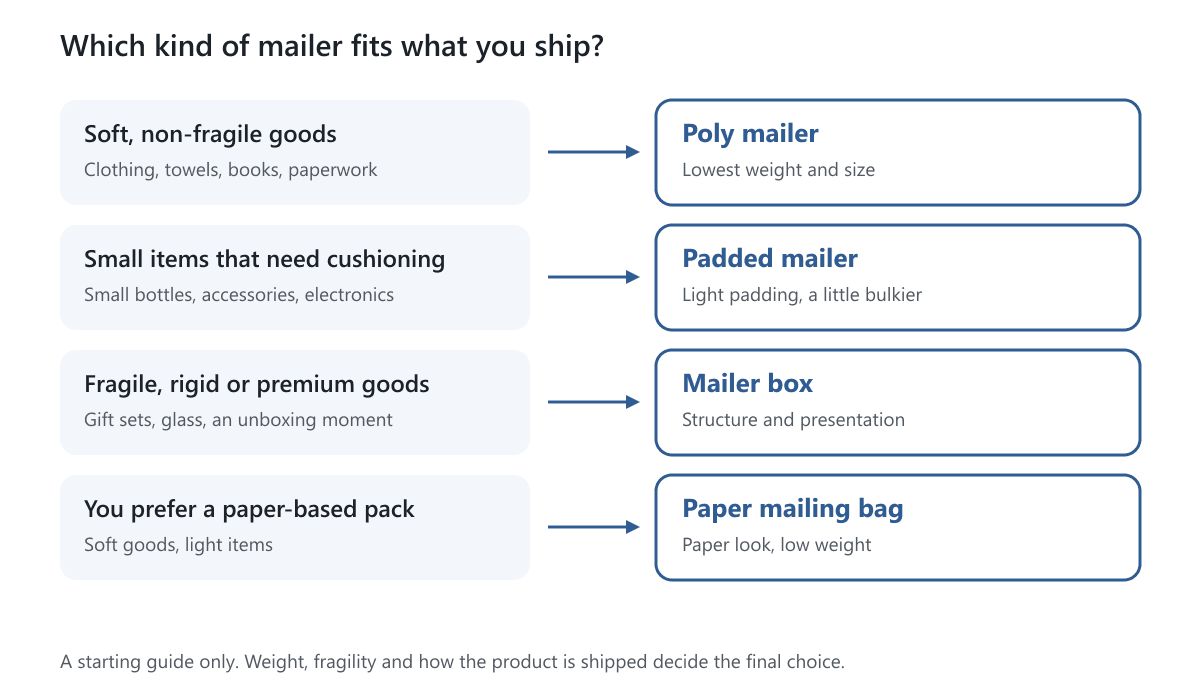
| Poly mailer | Padded mailer | Mailer box | Paper mailing bag | |
|---|---|---|---|---|
| Protection | Low, moisture and tears | Medium, cushioned | High, rigid | Low to medium |
| Shipping weight and size | Lowest | Low | Higher | Low |
| Storage space | Almost none | Small | Larger, ships flat | Small |
| Brand presentation | Printed bag | Printed bag | Strong, an unboxing moment | Paper look |
Choose a poly mailer for soft goods where protection matters less than cost and size. Choose a mailer box for products that need structure, such as fragile items, gift sets or premium products where the unboxing counts. Choose a paper mailing bag or a padded envelope if you prefer a paper-based pack or need light cushioning. Some brands use a mailer box for the premium line and a poly mailer for basics. If you are unsure, our guide to choosing the right box for your product can help.
Recycling and Composting Claims
If the film material matters to you, ask us about the options and what we can document with your quote, because what the film is and what it is certified for decide what you can say on the pack.
A few general points help you decide. Standard polyethylene mailers are film plastic. Where they can be recycled depends on local programs, and many areas accept clean plastic film only through special drop-off collections, not through household recycling. Rules vary by town, so check locally. Compostable films are different materials, and composting works only where the right facilities exist. Home composting and industrial composting are separate standards.
In the US, environmental claims must be supported by evidence. Do not print "recyclable" or "compostable" on your mailer unless the film's documentation supports it for your market. Our guide to whether bubble mailers are recyclable and our overview of eco-friendly packaging materials go deeper.
You can also reduce waste with choices that do not depend on the material: right-size the mailer, avoid extra filler and consider whether a reusable return mailer would stop a second bag being used.
Ordering Custom Poly Mailers
Poly mailers start at 500 units. Send us the size, the film color, the thickness you want, the closure and your artwork, and say how many you ship in a month so we can suggest a quantity. Our quotes include shipping, and we reply within 1 business day.
Production takes 5 to 7 working days after artwork is approved and payment is received, with delivery time added on top. Larger or more complex orders can take longer, and we confirm the date in your quote. Free design support is available. If you are not sure about size or film, order a sample first. Our Samples page lists every sample type, and the Standard Sample Kit costs $50 with shipping included.
Common Poly Mailer Mistakes
- Choosing a size by guessing instead of measuring the packed product.
- Forgetting the flap in the length.
- Using a thin film for heavy items or items with hard corners.
- Printing over the seal strip.
- Leaving no flat area for the shipping label.
- Making light colors on a dark film and not asking for a proof.
- Using a poly mailer for fragile goods.
- Printing a recycling or composting claim without documentation.
Next Step
Measure your packed product, note its weight, and decide how you want the mailer to look. Then request a free quote and send your artwork if you have it. We will recommend a size and film.
Frequently Asked Questions
What size poly mailer do I need?
Measure the packed product. The mailer's width should be at least the product's width plus its thickness, and the length needs the product's length plus a flap of about 1.5 to 2 inches. A 10 x 13 inch mailer fits one folded T-shirt, and a 14.5 x 19 inch mailer fits a bulky hoodie.
What thickness of poly mailer do I need?
About 2 to 3 mil is a common range for clothing, where a mil is 0.001 inch. Use a thicker film for heavy items or goods with edges. Thickness is only one factor, so test a sample with your product.
Are custom poly mailers waterproof?
Polyethylene film resists moisture, so parcels are usually protected from rain. But seams, strips and punctures can still let water in, so we do not promise waterproof performance. Test a sample if your goods are sensitive to water.
What is the minimum order for custom poly mailers?
The minimum order is 500 units. Tell us the size, film and quantity, and we will confirm details with your quote.
Can I print on both sides of a poly mailer?
Tell us what you want to print and where, and we confirm the printing method and the number of colors with your quote. Keep the seal strip and a label zone free of print.
Are poly mailers recyclable?
Standard polyethylene mailers are film plastic, and recycling depends on local programs, which often accept clean plastic film only through special drop-off points. Ask us about the film options and what we can document with your quote.
When should I use a mailer box instead?
Use a mailer box when the product is fragile, rigid or premium, or when the unboxing matters. A poly mailer suits soft goods where cost, size and weight matter most. A padded mailer or paper mailing bag sits in between.
Written by the PacksDo Team
We make custom printed packaging, from boxes and mailers to bags, labels and inserts. Questions about this guide? Ask us.