In this article
- 1Start With What the Box Must Do
- 2Which Box for Which Product
- 3What to Prepare Before You Ask for a Quote
- 4Get the Artwork Ready
- 5How to Compare Quotes
- 6Minimum Orders and Quantity
- 7Samples and Proofs
- 8Timeline: When Will the Boxes Arrive?
- 9Shipping and Receiving
- 10Special Cases
- 11Common Mistakes
- 12A Pre-Order Checklist
- 13Ready to Order?
To buy custom printed boxes without surprises, decide what the box must do, measure your product, choose a box type and board, prepare artwork, compare quotes on identical specifications, check a sample, then order. Expect production to take 5 to 7 working days after approval and payment, plus delivery time.
This is a buyer's guide. It covers which box suits which product, what to prepare before you ask for a quote, how to compare quotes fairly, minimum order quantities, samples and proofs, a practical timeline, shipping and receiving, and the mistakes buyers make most. It ends with a checklist you can copy.
We keep the detail of other topics in their own guides. For matching a product to a box type, read how to choose the right box for your product. For what drives the price, see our packaging cost guide. For sizing, see the folding carton size guide. For styles and materials of retail cartons, see our guide to folding cartons, the paperboard guide and the tuck box guide.
Key takeaways
- Start with the job. Shelf, shipping, gift or subscription: the job decides the box type.
- Prepare five things. The inside size, the quantity, the box type, the print and finish, and the artwork or at least a logo.
- Compare like with like. Two quotes only compare when size, board, print, coating, quantity, proof and shipping match.
- Test a sample. A structural sample or a sample kit costs little compared with a printed run.
- Plan the calendar. Production is 5 to 7 working days after approval and payment, and delivery is on top. Larger or more complex orders can take longer, and we confirm the date in your quote.
Start With What the Box Must Do
Every box has a main job, and the job narrows the choices fast. Ask yourself these questions before you look at any catalog.
- Where will it be seen? On a shelf, in a customer's hands, or only inside a shipping carton?
- How will it travel? Alone through the mail, inside another carton, or by hand?
- What does it hold? Weight, fragility and shape decide the board and the style.
- What should the customer feel? A quick, practical pack, or a gift they keep?
- How many will you need, and how often? A one-time launch and a monthly subscription are different jobs.
Write the answers down. They go straight into your quote request.
Which Box for Which Product
Most custom printed boxes fall into a few families. The picture shows five that cover most needs.
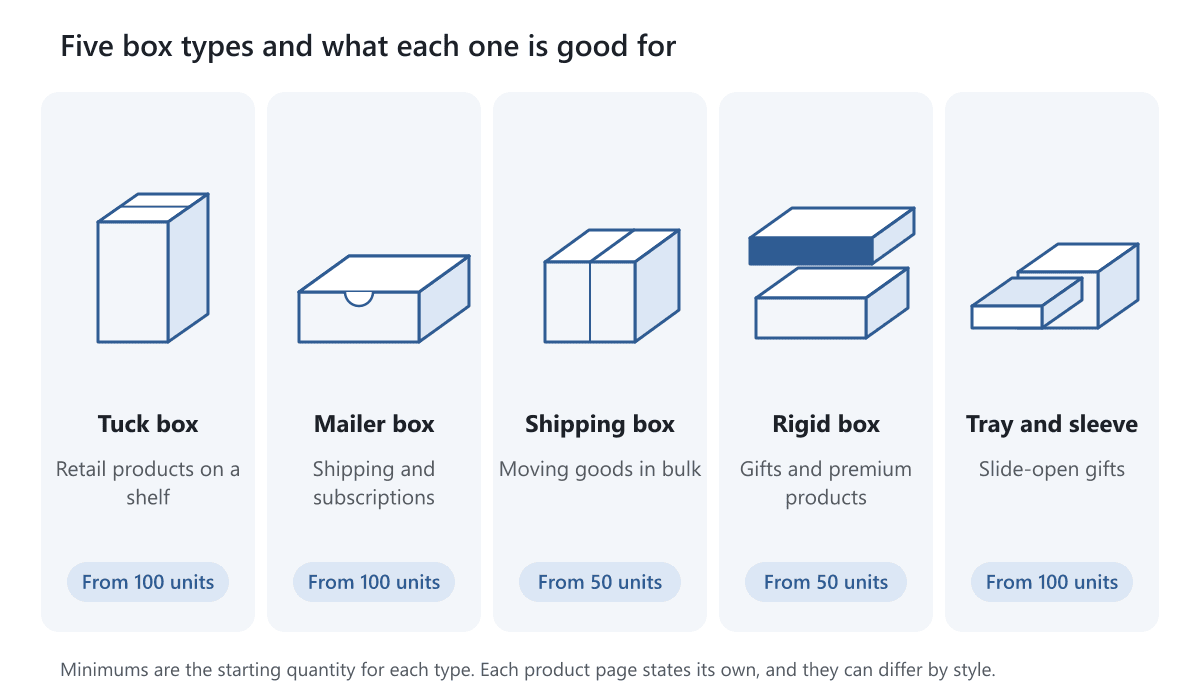
| Box type | Best for | Board | Starting quantity |
|---|---|---|---|
| Tuck box | Retail products: cosmetics, supplements, soap | Paperboard, 300-400gsm | 100 units |
| Pillow box | Small gifts and light items | Paperboard, 300-400gsm | 100 units |
| Mailer box | E-commerce, subscriptions, gifts that ship | Corrugated | 100 units |
| Shipping box | Moving goods in bulk | Corrugated | 50 units |
| Rigid box | Premium gifts and keepsakes | Rigid board, 800-2000gsm, wrapped | 50 units |
| Tray and sleeve | Slide-open gift and unboxing | Paperboard | 100 units |
| Display box | Counter and shelf display | Paperboard | 100 units |
Two shortcuts help. If the box goes straight to the customer in the mail, start with a mailer or a shipping box. If the box sits on a shelf and ships inside something else, start with a folding carton. Our folding carton and corrugated pages explain each family, and the Custom Product Boxes page lists box types by what you sell.
What to Prepare Before You Ask for a Quote
A good quote request is specific. The more you give, the less back-and-forth you need, and the faster the reply. Gather these.
- Inside size. The size of the space for your product, written length x width x height. Our measuring guide shows how.
- Quantity. Ask for two or three quantities, such as 500, 1,000 and 2,500, so you can see how the unit cost falls.
- Box type. From the table above, or ask us to recommend one.
- Board. White or kraft paperboard, corrugated or rigid. If unsure, say what you are packing.
- Print. CMYK or Pantone, outside only or inside too.
- Finish. Varnish or lamination, with matte, glossy, satin or soft touch. Add foil, emboss or spot UV only if you need them.
- Artwork status. Ready, in progress, or a logo only. We offer free design support.
- Deadline and address. The date you need the boxes, and where they go.
Here is an example of a clear request. It is an invented sample, not a real order: "We sell 2 oz face cream in a glass jar, 60 x 60 x 45 mm. We need a tuck box with an inside size of 64 x 64 x 49 mm, white board, CMYK on the outside, matte lamination, quantities of 500 and 1,000, and delivery to Texas by November 15. Our logo is a vector file."
You can send this through our quote page. We reply within 1 business day.
Get the Artwork Ready
Artwork is the step that most often slows an order. You do not have to be a designer, but a few basics save days.
- Use the dieline. It is the flat outline of the box with cut and fold lines. Our free dieline templates give you one in PDF, SVG or DXF at real size, and our dieline help article explains the lines.
- Add a bleed. Extend background color a few millimeters past the cut line so a small shift does not leave a white edge. See what bleed is.
- Keep text inside the safe area and off the folds.
- Design in CMYK, or name your Pantone colors. Screen colors can shift when printed. See our color systems article.
- Use sharp images and vector logos. A blurry image prints blurry. A photo should be high resolution at the size it will be printed, commonly 300 dpi.
- Check the legal text. Your product may need ingredients, weight, barcodes or warnings. Add them before you send the file.
We confirm the final dieline with you before printing. Send what you have, even a rough idea, and we help with the rest.
How to Compare Quotes
Two quotes for custom printed boxes can differ by a lot, and the cause is often not price but scope. One quote may use thinner board, a cheaper coating or leave out shipping. Check each line before you look at the total.
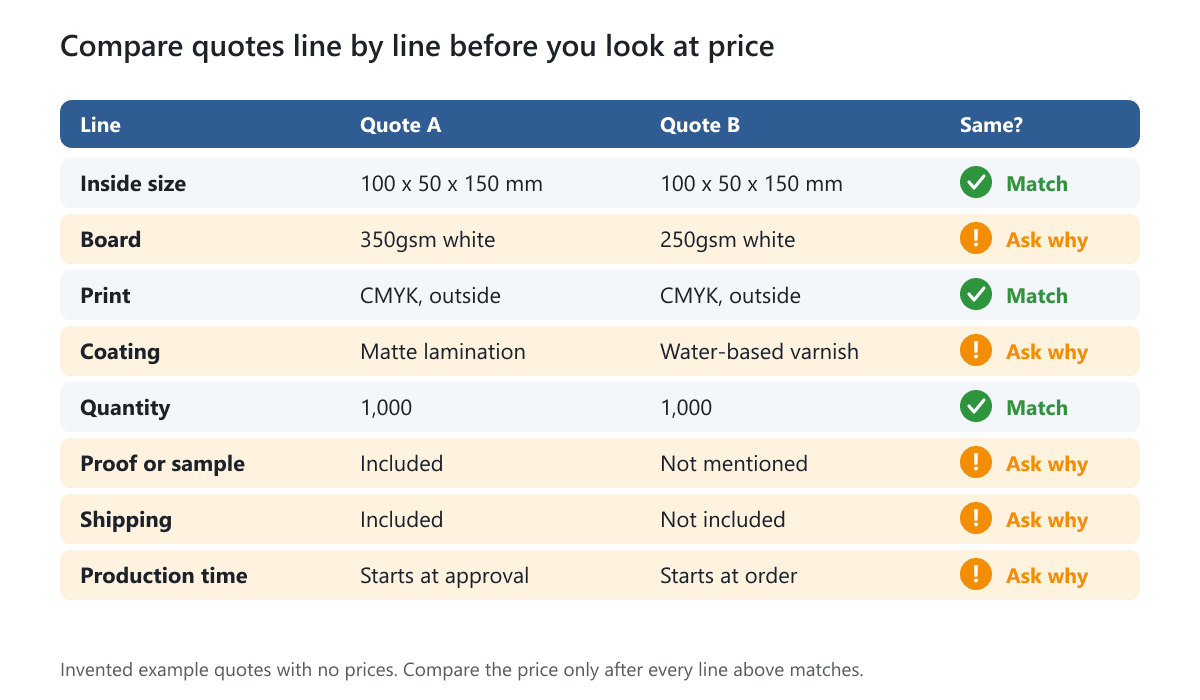
- Size. Are both inside sizes, and are they the same?
- Board and thickness. Compare gsm or caliper, and the type: white, kraft, corrugated or rigid.
- Print. Colors, one side or both, and whether the inside is printed.
- Coating and finish. Varnish and lamination differ in protection and in cost.
- Quantity. Compare at the same quantity, and ask about price breaks.
- Proof or sample. Is one included, or is it extra?
- Shipping. Our quotes include shipping to the US and Canada. Taxes and duties are not included. Check what each supplier includes.
- Timeline. Does it start when you order, or when artwork is approved and paid?
- Tolerance and reorders. Ask what variation to expect, and whether artwork is kept for repeat orders.
Only when every line matches should you compare the price. Our product pages show a starting price per unit, and the final price depends on quantity, size, material and finish. For what moves the price, read the cost guide.
Minimum Orders and Quantity
Minimum order quantities depend on the product. Most of our boxes start at 100 units, and rigid boxes and cardboard tubes have a low minimum and shipping boxes start at 50. Paper bags, poly mailers, stickers and labels, cards and hang tags start at 500. Each product page states its own.
Quantity changes the cost per box. Setting up a print run takes the same work whether you make 100 boxes or 1,000, so the cost per box generally falls as the quantity rises. That does not mean you should always order the most. Think about storage space, shelf life of your design and cash flow.
A Simple Way to Choose a Quantity
- Estimate how many units you will sell in the next 3 to 6 months.
- Ask for quotes at that number, a lower one and a higher one.
- Check storage: cartons ship flat, rigid boxes may not.
- Think about design changes. If your label or claim will change soon, order less.
A small first run is a sensible way to test a box before you commit to a big one. Starting quantities are low for exactly this reason.
Samples and Proofs
A sample is low-cost insurance. It lets you check size, board, color and feel before the full run.
- Structural sample. An unprinted prototype that shows the size and form of your box.
- Print proofs. Samples that show how your artwork prints. The Samples page lists each type.
- Standard Sample Kit. It costs $50, shipping included, and lets you hold boards, styles and finishes. It may not include rigid boxes or boxes that ship assembled, so ask about rigid samples.
Look at four things on a sample. First, does the product fit and slide in? Second, does the box close securely? Third, do the colors look right in daylight and under shop lights? Fourth, does it survive a gentle shake and a stand on its end? If something is off, fix it now, not after the run.
The Samples page and the Standard Sample Kit page explain what is available.
Timeline: When Will the Boxes Arrive?
Production starts once artwork is approved and payment is received. It takes 5 to 7 working days. Larger or more complex orders can take longer, and we confirm the date in your quote. Delivery time depends on the carrier and your location, and it is added on top.
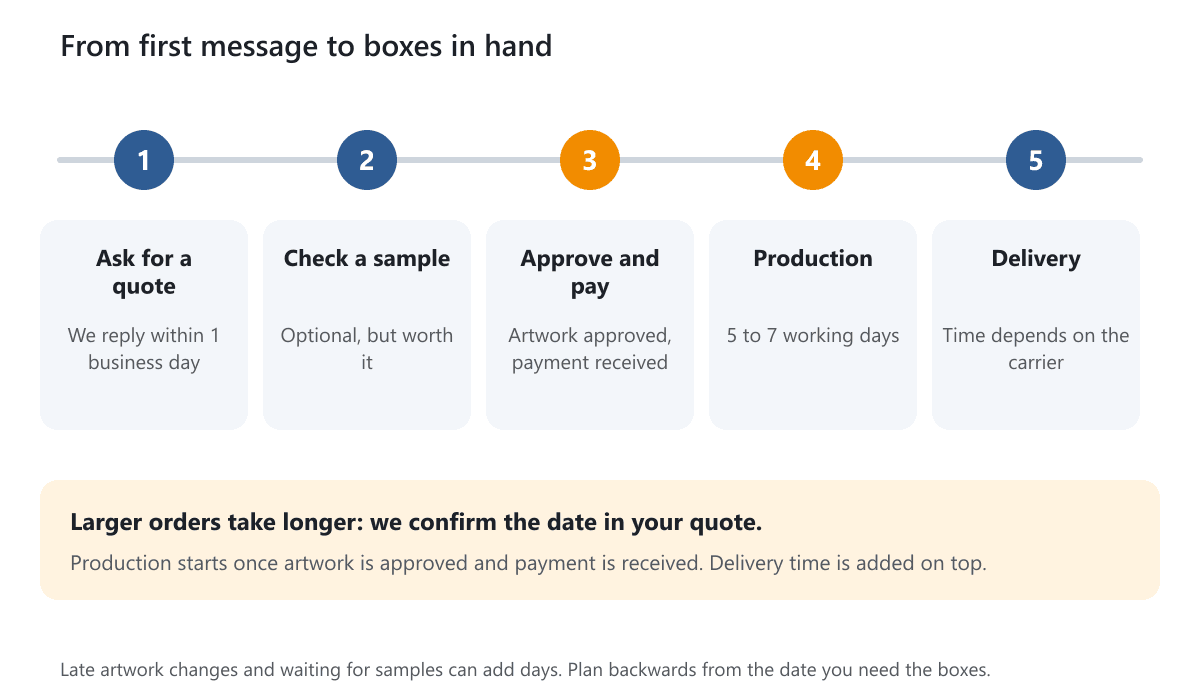
Here is an example of working backward from a date. Suppose you need cartons on your shelf by a fixed launch date, and your order is large enough to take 21 working days (about 4 weeks). Allow a week or two for samples and artwork before production starts, and leave time for delivery and a buffer for the unexpected. That is easily 7 or 8 weeks, so start well ahead. For a standard order the numbers are shorter, but the method is the same.
Rush options may exist for some orders. See our rush orders article and the turn around time article for details.
Shipping and Receiving
Our quotes include shipping to the US and Canada. Taxes, duties and remote-area surcharges are not included, and outside the US and Canada the shipping cost is shown in the quote. Delivery time is added on top of production.
When the boxes arrive, check them before you sign off.
- Count the cartons against the order.
- Open one and look at the print, the fold and the fit.
- Photograph any damage and tell us quickly. Our return and refund policy explains the process.
- Store them dry and flat, off the floor, away from heat.
- Keep one as a reference for your next order.
Special Cases
Small Runs and First Orders
Starting quantities begin at 50 to 100 units for most boxes, so you can test a design and a market. Order a sample first, and choose simple finishes while you learn what sells.
Fragile or Heavy Products
Choose heavier board and a stronger structure, and add an insert to hold the product still. See our box inserts page. Test the sample with the real product.
Food and Anything That Touches the Product
If the box touches food or a product directly, tell us. The board, coating and inks must suit the use, and we confirm the options that fit. Many brands use a primary pack inside the box.
International Shipping
Outside the US and Canada, shipping is quoted separately, and import duties and taxes may apply. Ask your carrier or customs broker about local rules.
Sustainability Goals
If recycling matters to you, say so early. Paper-based boxes can be recyclable where local facilities accept them, and plastic films, foils and some coatings can make recycling harder. Recycled stock options are available on request. Our guide to eco-friendly packaging materials goes through the choices.
Common Mistakes
- Ordering from a size on a screen instead of from a measured product.
- Comparing prices before the specifications match.
- Skipping a sample to save a week, then fixing a fit problem in 1,000 boxes.
- Sending low-resolution artwork or a logo with a white box around it.
- Choosing a box by looks without checking how it ships.
- Forgetting the insert, wrap or tissue in the size.
- Not leaving time for approval, production and delivery.
- Adding finishes you do not need.
- Ordering the largest quantity without checking storage.
A Pre-Order Checklist
- I know what the box must do: shelf, ship, gift or subscription.
- I measured the product with its cap, wrap and insert, and I know the inside size.
- I chose a box type and a board, and I asked for two or three quantities.
- I know the print: CMYK or Pantone, outside or inside.
- I chose a coating and a finish, and only the effects I need.
- My artwork is on the dieline, with a bleed, and my text is off the folds.
- My quotes match on size, board, print, coating, quantity, proof, shipping and timeline.
- I ordered or checked a sample.
- I counted back from my date, with production time, delivery and a buffer.
- I have a place to store the boxes.
Ready to Order?
Send us your product, the size and the quantity, and tell us what you want the box to do. We reply within 1 business day with a quote, and we offer free design support if you need it. Start with the quote page, or order a Standard Sample Kit to feel the boards first.
Frequently Asked Questions
What is the minimum order for custom printed boxes?
It depends on the box. Most of our boxes start at 100 units. Rigid boxes and cardboard tubes have a low minimum, shipping boxes start at 50, and paper bags, poly mailers, stickers, cards and hang tags start at 500. Each product page states its own minimum.
How long does it take to get custom printed boxes?
Production takes 5 to 7 working days after artwork is approved and payment is received. Larger or more complex orders can take longer, and we confirm the date in your quote. Delivery time is added on top. See our turn around time article.
How much do custom printed boxes cost?
It depends on the size, material, quantity, printing and finish. Each product page shows a starting price per unit, and quotes include shipping. Read the cost guide for what moves the price, then get a free quote.
Do I need a sample before I order?
You do not have to, but it is wise. A structural sample shows size and form, and the Standard Sample Kit costs $50, shipping included. It may not include rigid boxes or boxes that ship assembled.
What artwork do I need?
A dieline with your design placed on it, a bleed, vector logos and sharp images, in CMYK or with named Pantone colors. If you only have a logo, we offer free design support. Our free dieline templates are a good starting point.
What is the difference between a mailer box and a shipping box?
A mailer box is a one-piece corrugated box with an attached lid, made for shipping and for unboxing. A shipping box is a corrugated box with flaps that you close with tape. See the mailer boxes and shipping boxes pages.
Do your quotes include shipping?
Yes, for the US and Canada. Taxes, duties and remote-area surcharges are not included. Outside the US and Canada the shipping cost is shown in the quote.
Written by the PacksDo Team
We make custom printed packaging, from boxes and mailers to bags, labels and inserts. Questions about this guide? Ask us.