In this article
- 1Measure the Palette First
- 2Which Box Suits a Palette?
- 3Magnetic Boxes: How They Work
- 4Inserts and Recesses That Hold the Palette
- 5Protecting the Pans in Transit
- 6Printing, Finishes and the Look of the Box
- 7Shade Lists, Ingredients and Required Text
- 8Gift Sets and Bundles
- 9What Changes the Price and the Minimum
- 10Three Example Scenarios
- 11Common Mistakes
- 12Checklist Before You Order
- 13Next Steps
Eyeshadow palette packaging has one main job: keep a flat, fragile compact from being pressed, bent or knocked in transit. The most common answer is a rigid box with a magnetic lid and a recess in the insert, because the thick walls stop the box from flexing and the recess holds the palette still. Slimmer or lower-priced palettes often go in a printed tuck box or a tray and sleeve box.
This guide is about packaging for palettes only. It covers measuring, box types, magnetic lids, inserts, protecting the pans, finishes, shade lists, gift sets and shipping, with examples and a checklist. For the full picture of beauty packaging, see our cosmetic packaging boxes guide. For a smaller product, see our lipstick boxes guide.
Key takeaways
- Measure the palette closed. Length, width and thickness, plus any raised latch, hinge or mirror that sticks out.
- Thick board gives the best protection. Rigid boxes use board of 800 to 2000gsm and do not flex like a folding carton.
- The insert is the real protection. A recess that holds the palette flat keeps pressure off the pans.
- Plan the shipping layers together. The gift box, the paper fill and the outer box all share the shock.
- Shade lists take space. Palettes carry many shades, so plan where the text, ingredients and codes go.
- Ask for a sample. A palette is heavy for its size, so test the lid, the magnets and the fit with a real one.
Measure the Palette First
A palette is a flat compact with a hinged lid, a set of pans and often a mirror. The box has to fit around it with a little room, and the insert has to hold it flat. Start by measuring the palette closed, as it will sit in the box.
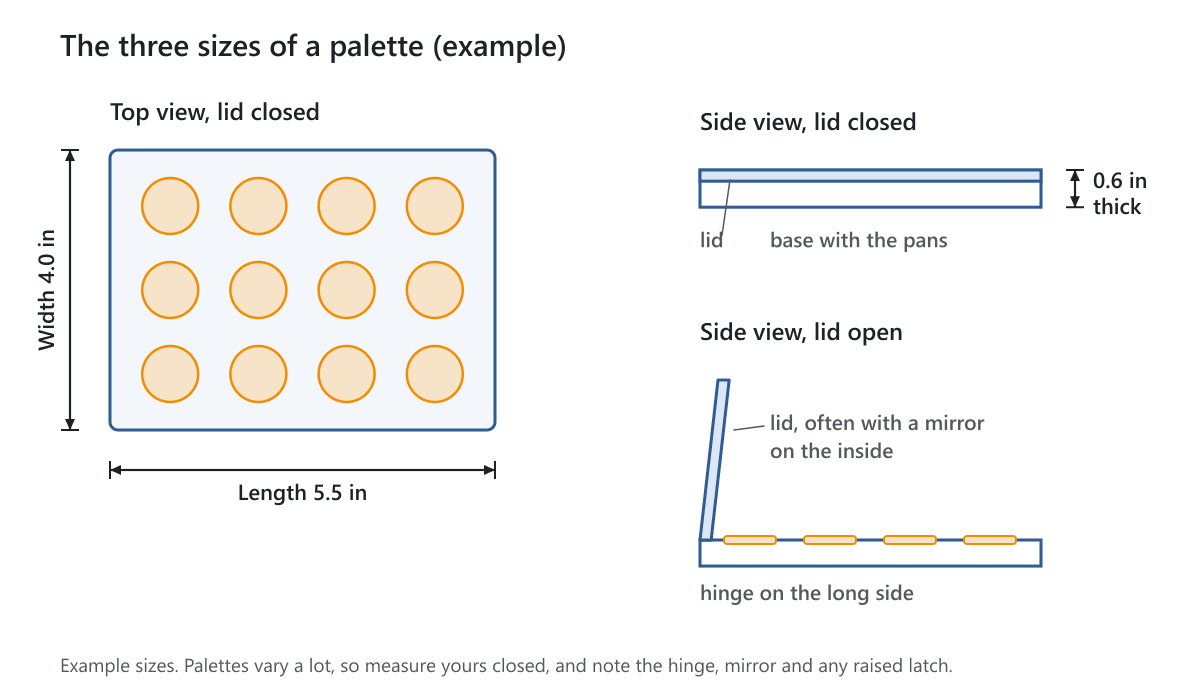
- Length and width. The two long sides of the closed compact. Measure at the widest point, including any hinge or latch.
- Thickness. The closed height. A latch, a raised logo or a domed lid adds to it.
- Hinge side. Know which long side is hinged, because it decides how the palette sits and how a shopper lifts it out.
- Weight. A metal or glass-heavy palette needs a stronger insert and thicker board.
- Pan layout. Pans stand a little proud of the base in some palettes, and the insert must never press on them.
The sizes below are typical, to help you check your numbers. They are not specifications. Your palette may be bigger or smaller.
| Palette | Typical length | Typical width | Typical closed thickness |
|---|---|---|---|
| Mini or travel, 4 to 6 pans | 3 to 4.5 in (75 to 115 mm) | 2.5 to 4 in (65 to 100 mm) | 0.4 to 0.7 in (10 to 18 mm) |
| Standard, 9 to 15 pans | 5 to 7 in (125 to 180 mm) | 4 to 5.5 in (100 to 140 mm) | 0.5 to 0.9 in (13 to 23 mm) |
| Large, 18 pans or more | 8 to 12 in (200 to 300 mm) | 5 to 8 in (125 to 200 mm) | 0.6 to 1.0 in (15 to 25 mm) |
Add about 1/8 inch (3 mm) of clearance on each side so the palette goes in without scraping, then add the insert. Our measuring guide explains inside and outside dimensions. A rigid box has thick walls, so its outside is clearly larger than its inside.
Which Box Suits a Palette?
Five structures cover most palettes. The choice mostly depends on the price point, how heavy the palette is and how it will be shipped.
| Box type | Feel | Protection | Ships flat | Good for |
|---|---|---|---|---|
| Rigid box, magnetic lid | Premium, solid | Very good | Usually no | Luxury palettes, gifts |
| Rigid lid and base | Premium, classic | Very good | Usually no | Gift sets, larger palettes |
| Tray and sleeve (drawer) box | Slide-open reveal | Good | Foldable versions yes | Mid-range palettes, sets |
| Two piece foldable box | Lid and base, light | Medium to good | Yes | Slim palettes, cost-sensitive runs |
| Tuck box with an insert | Simple, clean | Medium, needs an outer box | Yes | Mini and slim palettes |
A rigid box is built from thick board wrapped in printed paper. A tray and sleeve box slides open like a drawer. A two piece foldable box has a lid and a base that ship flat. A tuck box is the lightest and usually the lowest-cost option, and a packaging sleeve can add a printed outer layer over a plain tray.
Choose by weight and price. A heavy palette in a thin carton can bend the box and crack the pans. A very light mini palette in a heavy rigid box can feel out of balance and costs more than it needs to.
Magnetic Boxes: How They Work
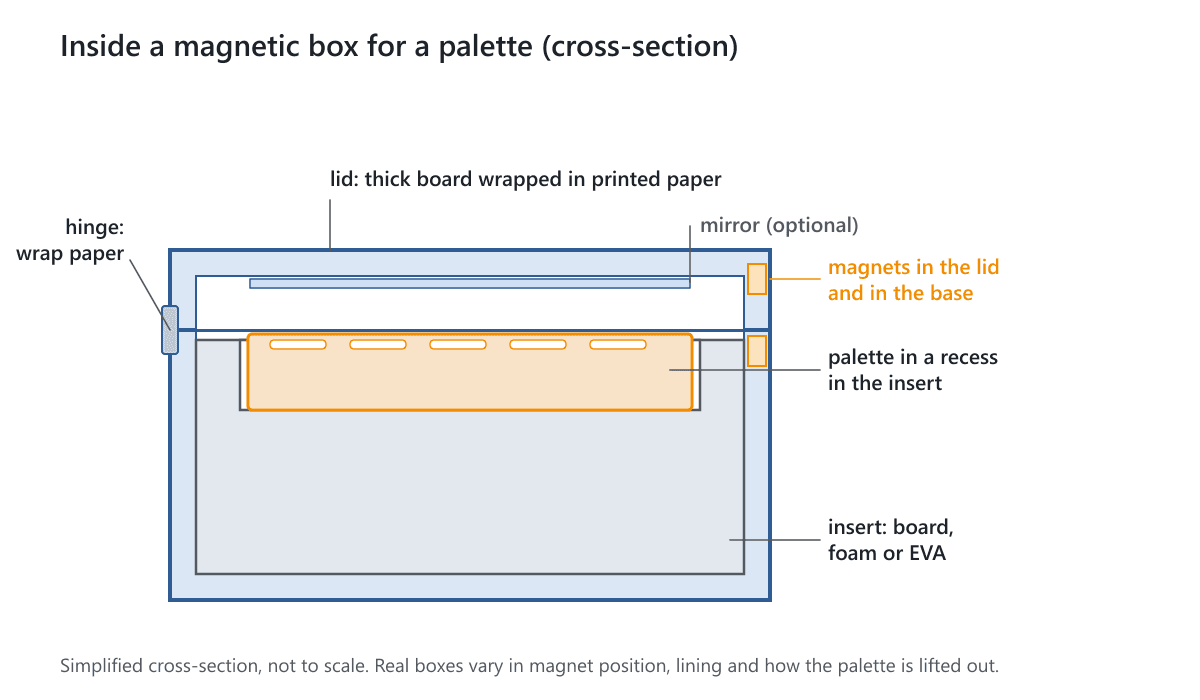
A magnetic box has a hinged lid that closes with small magnets set into the lid and the base. The lid stays shut without a ribbon, a latch or a tuck flap, and opens with a soft click. It is a popular structure for palettes because the box feels solid and the lid lifts open like the palette itself.
What to Decide
- Lid style. A hinged lid opens like a book. A lift-off lid separates fully. Ask for a sample of each to compare the feel.
- Magnet strength. Too weak and the lid pops open. Too strong and shoppers struggle. This is easy to judge in your hand, not on a screen.
- A finger notch or ribbon. A small notch or a ribbon tab helps lift the palette out of the recess.
- Lining. The inside can be printed paper, a solid color or a flocked or textured lining. Ask what is possible for your project.
Magnets add cost and a little weight. Small closure magnets are usually fine in parcels, but check your carrier's rules for magnets, especially for international air shipping.
Inserts and Recesses That Hold the Palette
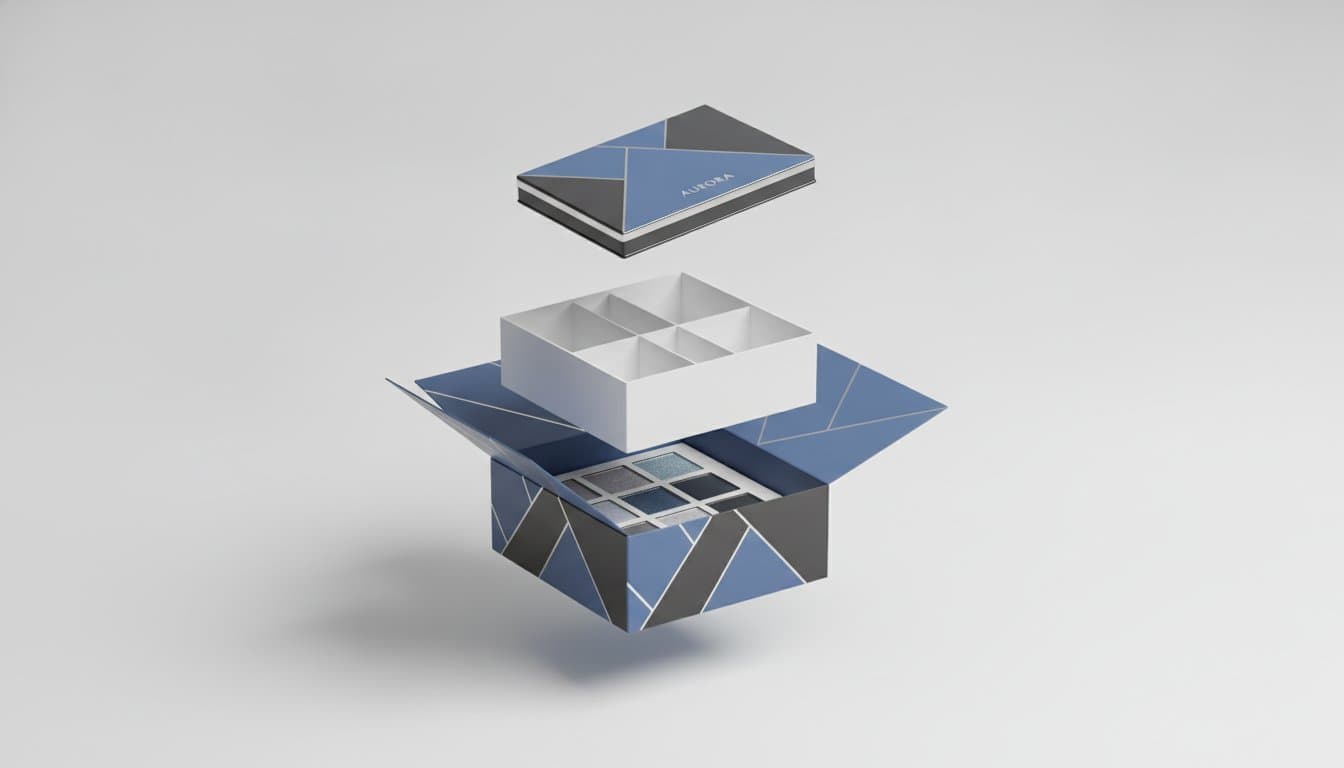
An insert is a shaped piece inside the box. For a palette it is usually a tray with a recess, a shallow pocket the same size as the palette, so the palette sits flat and cannot slide. The recess depth is chosen so the palette sits level with the surface or just above it, and nothing presses on the lid or the pans.
Box inserts can be made from cardboard, molded pulp, foam or plastic. Board gives a clean, paper-based look. Foam or EVA grips more softly and suits heavy compacts. Whichever you choose, the recess should be slightly larger than the palette, so it drops in and lifts out without catching.
Details That Make It Feel Good
- A finger notch on one side, so the palette can be lifted with a fingertip.
- A second layer or pocket under or beside the palette, for a brush, a card or a sample.
- A lid lining that is soft or printed, so the inside looks as good as the outside.
- A mirror in the lid. Some brands ask for one. Ask us whether it is possible for your structure.
Plan the insert first. It uses height, so it changes the inside height of the box. Our inserts checklist lists the choices in detail.
Protecting the Pans in Transit
Pressed powder cracks when it is squeezed, dropped or shaken against something hard. Most damage comes from three causes: pressure on the pan face, impact on a corner, and the palette sliding inside a box that is too big. Each can be reduced with the layers below.
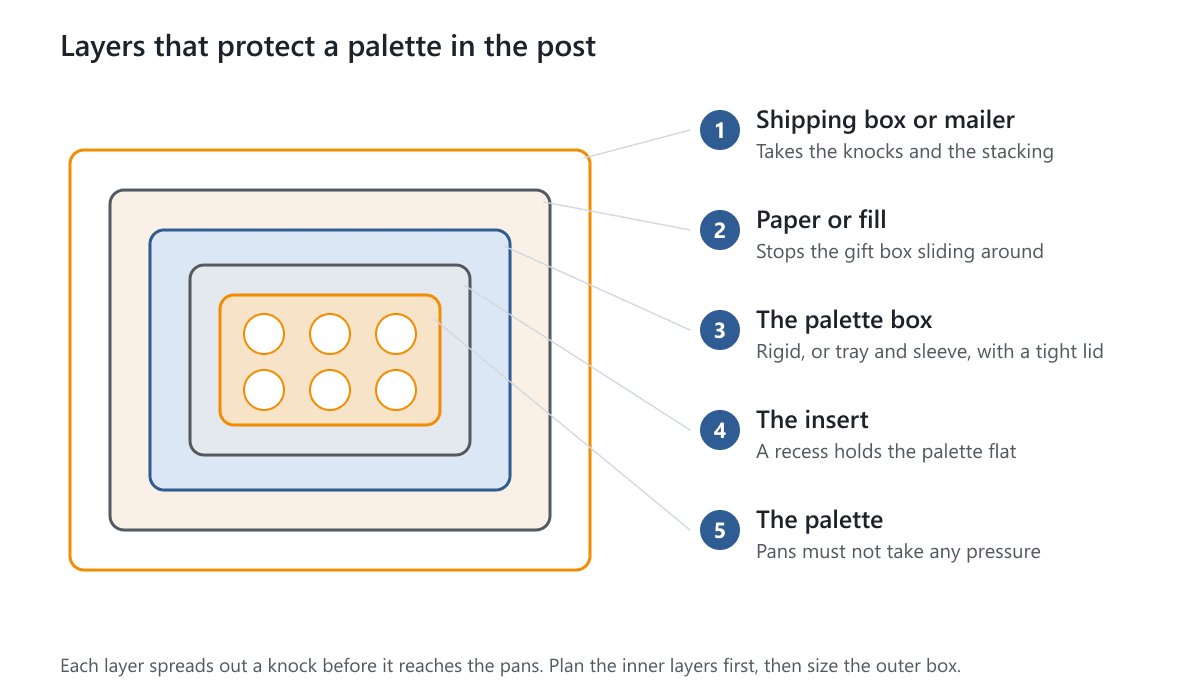
- Hold the palette flat. A recess stops it tilting and sliding.
- Keep the lid off the pans. The gap above the pans must be big enough that nothing touches them when the box is squeezed.
- Fill the empty space. Paper fill or a snug outer box stops the gift box moving. See mailer boxes and shipping boxes.
- Use a strong outer box. The gift box protects the look, and the shipping box protects the parcel.
- Test it. Pack a real palette, drop the parcel from table height, shake it, then open it and look at the pans.
A palette box that is meant to ship alone, without an outer box, needs a thick wall, a fitted insert and a tight, secure lid. Even then, test it.
Printing, Finishes and the Look of the Box
The box is part of the product. Printing is CMYK or Pantone: use Pantone to match one signature color exactly and CMYK for artwork with many colors. See our color systems guide. Matte, glossy, satin and soft touch coatings change the feel. Foil stamping, embossing, debossing and spot UV add detail.
- Soft touch plus foil is a popular pairing for a quiet, premium look.
- Spot UV works well to pick out a pattern on a matte base.
- Embossing suits a bold logo on a thick board. Keep fine details large enough to emboss cleanly.
- Inside print is easy to forget. A pattern or a message under the lid makes the opening feel finished.
If your artwork bleeds off the edge, send it with bleed. See what bleed in packaging means and how much to add. Our varnish vs lamination guide explains the coatings.
Shade Lists, Ingredients and Required Text
A palette carries many shades, and many shade names. The brand is responsible for the text on the pack, including shade names and the ingredient list, and the rules depend on the country. We print the artwork you approve. We do not check it against regulations. Check the current rules for each market you sell in.
Where the Text Can Go
- On the box. Brand and product name on the front, net contents and company details on the back or base.
- Under the lid or in a card. A shade chart with names and numbers is easy to see when the palette is open.
- On a leaflet or insert card. Ingredient lists for many shades can be long. A folded card or a printed card in the box holds them in readable type.
- On a sticker. Batch codes and market-specific text can go on a sticker or label, so you do not reprint the box when they change.
Make the shade names match the pans in the palette and on the chart. A mismatch is a common reason for returns and complaints. Tell us at the start which text must appear and which parts change between batches, and we will leave room for it on the dieline.
Gift Sets and Bundles
A palette often sits in a set with a brush, a lip product or a card. A set changes the structure. You need a second recess or a divider, and the box must be tall enough for the tallest item. A drawer or a rigid box with two compartments is the usual choice. Box dividers can separate items inside a larger box.
If the set will be given as a present, a tissue wrap and a card add to the feel. See our tissue paper page. Keep the weight in mind: a set can be heavy, so check the outside size and weight with your carrier before you decide on the box.
What Changes the Price and the Minimum
Rigid boxes cost more than folding cartons because they are built from thick board and wrapped by hand. Magnets, ribbon pulls, fitted inserts and extra finishes add to the cost. Quantity helps, and price falls as it grows. Every product page shows a starting price per unit, and your quote shows the full price with shipping included to the US and Canada. Taxes and duties are not included. Our packaging cost guide covers the cost drivers.
Minimums depend on the product, and each product page states its own. Rigid boxes have a low minimum, and most other boxes start at 100. Production takes 5 to 7 working days after artwork approval and payment. Larger or more complex orders can take longer, and we confirm the date in your quote. Delivery time is added on top.
A structural sample is an unprinted prototype that shows the size and form of the box, and it is the best way to check the fit. The Standard Sample Kit costs $50, shipping included, but it may not include rigid boxes or boxes that ship assembled, so ask us about rigid samples. See the samples page for every option.
Three Example Scenarios
These are invented, to show how the choices play out. They are not customers.
A Small Brand, a Premium Launch
A small brand launching one 12-pan palette in a run of 300 could choose a rigid box with a magnetic lid, a board insert with a recess and one foil logo. The structure feels premium without extra finishes, and the insert protects the pans.
A Slim Palette at a Lower Price
A brand selling a thin 6-pan palette at a lower price point could use a tuck box with a tray insert, packed in a mailer for online orders. The carton is light and ships flat, and the mailer handles the transit.
A Holiday Set
A brand packing a palette with a brush and a mini lip product could use a tray and sleeve box with two compartments and a seasonal sleeve. The tray stays the same all year, and only the sleeve changes.
Common Mistakes
- Measuring the palette open, or without the latch or mirror.
- Making the recess too deep or too shallow, so the lid presses on the pans.
- Choosing a folding carton for a heavy palette that will ship alone.
- Skipping an outer box and relying on the gift box to survive the post.
- Using strong magnets without testing how the lid feels to open.
- Not leaving room for the shade list, ingredients and batch code.
- Letting the shade names on the chart differ from the pans.
- Judging the color of the box or the foil from a screen.
Checklist Before You Order
- Palette length, width and closed thickness, with the latch and hinge.
- Weight of the palette and of the full set.
- Box type and lid style, and a sample of the closure.
- Insert type, recess depth and finger notch.
- Finishes and brand colors, with Pantone numbers if you have them.
- Shade list, ingredients and other text, and where each will go.
- Shipping method, outer box and fill.
- Quantity for the first run.
Next Steps
Tell us your palette size, how it will be sold and shipped, and how many you need. We reply within 1 business day and offer free design support. You can get a free quote, start from a free dieline template, or look at our cosmetic packaging page for related products.
Frequently Asked Questions
What is the best box for an eyeshadow palette?
For most premium palettes, a rigid box with a magnetic lid and a recess in the insert. It does not flex, so it protects the pans and feels solid. For slim or lower-priced palettes, a tuck box with an insert or a tray and sleeve box is often enough.
How do I stop eyeshadow pans breaking in shipping?
Hold the palette flat in a recess, keep the lid clear of the pans, fill empty space and use a strong outer box. Then test with a real palette: drop the parcel from table height, shake it and open it. Pressed powder cracks under pressure and impact, so each layer helps.
What size should an eyeshadow palette box be?
It depends on the palette. A standard 12-pan palette is often about 5 to 7 inches long, 4 to 5.5 inches wide and 0.5 to 0.9 inch thick, but sizes vary a lot. Measure yours closed, add about 1/8 inch of clearance on each side and the insert, and send us the inside size.
Do magnetic boxes need an outer shipping box?
For parcels, usually yes. A rigid magnetic box protects well, but corners can dent and a parcel can be squeezed. An outer mailer or shipping box with paper fill adds protection. Test your own packed parcel.
Can I add a mirror to the box lid?
Some brands do, but it depends on the structure. Ask us whether it is possible for your project. Many palettes already carry their own mirror, so check whether you need a second one.
What text goes on an eyeshadow palette box?
Typically the product name, shade names, net contents, ingredients, any warnings, company details and a barcode. Rules depend on the country, and the brand is responsible for the wording. Send us the final text and we will leave room for it.
What is the minimum order for custom palette boxes?
Rigid boxes have a low minimum, and most other boxes start at 100. Each product page states its own minimum, and we confirm it in your quote.
Written by the PacksDo Team
We make custom printed packaging, from boxes and mailers to bags, labels and inserts. Questions about this guide? Ask us.