In this article
A lipstick box is a small, tall carton that holds one tube upright. For most brands, the best starting point is a printed tuck box with a platform insert that keeps the tube from moving. A sleeve, a drawer box or a rigid box suits sets and gifts. The right size comes from measuring your tube with its cap on, then adding about 1/8 inch of clearance on each side.
This guide is about lipstick boxes only. It covers tube sizes, box styles, inserts, windows, finishes, shade labels, sets and shipping, with worked numbers and common mistakes. For the wider view of beauty packaging, read our cosmetic packaging boxes guide. For palettes, see our eyeshadow palette packaging guide. You can also browse our lipstick boxes page.
Key takeaways
- Measure the tube, cap included. The cap is often wider than the body, so use the widest point.
- A tuck box with an insert covers most needs. It is light, ships flat and prints on every panel.
- The insert matters more than the carton. A tube that rattles or leans looks cheap and can scuff.
- Plan the shade system early. One printed box per shade, or one blank box plus a shade sticker, changes cost and flexibility.
- Keep text and codes on the plan. Barcode, net contents and batch code need space, and the brand supplies the wording.
- Test a sample. Check fit, closing, and how the finish feels before a full run.
Measure the Lipstick Tube First
Lipstick tubes are not standard. They vary in height, width and shape, so a box made for one brand's tube may not fit another's. Start by measuring the tube you actually use, filled and with its cap on.
The ranges below are typical, to help you check your numbers. They are not specifications. Always measure your own tube.
| Product | Typical height with cap | Typical width | Notes |
|---|---|---|---|
| Bullet lipstick (round) | 2.5 to 3.5 in (65 to 90 mm) | 0.7 to 1.0 in (18 to 25 mm) | Cap is often the widest part |
| Square or slim lipstick | 2.5 to 3.5 in (65 to 90 mm) | 0.7 to 1.0 in per side | Needs a square cutout in the insert |
| Lip balm stick | 2 to 3 in (50 to 75 mm) | 0.6 to 0.8 in (15 to 20 mm) | Often lighter, sometimes paper or plastic |
| Lip gloss tube or wand | 3.5 to 4.5 in (90 to 115 mm) | 0.6 to 0.9 in (15 to 23 mm) | Longer and slimmer, may have a doe-foot wand |
| Liquid lipstick vial | 3 to 4.5 in (75 to 115 mm) | 0.6 to 0.9 in (15 to 23 mm) | Check the cap and any collar |
How to Measure
- Height: from the base to the top of the cap, with the cap closed.
- Width: at the widest point. If the tube is round, measure the diameter. If it is square or oval, measure both sides.
- Weight: a metal tube is heavy, and weight changes how much the insert has to hold.
- Shape details: collars, ridges, a clip or a magnet on the cap all add to the size.
- Three tubes, not one. Tubes vary a little, so use the largest numbers.
Our measuring guide explains inside and outside dimensions and why board thickness matters, which is small for a paperboard carton and larger for a rigid box.
A Worked Example
This is an invented example. A round tube is 0.85 inch across and 3.0 inches tall with the cap on. With 1/8 inch (0.125) of clearance on each side, the inside is 0.85 + 0.25 = 1.1 inches wide in both directions. For the height, add a platform insert of 0.35 inch under the tube and 0.15 inch of headroom above the cap: 0.35 + 3.0 + 0.15 = 3.5 inches. The inside size is 1.1 x 1.1 x 3.5 inches.
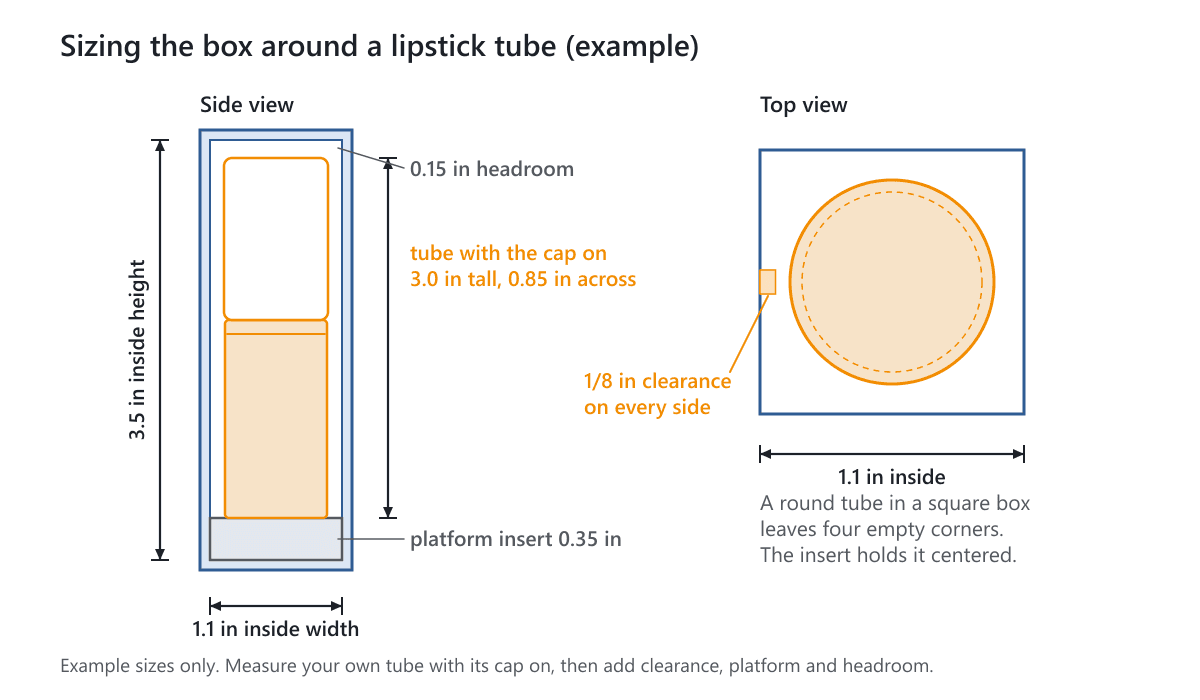
A paperboard carton has thin walls, so the outside is only slightly bigger. A rigid box wall is several millimeters thick, so the outside grows more. Check a pattern at that size with our free straight tuck end dieline template.
Which Box Style Suits a Lipstick?
Four structures cover nearly every lipstick box. They differ in feel, protection and cost, as the table shows.
| Style | Feel | Protection | Ships flat | Best for |
|---|---|---|---|---|
| Tuck box | Light, simple, clean | Good with an insert | Yes | Single tubes, retail shelves |
| Sleeve over a tray | Layered, slightly premium | Good, tray holds the tube | Usually, if the tray is foldable | Limited editions, sets |
| Drawer box (tray and sleeve) | Slide-open reveal | Good, tray is part of the pack | Foldable versions yes | Duos, trios, gifts |
| Rigid box | Heavy, solid, premium | Very good | Usually no | Luxury lines, gift sets |
Tuck Boxes: Straight or Reverse
A tuck box closes with a flap that tucks into the front. In a straight tuck end box, both flaps hinge from the same panel, so they fold in the same direction. In a reverse tuck end box, the flaps hinge from opposite panels, so they fold in opposite directions. Our free dieline templates for straight tuck end and reverse tuck end show both patterns flat.
Sleeves, Drawers and Rigid Boxes
A packaging sleeve wraps a plain tray or carton and lets you change the outside look cheaply, for example for a seasonal shade. A tray and sleeve box slides open like a drawer, and suits sets because the whole display is revealed. For the heaviest feel, rigid boxes use board of 800 to 2000gsm wrapped in printed paper, with a lift-off or magnetic lid.
Inserts That Hold the Tube Upright
A lipstick bullet is soft and the cap is usually held on by friction or a light click, so a tube knocking around in a box can scuff the print, loosen the cap or crush the bullet. An insert stops that. Four layouts are common.
- Platform. A raised ledge that the tube stands on, with space under it. It keeps the tube upright and centered. Simple and cheap.
- Collar. A ring of board around the tube. It grips the body and keeps the tube from leaning.
- Tray with cutouts. A flat piece with holes for each tube. This is the usual layout for sets.
- Fitted cavity. A recess shaped to the tube, often in foam or a deeper board tray, for rigid boxes.
Box inserts can be cardboard, molded pulp, foam or plastic. Cardboard is paper-based and usually the lightest. Foam grips most tightly. Whatever you choose, make the cutout a little larger than the tube so it slides in and out without catching.
One practical point: lipstick can soften in heat. If your product ships in warm months, think about shade, shipping route and storage, and ask the formulator what temperatures the product handles.
Windows, Foil and Spot UV
A small box has little space, so every treatment has to earn its place. Pick one or two.
Windows
A window is a cut-out in the box, often covered with a clear film (window patching). On a lipstick box it shows the tube or the bullet color. The trade-offs: it adds a step and cost, and it exposes the product to light and handling. A color shown through a window will also look different from a printed swatch.
Foil, Embossing and Spot UV
Foil stamping adds a metallic line or logo. Embossing raises a shape in the board. Spot UV adds a glossy coating in chosen areas. On a narrow box, keep these bold and simple, and leave space around them. Very fine lines may not stamp or emboss cleanly. For a quiet premium look, a soft touch coating in one solid color with a single foil logo is hard to beat. Our varnish vs lamination guide explains the coatings.
Color
If your brand has one signature color, ask for a Pantone match. If your box shows a range of shades, CMYK builds them from four inks. See our color systems guide. Printed shades will not match a real lipstick exactly, so treat a printed swatch as an indication, not a promise, and check proofs in person.
Shade Names, Labels and Stickers
If you sell several shades, you need a system for telling them apart. There are three common ways to do it.
| Method | How it works | Good for | Watch for |
|---|---|---|---|
| A printed box per shade | Each shade has its own artwork | Established lines, large volumes | Several artwork files, more stock to manage |
| One box plus a shade sticker | Same box for every shade, a sticker or label names it | Launches, many shades, small runs | Stickers must be applied by hand or by your packer |
| A color band or end panel | A printed area on the box matches the shade | Quick visual identification | Printed colors vary, and each color needs its own file |
Stickers and labels start at 500 units, so a sticker system also needs a larger first order of stickers than of boxes. Ask us whether several shades can be printed in one run, and how that changes the minimum.
Required Text
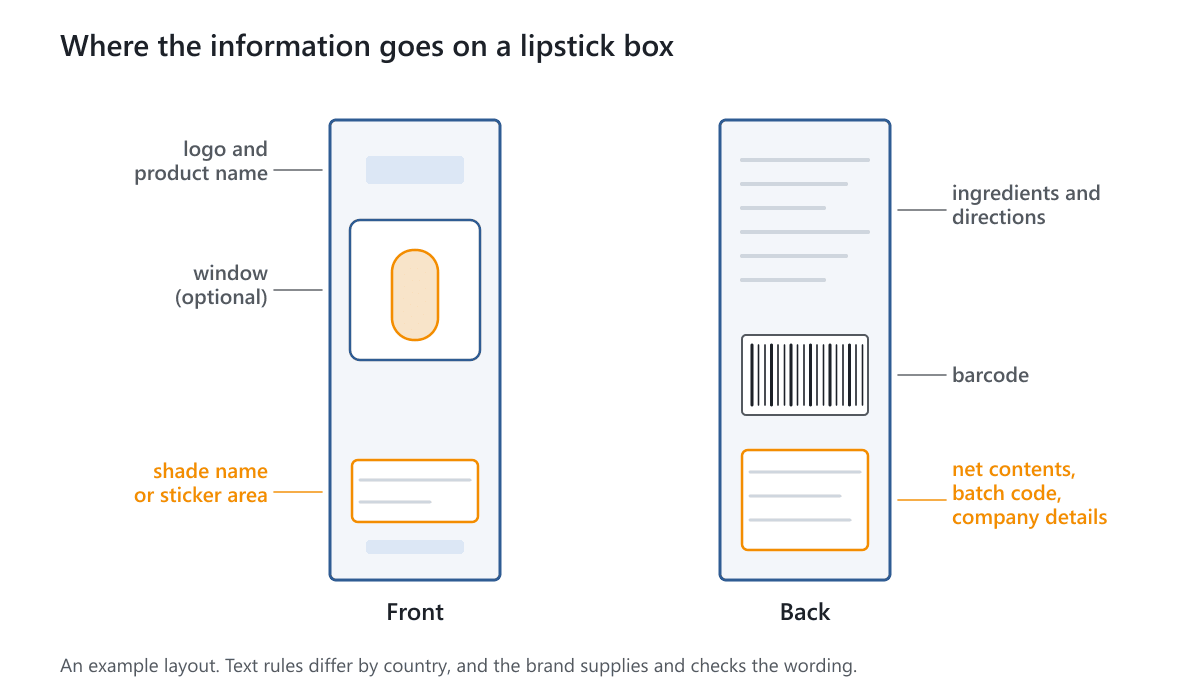
A lipstick box usually carries the product name, net contents, ingredients, directions or warnings where needed, a barcode, a batch code and company details. The exact rules depend on the country, and the brand is responsible for the wording. We print what you approve, so send us the final text and tell us which items change between batches. Leave room for the barcode on a flat, uncurved panel.
Single Boxes vs Sets and Gift Sets
A set changes the structure. Tubes standing in a row need an insert with a cutout for each one, and the box must be tall enough for the cap. Tubes lying flat need a shallower tray, but the box is longer. Either layout needs arithmetic, and the picture shows an example for three tubes.
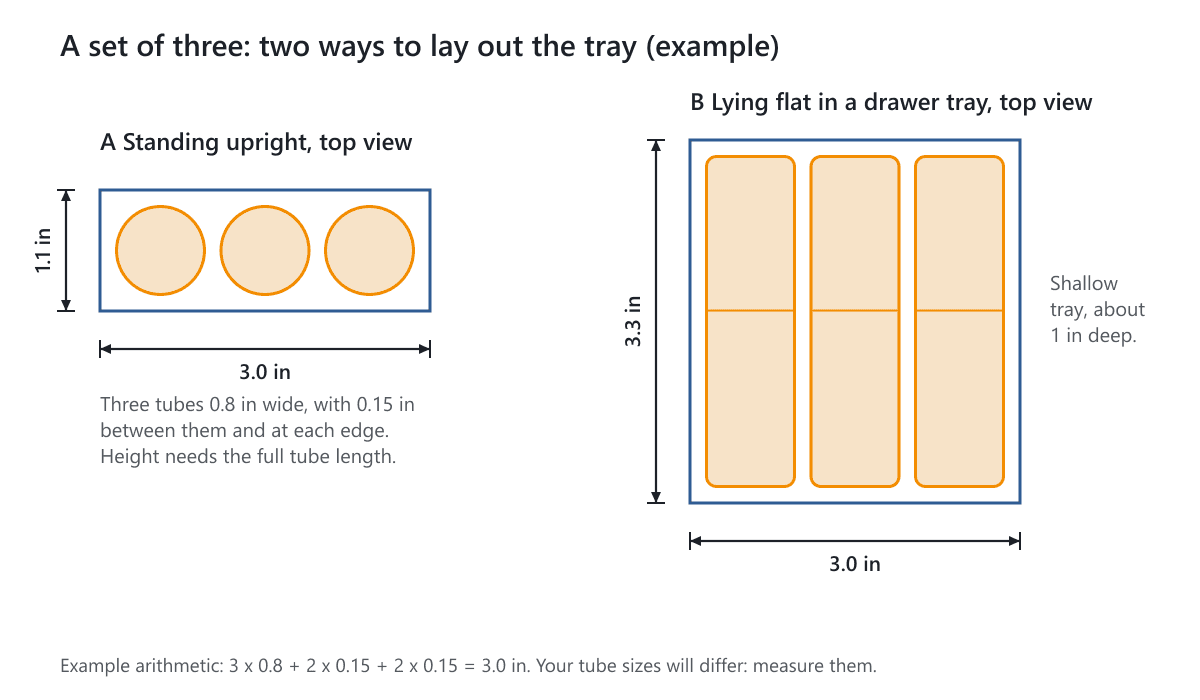
In the example, three tubes are 0.8 inch wide, with 0.15 inch between tubes and at each edge: 3 x 0.8 + 2 x 0.15 + 2 x 0.15 = 3.0 inches. Standing in a row, the box is 3.0 inches long and 1.1 inches deep. Lying flat in a tray, the box is 3.0 inches wide and about 3.3 inches long. Your numbers will differ, so measure your tubes.
For a gift set, a tray and sleeve box or a rigid box with a fitted tray feels more special. If you want a two-part look that ships flat, ask about a two piece foldable box. A thank-you card or a short note can sit under the tubes or in a pocket in the lid.
Shipping Lipstick Boxes
A lipstick carton is thin and light, so it is not built to travel alone. A boxed tube in a loose padded bag can be crushed. Better options are a mailer box sized to the carton, or a shipping carton with the cartons packed snugly and a little paper to stop movement.
For online orders, treat the printed carton as part of the product, and use a stronger outer box for protection. Carriers price by size and weight, so check the outside size of the packed box. Our packaging cost guide explains how size affects price.
Three Example Scenarios
These are invented, to show how the choices play out. They are not customers.
A New Brand With Six Shades
An indie brand launching six shades with 300 units each could order one printed tuck box, the same for every shade, with a platform insert, and put a shade sticker on the end panel. One artwork file, one dieline, flexible stock. The trade-off is that someone has to apply the stickers.
A Duo for the Holidays
A brand selling a lipstick and a matching liner as a gift could use a tray and sleeve box with a two-cutout insert and a foil logo. The sleeve can carry seasonal artwork, and the tray can stay plain.
A Premium Single With a Window
A luxury line with one hero shade could use a rigid box with a magnetic lid and a fitted tray, or a tuck box with a window patch and spot UV. The rigid box feels heavier and ships separately. The window carton is lighter and lets the shade show.
Common Mistakes
- Measuring the tube without its cap, then finding the box is too short.
- Making the inside too tight, so the tube scuffs the print each time it goes in.
- Making the inside too loose, so the tube rattles and tilts.
- Forgetting that a round tube leaves empty corners in a square box, and no insert to fill them.
- Putting a barcode on a fold or over a window.
- Putting fine foil lines on a narrow panel.
- Ordering several shade boxes before testing one.
- Judging the shade color from a screen, not a printed proof.
Checklist Before You Order
- Tube height, width and shape, measured with the cap on.
- Inside size you want, and whether it includes an insert.
- Single, duo or set, and the layout (standing or lying).
- Shade system: separate boxes, stickers or color bands.
- Finishes: one or two, with artwork that suits them.
- Text, barcode and batch code, and where each will go.
- Quantity per shade and for the first run.
Next Steps
Send us your tube measurements, how many shades you have and how the product will be sold. We reply within 1 business day and offer free design support. Most boxes start at 100 units and rigid boxes have a low minimum, and each product page states its own minimum. Production takes 5 to 7 working days after artwork approval and payment, longer for large orders. You can get a free quote or order the Standard Sample Kit for $50, shipping included, to feel the boxes first. It may not include rigid boxes, so ask us about rigid samples.
Frequently Asked Questions
What size is a lipstick box?
It depends on the tube. A typical bullet lipstick is 2.5 to 3.5 inches tall and 0.7 to 1.0 inch across, so the box inside is often about 1.1 x 1.1 x 3.5 inches for a mid-range tube. Measure your own tube with its cap on, then add about 1/8 inch of clearance on each side.
What is the best material for lipstick boxes?
Most are printed on white or brown kraft paperboard, typically 300 to 400gsm. Rigid boxes use thick board, 800 to 2000gsm, wrapped in printed paper. Paperboard keeps costs low and ships flat; rigid board feels more premium.
Do lipstick boxes need an insert?
Usually yes. A platform, collar or cutout keeps the tube upright and stops it scuffing the print or loosening the cap. A very snug tube in a small carton may not need one, but test it with a sample.
Can I use one box for all my shades?
Yes. Many brands print one box and add a shade sticker or a printed label. This keeps one artwork file and flexible stock. Stickers and labels start at 500 units, so plan the sticker order with the box order.
What is the difference between a straight tuck and a reverse tuck box?
In a straight tuck end box, both flaps hinge from the same panel and fold in the same direction. In a reverse tuck end box, the flaps hinge from opposite panels and fold in opposite directions. Both are paperboard cartons that ship flat.
Can I add a window to a lipstick box?
Yes. Window patching adds a clear film over a cut-out so shoppers can see the tube. It adds a step, so it costs more than a plain carton, and it shows the product to light and handling.
What text must be on a lipstick box?
It depends on the country, but usually the product name, net contents, ingredients, any warnings, company details and a barcode. The brand is responsible for the wording. Send us the final text and we will leave space for it.
Written by the PacksDo Team
We make custom printed packaging, from boxes and mailers to bags, labels and inserts. Questions about this guide? Ask us.