In this article
- 1What Paperboard Is
- 2White (SBS) or Brown Kraft: Which Paperboard?
- 3Thickness: GSM, Points and Caliper
- 4Coatings: Protecting the Print
- 5Finishes: How the Surface Looks and Feels
- 6Printing on Paperboard: CMYK and Pantone
- 7Strength Limits: When to Move to Corrugated or Rigid
- 8Shelf Considerations for Retail Cartons
- 9Recycling, in General Terms
- 10A Material Decision Table
- 11Test the Board Before You Commit
- 12Common Mistakes
- 13Next Step
Paperboard cartons are boxes made from solid paperboard, a stiff, paper-based board that is much thicker than printer paper. Ours are typically 300 to 400gsm, in white (SBS) or brown kraft. White gives the brightest color, kraft gives a natural look, and the thickness should match the weight of what goes inside.
This guide is about the material. It explains what paperboard is, how white and kraft differ, how to read gsm and caliper, what coatings and finishes do, how printing behaves on each board, and when a carton is the wrong choice and corrugated or rigid is better. It ends with a decision table you can copy.
Looking for something else? Our guide to folding cartons covers styles and ordering, the size guide covers measuring, and the tuck box guide covers the most common style.
Key takeaways
- Paperboard is thick, paper-based board. For cartons we offer 300 to 400gsm, in white (SBS) or brown kraft.
- White is for color, kraft is for a natural look. Kraft is brown, so it suits simple one or two color designs.
- Thickness follows weight. Bigger or heavier cartons need heavier board, and a lock bottom helps with weight.
- Coatings protect, finishes change the feel. Varnish and lamination protect the print. Matte, satin, glossy and soft touch set the look.
- Know the limit. Paperboard is for the shelf. If a pack ships alone or should feel like a gift, look at corrugated or rigid.
What Paperboard Is
Paperboard is made from wood pulp pressed into layers, which makes it stiffer and thicker than paper. Definitions vary, but board usually starts at around 250gsm. Gsm means grams per square meter, so a higher number is a heavier, thicker sheet. Printer paper is typically 80 to 100gsm.
The words people use are confusing, so here is a short glossary.
- Paperboard. Solid board, used for folding cartons. This is what this guide is about.
- Cardboard. An everyday word that usually means corrugated board, the kind used for shipping boxes.
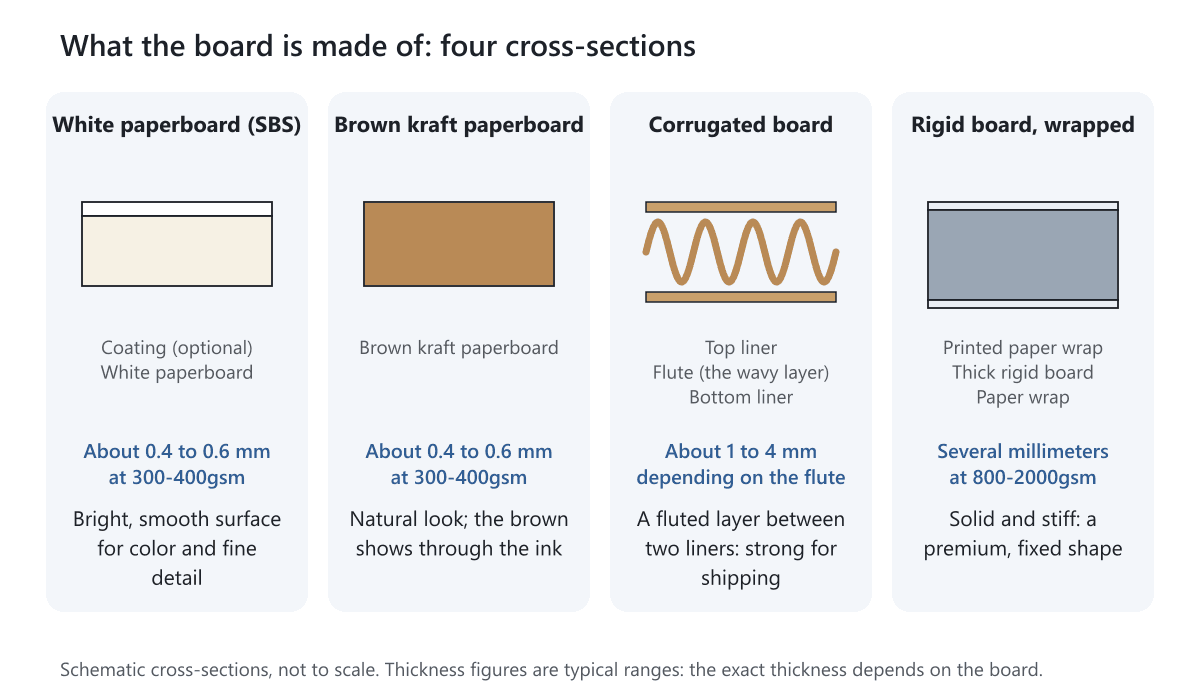
- Corrugated board. A fluted layer between two flat liners. It is thicker and stronger than paperboard.
- Chipboard. A coarse, often recycled board. Different suppliers use the word for different things, so ask what is meant. Rigid boxes use a thick board inside the paper wrap.
A paperboard carton, then, is a single layer of solid board that is printed, cut, creased and folded. The drawing below shows how it compares with corrugated and rigid board.
White (SBS) or Brown Kraft: Which Paperboard?
SBS stands for solid bleached sulfate. It is made from bleached wood fiber, so it is bright white and smooth. That surface holds fine detail and strong color, which is why it is the usual choice for cosmetics, supplements and anything with photos. Kraft is made from unbleached fiber, so it keeps its natural brown color. It gives a warm, earthy look but changes how ink appears.
| White (SBS) | Brown kraft | |
|---|---|---|
| Look | Bright white, smooth | Natural brown, a little textured |
| Color printing | Colors look true and bright | Colors look darker and muted, since the brown shows through |
| Best designs | Full color, photos, gradients | Simple one or two color designs, black or white ink |
| Brand feel | Clean, modern, premium | Handmade, natural, earthy |
| Watch for | Shows scuffs on dark ink, so coat it | Little room for bright colors |
A rule of thumb: if you need bright brand colors, use white. If you want the board itself to be part of the look, use kraft. Other grades exist, such as boards with a recycled core and a gray back, and recycled stock options are available on request.
Not sure how the board feels in the hand? The Standard Sample Kit costs $50, shipping included, and lets you compare boards and finishes yourself.
Thickness: GSM, Points and Caliper
Three terms describe how heavy or thick a board is, and they are easy to mix up.
- GSM is weight: grams per square meter. We quote carton board at 300 to 400gsm.
- Caliper is thickness. In packaging it is usually written in points, where 1 point is 0.001 inch (0.0254 mm). A 16 point board is about 0.4 mm thick.
- Stiffness is how much the board resists bending. It depends on thickness far more than weight.
Gsm and caliper do not convert exactly, because some boards are bulkier than others at the same weight. As a rough guide, 300 to 400gsm carton board is about 0.4 to 0.6 mm thick. Ask for the caliper if the thickness matters to your design.
Stiffness rises quickly with thickness. In simple terms, doubling the thickness of a flat board makes it about eight times as stiff. That is why a small step up in board can make a carton feel solid. The cost is that thicker board is harder to fold, can crack at creases more easily and uses more material.
Matching Thickness to the Product
Use the table as a starting point, then test it with a sample. Larger cartons usually need heavier board than small ones, even for light products, because a big flat panel flexes more.
| Product | Board approach | Extra help |
|---|---|---|
| Very light: lip balm, sachets, tea | Lower part of 300 to 400gsm | A tuck end is usually enough |
| Light: soap bar, small bottle, cosmetics | Middle of the range | A snug fit and a coating for scuffs |
| Medium: tall bottles, 4 oz jars | Middle to upper part of the range | An insert if fragile, a lock bottom if it feels bottom-heavy |
| Heavy: glass candle jar | Upper part of the range | A lock bottom, then test with a sample. Consider corrugated if it still sags |
These are not fixed limits. When we see your size and weight, we recommend the board.
Coatings: Protecting the Print
Paperboard scuffs and absorbs moisture, so printed cartons are normally coated. A coating is a thin protective layer over the print. There are two main choices.
- Varnish. A water-based coating. It guards against scratches and scuffs, and it adds the least material. It is not as protective as lamination.
- Lamination. A thin film bonded to the board. It protects more against cracks, tears and handling, but it adds plastic, which can make recycling harder.
Use varnish when the carton just needs light protection, and lamination when it will be handled a lot, packed in bulk or shipped. Our varnish vs lamination guide compares them in more detail.
Uncoated board, especially kraft, feels natural, but it marks easily and takes up moisture. It suits dry, low-handling products.
Finishes: How the Surface Looks and Feels
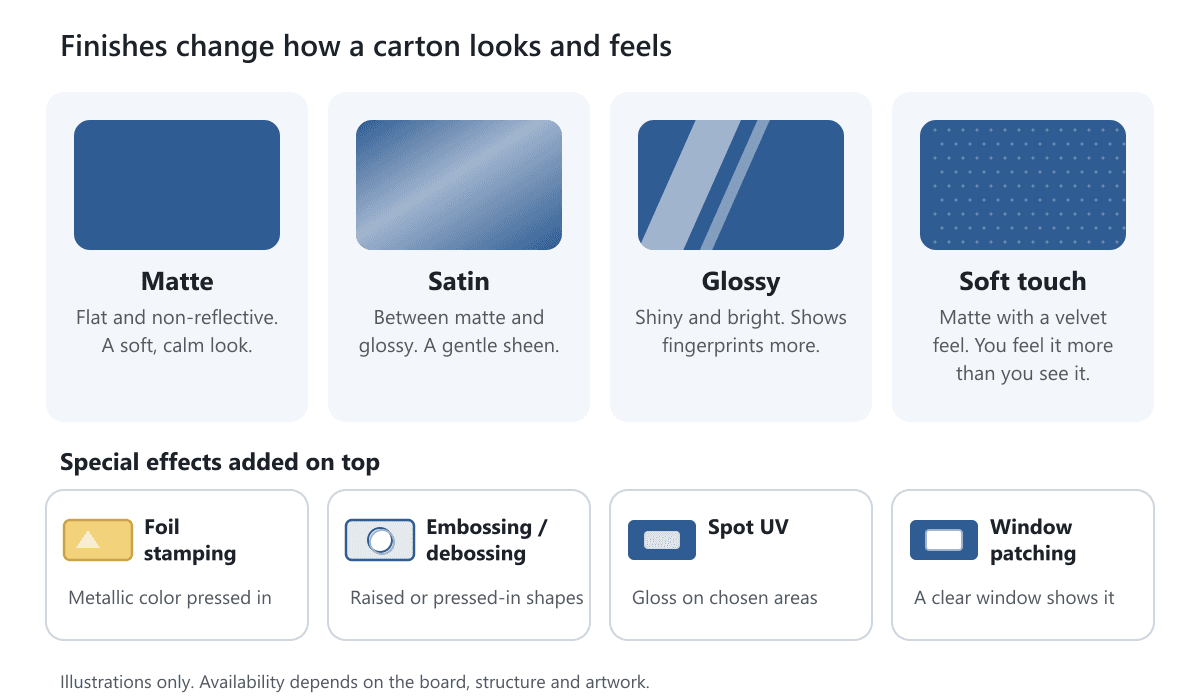
The finish sets how the coating reads to the eye and the hand. You pick it with the coating.
| Finish | Look | Feel | Good for |
|---|---|---|---|
| Matte | Flat, non-reflective | Smooth | A calm, modern look. Hides glare under shop lights |
| Satin | Soft sheen | Smooth | A middle path between matte and glossy |
| Glossy | Shiny, deep color | Slick | Bold color. Shows fingerprints more |
| Soft touch | Matte | Velvet-like | Premium cosmetics and gifts, where touch matters |
Special Effects: Foil, Emboss, Spot UV and Windows
- Foil stamping. A metallic layer pressed onto chosen areas, often a logo.
- Embossing and debossing. A shape pressed up or down, so you can feel it.
- Spot UV. A glossy coat on selected areas, such as a logo, against a matte background.
- Window patching. A cutout covered with clear film so the product shows.
Each effect adds cost and steps. Use one or two on purpose. A matte carton with a single foil logo often looks richer than a carton with every effect at once. Foil, thick coatings and plastic window film can also make recycling harder, so weigh that if recyclability matters to you.
Printing on Paperboard: CMYK and Pantone
We print in CMYK or Pantone. CMYK builds color from four inks, cyan, magenta, yellow and black, and it is the usual choice for photos and designs with many colors. Pantone mixes a specific ink for one exact color. It suits a brand color that must match every time, and it is the more premium option.
Board changes how a color looks, so ask for a printed proof or sample when color matters. White board shows color as intended. Kraft makes colors darker. Design in CMYK, not RGB, because screen colors can shift when printed. Our color systems article explains the difference, and our guide to what bleed is covers how far the color should extend past the cut.
Strength Limits: When to Move to Corrugated or Rigid
Paperboard is a retail material. It holds its shape on a shelf and gives a clean print surface, but it is not built to take the load of a parcel network, and it does not cushion a drop. The drawing shows how to decide.
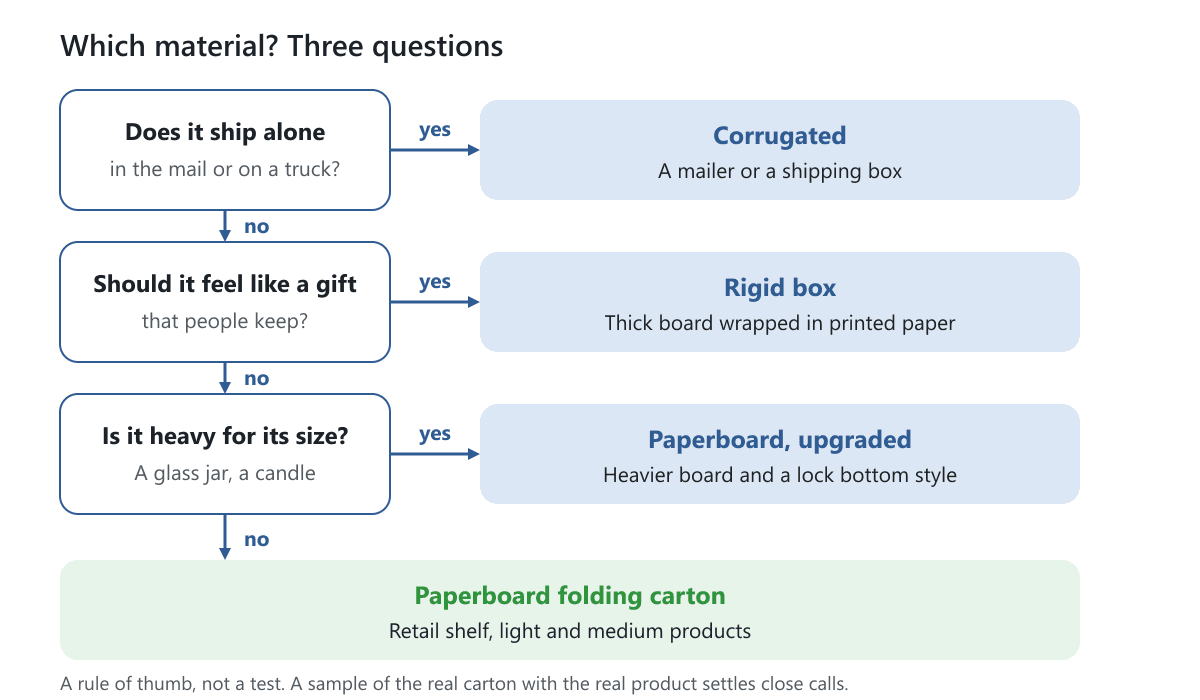
- It ships by itself. Corrugated board is built for shipping. See our mailer boxes and corrugated packaging.
- It should feel like a keepsake. A rigid box is thick board wrapped in printed paper, and it keeps its shape.
- It is heavy or fragile. Try heavier board and a lock bottom first. If the carton still sags, move up.
- It will be stacked or handled hard. Corrugated outer boxes protect cartons in transit.
Moving up has trade-offs. Corrugated and rigid cost more and take more space to store. A rigid box does not always ship flat. Our rigid boxes vs folding cartons article compares them, and the two piece foldable box sits between a carton and a rigid box.
Shelf Considerations for Retail Cartons
A carton on a shelf has a different job from one in a drawer. Check these points.
- Stability. A tall, narrow carton can tip over. A wider base or a lock bottom helps.
- Hang or stand. A hang tab or hanger suits peg displays. See the features on our tuck boxes page.
- Information. Your product may need ingredients, weight, barcodes and warnings. Leave space, keep them legible and away from creases, and check the rules that apply to your product.
- Light and glare. Glossy finishes reflect shop lighting and can hide text. Matte or satin reads more easily.
- Handling. Shoppers pick products up. A soft touch or varnish resists marks.
- Shelf size. Some retailers set maximum sizes, so check before you finalize the dimensions.
Recycling, in General Terms
Paper and board are among the most widely collected materials, and plain paperboard without plastic film is generally the easiest to recycle. Coatings, laminations, foils, window film, adhesives and food residue can make recycling harder, and rules differ by town. Check what your local program accepts.
About our cartons, we can say they are paper-based and that recycled stock options are available on request. A finished pack can be recyclable where local facilities accept it, depending on the board, inks, coatings and adhesives. If recycling matters to you, say so at the quote stage and tell us what you need, and we confirm the options. Our guide to eco-friendly packaging materials and the one on whether cardboard gets recycled go further.
A Material Decision Table
Use this as a starting point and confirm it with a sample.
| Your situation | Board | Coating | Finish |
|---|---|---|---|
| Bright brand color, cosmetics or supplements | White (SBS) | Varnish or lamination | Matte or soft touch |
| Natural, handmade look | Brown kraft | Varnish, or leave it plain | Matte |
| Heavy product on a shelf | Upper part of 300 to 400gsm | Lamination for handling | Matte or satin |
| Premium gift | White, or a rigid box | Lamination | Soft touch, plus foil or emboss |
| Ships alone to customers | Corrugated mailer | Varnish or none | Matte |
| Recycling matters | Plain board, ask for recycled stock | Varnish rather than plastic film | Simple, few effects |
Test the Board Before You Commit
Specs on paper only go so far. Hold the board, fold it, scuff it and fill it.
- Feel the thickness. Bend a corner and see if it holds.
- Check the color. Compare the printed color with your brand color in daylight and shop light.
- Rub it. Test how the coating handles scuffs and fingerprints.
- Fill it. Put the real product in and stand the carton on its end.
- Ship it. Send a filled sample the way it will really travel.
A structural sample is an unprinted prototype that shows size and form. The Samples page lists every type, including proofs that show print.
Common Mistakes
- Choosing kraft for a design with bright colors.
- Choosing board by price alone, then finding it sags.
- Using glossy finish on a carton with a lot of small text.
- Adding every special effect instead of one that matters.
- Using a folding carton as a shipping box.
- Assuming a coating is recyclable without asking.
- Skipping a sample.
Next Step
Tell us what you are packing, its weight, how it will be sold and how many you need, and we will recommend a board, a coating and a finish. Minimums depend on the product, and most folding cartons start at 100 units. We offer free design support and reply within 1 business day. Get a free quote, or open the folding carton page to see styles.
Frequently Asked Questions
What is the difference between paperboard and cardboard?
Paperboard is solid board used for folding cartons. People often say cardboard to mean corrugated board, which has a fluted layer between two liners and is used for shipping boxes. The words are not exact, so say which one you need.
What is the difference between paperboard and chipboard?
Chipboard is a coarse, often recycled board, and suppliers use the word in different ways. Paperboard cartons use a smoother board that prints well. If a quote says chipboard, ask what grade it is and what it is used for.
What thickness should my carton be?
Our folding carton board is typically 300 to 400gsm, roughly 0.4 to 0.6 mm thick. Light products suit the lower end, and heavy or large cartons need the upper end. Tell us the size and weight, and we recommend the board.
Can paperboard cartons be used for shipping?
Not on their own. Paperboard is made for retail shelves, not for parcel networks. Put filled cartons in a corrugated shipper or choose a mailer box for products that ship alone.
Are paperboard cartons recyclable?
Paper-based cartons can be recyclable where local facilities accept them. Plain board is the easiest to recycle. Plastic laminations, foils, windows and some adhesives can make recycling harder, and rules differ by town. Recycled stock options are available on request.
Which is better, white or kraft paperboard?
Neither is better. White suits bright, full-color designs. Kraft suits a natural look with simple one or two color designs. The brown of kraft shows through the ink and darkens colors.
Can I use paperboard for food or direct-contact products?
It depends on the board, coating, inks and how the product touches the pack. We cannot say a standard carton suits direct contact. Tell us the product and the rules you must follow, and we confirm the options. Many brands use a primary pack inside the carton.
Written by the PacksDo Team
We make custom printed packaging, from boxes and mailers to bags, labels and inserts. Questions about this guide? Ask us.