In this article
A custom hang tag is a small printed card that you attach to a product with a string, loop or fastener. For most products, a flat tag of about 2 x 3.5 inches printed on 300 to 500gsm board with a hole punched at the top does the job. Pick a folded tag instead if you need more room for care instructions or a longer brand story.
This guide covers the choices you will face when you order hang tags: size and shape, flat or folded, paper stock and weight, finishes, attachments, what to print, design tips and minimum orders. If you only need a short definition of the term first, read what a product hang tag is. Our hang tags page shows the two standard styles and the options.
Key takeaways
- Start with the job. A tag can carry a price, care instructions, a story or a QR code. Decide what it must say, then choose the size.
- Flat or folded. A flat tag has two print sides. A folded tag opens like a small booklet, with double the printing space.
- Stock matters. Hang tags typically use 300 to 500gsm board, white or brown kraft. Thicker feels more premium and hangs straighter.
- Plan the hole and the string first. Keep print away from the hole, and tell us how the tag will attach.
- Minimum order is 500 units. Order a sample first if the size or feel is new to you.
What a Hang Tag Does
A hang tag sits on the product where the customer sees and touches it before they open anything. It names the brand, gives the product details and often shows the price. In a shop, it is the label a shopper reads. When you sell online, it is the small touch that appears in the unboxing photo.
Hang tags are used on clothing, bags and accessories, but also on candle jars, bottles, small appliances, plants, gift items and handmade goods. They differ from a sticker or a sewn-in label. A sticker is stuck to a surface, a sewn-in label is part of the garment, and a hang tag is a separate card that hangs from the product and can be removed. Our stickers guide covers adhesive labels.
Sizes and Shapes
Size is the first decision, because it controls how much you can print and how the tag looks on the product. These ranges are common starting points, not limits. We can make custom sizes.
| Size (approx.) | Common uses | Notes |
|---|---|---|
| 1 x 2 to 1.5 x 3 inches | Jewelry, small jars, gift items | Room for a logo and one or two lines |
| 2 x 3.5 to 2 x 4 inches | Clothing, bags, candles, accessories | The most common size, close to a business card |
| 2.5 x 4.5 to 3 x 5 inches | Larger products, folded tags | Space for care text and a QR code |
| Round, 1.5 to 2.5 inches | Bottles, gift tags, soap | Works well with a string through a hole |
Measure the space on your product first. A tag that is too big overwhelms a small jar, and one that is too small is hard to read on a coat.
Shape Options
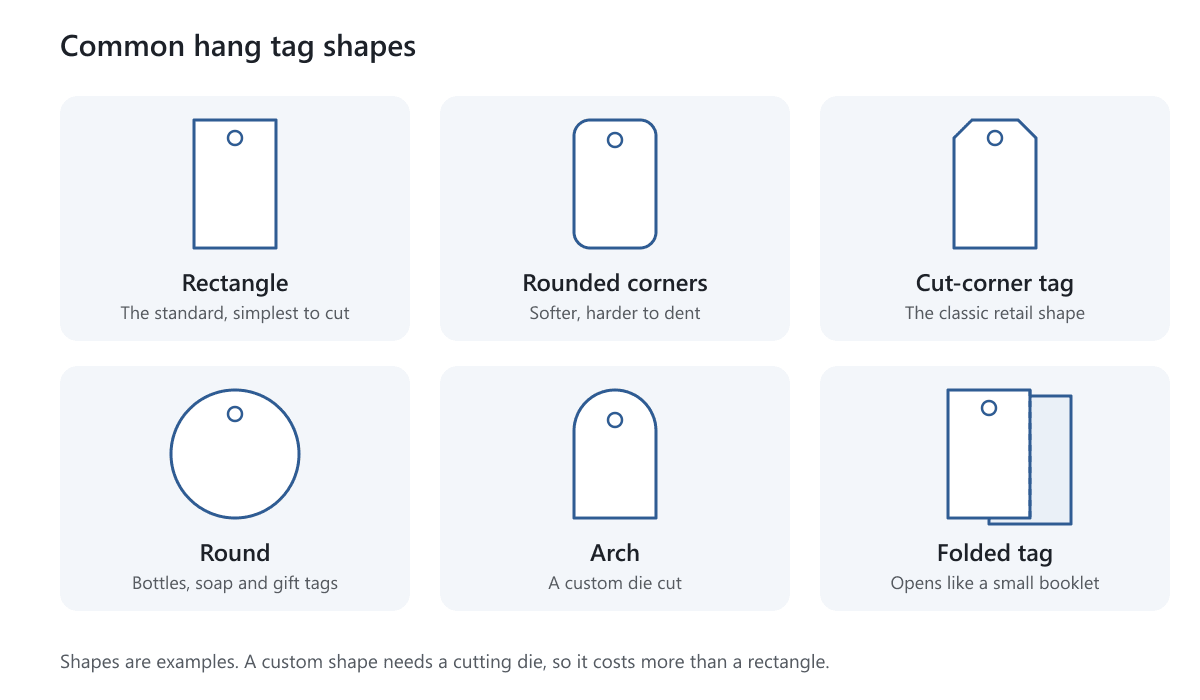
- Rectangle. The standard, and the simplest to cut. It makes good use of the stock.
- Rounded corners. Softer and safer to handle, and less likely to dent in a bag.
- Cut-corner tag. The classic retail shape, with the top corners clipped.
- Round, arch or custom die cut. A custom shape looks distinctive, but it needs a cutting die and uses more board, so it costs more.
If you want to see a template, try our free hang tag dieline or the round tag dieline, and type your own size.
Flat Tags vs Folded Tags
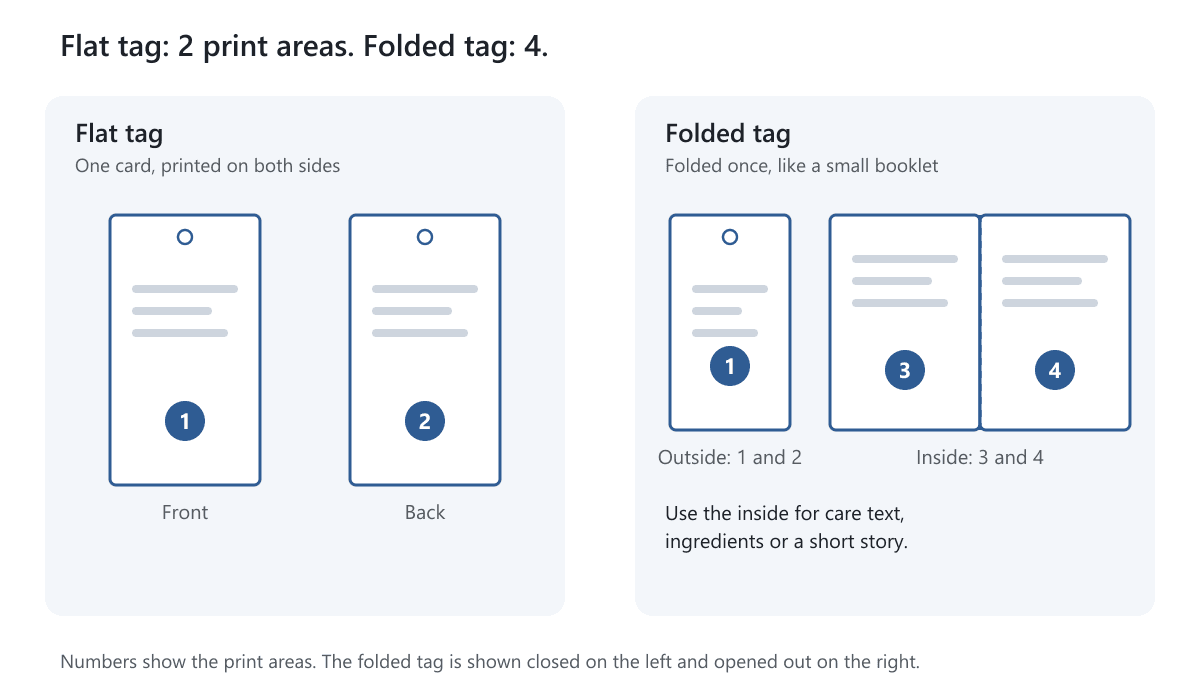
We offer two standard styles. A flat tag is a single card, printed on both sides. It is simple, light and the lowest cost. A folded tag is a card folded once, like a small booklet. It gives you double the printing space for descriptions and care instructions.
| Flat tag | Folded tag | |
|---|---|---|
| Print areas | 2 (front and back) | 4 (front, back and two inside) |
| Best for | Brand, name, price | Care text, ingredients, a story |
| Weight and bulk | Lightest | Slightly thicker and heavier |
| Cost | Lower | Higher, more board and folding |
Choose a flat tag when the product speaks for itself and the details fit on two sides. Choose a folded tag when you have a lot to say, such as ingredients, usage steps or a story. Do not fold a tag only to look premium, because a tag that opens needs something worth reading inside.
Paper Stocks and Weights
Hang tags are printed on card, and we offer 300 to 500gsm depending on the size. Gsm means grams per square meter, so a higher number means a thicker, stiffer card. As a comparison, many business cards use around 300 to 350gsm.
- 300gsm. Light and flexible, suited to small tags and lower-cost products.
- 350 to 400gsm. A good all-round weight. The tag holds its shape and feels solid.
- 450 to 500gsm. Thick and stiff, for larger tags and a premium feel.
White stock, made from solid bleached sulfate (SBS) paperboard, gives the cleanest print and the brightest colors. Brown kraft is unbleached, has a natural, handmade look and prints black or white only. A kraft tag suits candles, soap, food gifts and handmade goods, and a white tag suits fashion and full-color artwork.
Thin tags curl and fold, and they look cheap on a quality product. If you are unsure, order a sample and feel the difference. The Samples page lists what is available.
Printing and Finishes
Tags are printed in CMYK, the four-ink full-color process, or in Pantone, which matches an exact brand color. CMYK suits photos and many colors. Pantone suits a single logo color that must match. Our guide to color systems explains the difference in more detail.
A coating protects the print from fingerprints and scuffs. Varnish is a thin coating, and lamination is a film layer that protects more. You can choose a matte, glossy, satin or soft touch finish. Matte looks calm and modern, glossy makes colors pop, and soft touch feels velvety. Read varnish vs lamination before you choose.
Special finishes can make a small tag look much more expensive. Foil stamping adds a metallic shine to a logo, embossing or debossing raises or sinks a shape into the card, and spot UV adds shine to selected parts. Use them on one element, such as the logo, rather than all over.
Strings and Attachment Options
A hang tag is only useful if it stays on the product, so decide how it attaches before you design it. The hole position and size depend on the method.
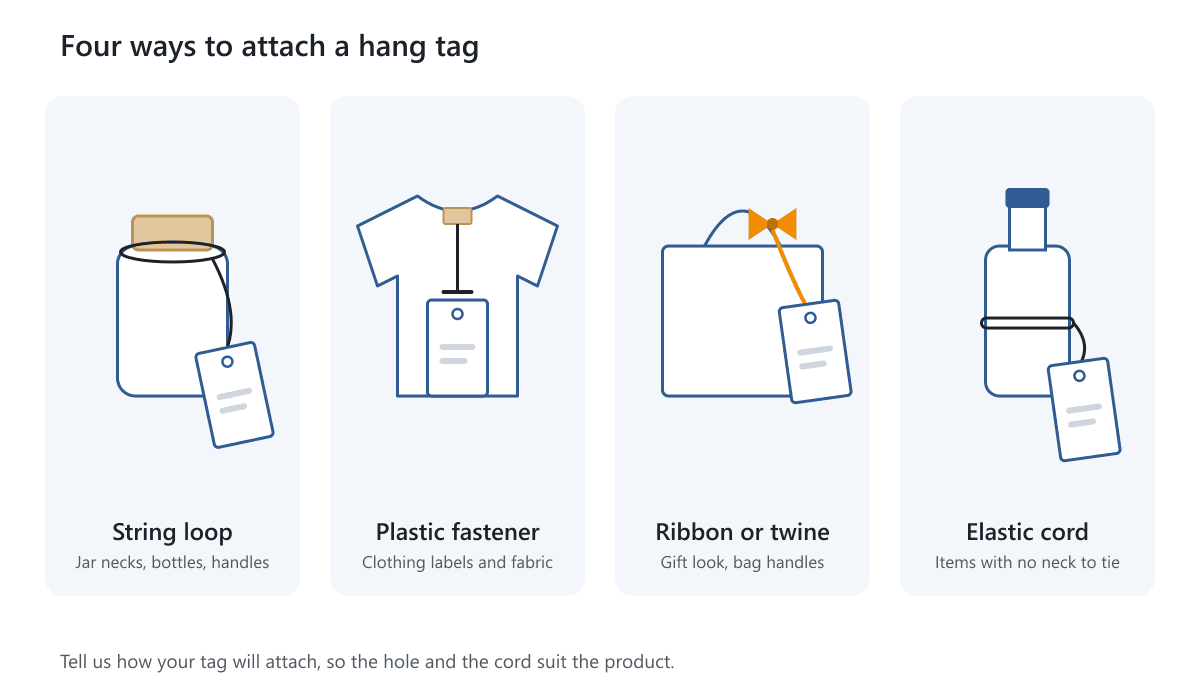
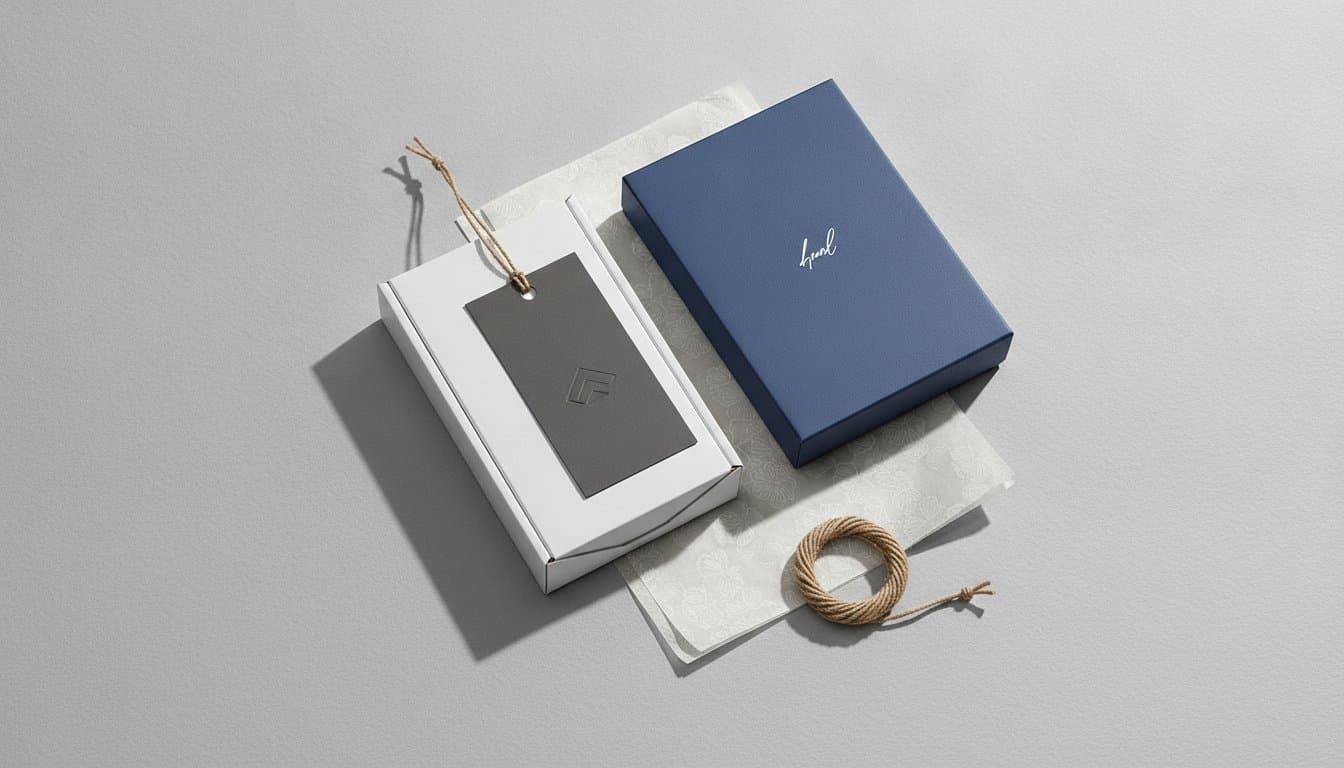
- String or cord loop. A loop through the hole goes around a jar neck, a handle or a strap. It is the most common choice for candles, bottles and bags.
- Plastic fastener. A small plastic bar or barb goes through a garment label or fabric and holds the tag. It is common on clothing.
- Ribbon or twine. A ribbon gives a gift look, and twine suits kraft tags and handmade goods.
- Elastic cord. A stretch loop fits an item that has no neck or handle to tie to.
- Safety pin or clip. Suited to items where a string is not possible.
Tell us how the tag will attach when you order, and we will confirm what we can supply. A typical hole is about 1/8 to 1/4 inch across, centered about 1/4 inch or more from the edge. A hole too close to the edge tears out, and a hole too big looks clumsy. Keep the print clear of the hole.
What to Print on a Hang Tag
Decide what the tag must say before you decide how it looks. A tag has little space, so every line has to earn its place.
Front: Brand and Name
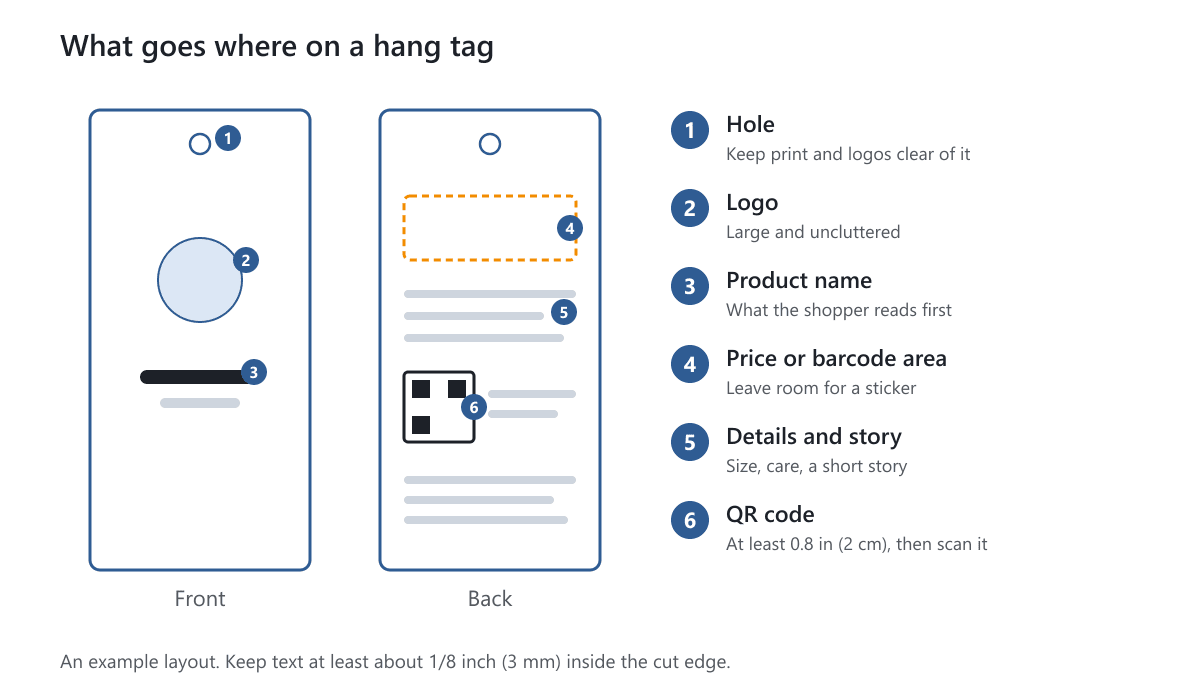
The front is for your logo and the product name. This is what a shopper sees first, so keep it clean and large. One strong element reads better than three small ones.
Back or Inside: Details
- Price or barcode. Many shops add a price sticker, so leave a clear area for it. Printing a price on the tag is risky if the price changes.
- Size, material and care. For clothing, care instructions are usually sewn into the garment, and the tag can repeat them. Rules differ by product and country, so check what you must show.
- Story. One or two sentences about who made it or why. Real, short and specific works better than a long mission statement.
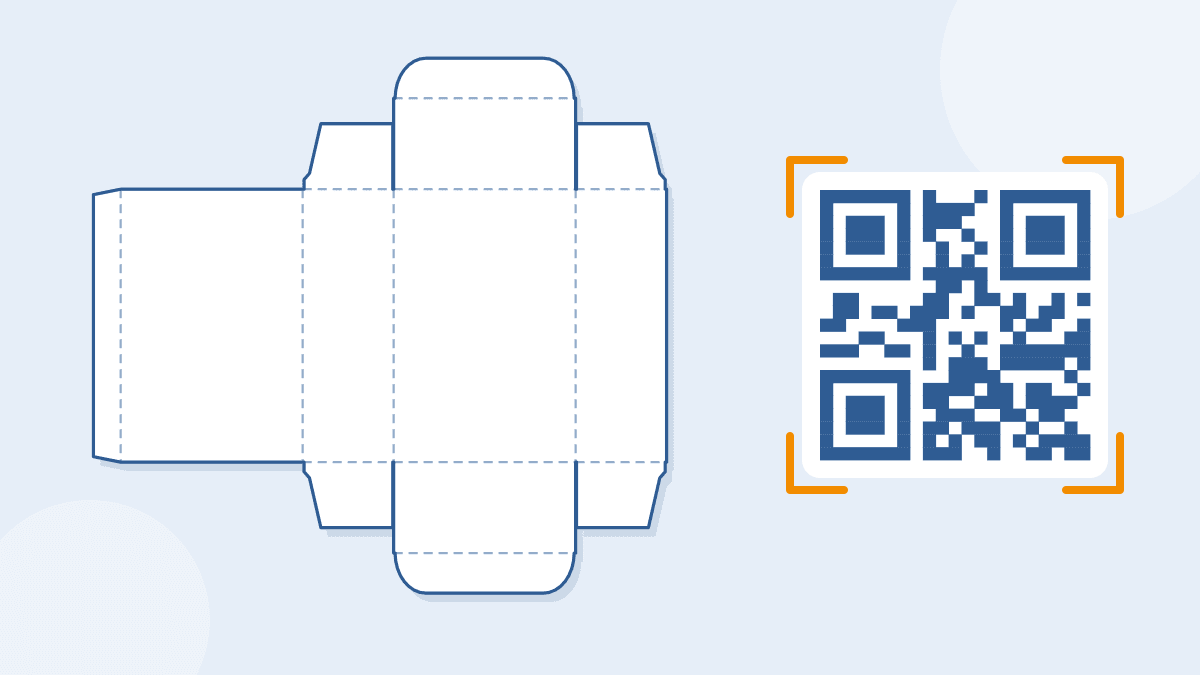
- QR code. Link to a product page, a care guide or a video. Print it at least about 0.8 inch (2 cm) square and test it by scanning before you approve.
- Contact details. A web address or social handle helps customers find you again.
For labels that have to carry legal information, such as fiber content or ingredients, check the rules for your product and market. A hang tag is easy to remove, so it is often not the right place for information that must stay with the product.
Design Tips for Small Tags
- Leave margins. Keep text and logos at least about 1/8 inch (3 mm) inside the cut edge. Cutting moves slightly.
- Add bleed. Extend background color or images past the cut line by about 1/8 inch so no white edge shows. Our guide to bleed in packaging explains how.
- Use contrast. Light text on a pale tag disappears. Check it at actual size.
- Keep text large enough. Body text under about 6 points is hard to read.
- Limit fonts and colors. Two fonts and two or three colors look consistent.
- Plan the hole. Keep a clear space around it, and do not run a logo through it.
- Proof before printing. Print the artwork at 100% on plain paper, cut it out and hold it against the product.
Send artwork as a layered file with fonts converted to outlines, using the dieline for the shape. Our dieline help article explains what a dieline is and how to use one.
Examples by Product
These are illustrations of the choices above, not customer cases.
Clothing Brand
A small clothing label could use a 2 x 4 inch folded tag in 350gsm white board with matte lamination. The front carries the logo, the inside has the care text and size chart, and a plastic fastener goes through the garment label.
Candle Maker
A candle maker could use a 2 inch round kraft tag with the scent name and burn time, tied around the jar neck with twine. Kraft prints in black or white, so the artwork is one ink, and it suits the handmade look.
Bottle or Gift Item
A bottle of oil or a gift set could carry a small flat tag with a foil logo and a short story on the back, hung from a ribbon.
Accessories and Bags
A bag or accessory brand could use a cut-corner tag with a QR code that links to a care guide, which keeps the tag small while still offering detail.
Ordering Hang Tags
Hang tags start at 500 units. You can order a sample first, and our Standard Sample Kit costs $50 with shipping included, and we choose the samples to match your niche or packaging type. To get a quote, send us the size, quantity, board, finish and artwork.
Production takes 5 to 7 working days after artwork is approved and payment is received. Larger or more complex orders can take longer, and we confirm the date in your quote. Delivery time is added on top. Quotes include shipping, and free design support is available if you need help with the artwork.
Hang tags work well beside other packaging pieces. Pair them with tuck boxes, packaging sleeves or printed cards so the whole pack looks like one brand.
Common Hang Tag Mistakes
- Choosing a size before checking it against the product.
- Using stock that is too thin, so the tag curls or bends.
- Printing too close to the hole or the edge.
- Leaving no room for a price sticker or barcode.
- Printing a price that will change.
- Making a QR code too small, or never scanning it.
- Printing a long text in a tiny size instead of using a folded tag.
- Putting legal information on a tag that customers will remove.
Next Step
Write down the product, the tag size you think you need, how it will attach and what it must say. Then request a free quote and tell us the board and finish you prefer. We reply within 1 business day, and if you are unsure about the size or weight, we can send a sample first.
Frequently Asked Questions
What size should a hang tag be?
Most are about 2 x 3.5 to 2 x 4 inches, close to a business card. Choose smaller for jewelry and small jars, and larger for folded tags with more text. Measure the space on your product, because the tag should not hide it.
What paper weight is best for hang tags?
Typically 300 to 500gsm, depending on size. A mid-range 350 to 400gsm holds its shape and feels solid for most tags, and 450 to 500gsm suits larger tags and a premium look. Thin tags curl and look cheap.
What is the difference between flat and folded hang tags?
A flat tag is a single card with two print sides. A folded tag is folded once and has four print areas, so it holds more text, such as care instructions or a story. Folded tags cost more because they use more board and folding.
Do hang tags come with strings?
Tell us how the tag will attach, whether a string loop, a plastic fastener, a ribbon or something else, and we will confirm what we can supply with your quote. The hole is punched to suit the attachment you choose.
Can I put a QR code on a hang tag?
Yes. Print it at least about 0.8 inch (2 cm) square, with plenty of white space around it, and scan it with several phones before you approve the artwork. Link it to a page that works well on a phone.
What is the minimum order for custom hang tags?
The minimum is 500 units for both flat and folded tags. If you are not sure about the size or the feel, order a sample first, and tell us your quantity for a quote.
What information must a hang tag show?
There is no single rule, because it depends on the product and the market. A tag usually shows the brand and product name, and often price, size and care. Legal information, such as fiber content, often belongs on a permanent label, so check what applies to you.
Written by the PacksDo Team
We make custom printed packaging, from boxes and mailers to bags, labels and inserts. Questions about this guide? Ask us.