In this article
A product hang tag is a small printed card, usually with a punched hole, that is attached to a product with string, elastic, ribbon or a plastic fastener. It carries your brand and the details a buyer needs, such as the name, size, price, care or use, and it is often the last thing a customer reads before choosing.
This is the short definition guide: what hang tags are, the types, sizes and materials, how to attach them, what to print and how to choose. If you want the deeper buying and design guide, read our custom hang tags guide. If you are ready to order, see our custom hang tags.
Key takeaways
- A hang tag is a branded information card that hangs from a product. It is not a sticker, and it can be removed.
- Two structures cover most needs: flat tags (two printed sides) and folded tags (four surfaces, like a small card).
- Paperboard in white or kraft is standard. Our hang tags are typically 300 to 500 gsm, depending on size.
- The hole and the attachment matter as much as the print. Choose the hole size and position before you finalize the design.
- Print what the buyer needs to decide: brand, product name, key details and, where relevant, care or use. Required legal labels may still need to be on the product itself.
- Hang tags start from 500 units with us, and each tag is printed to your design.
What a Hang Tag Is
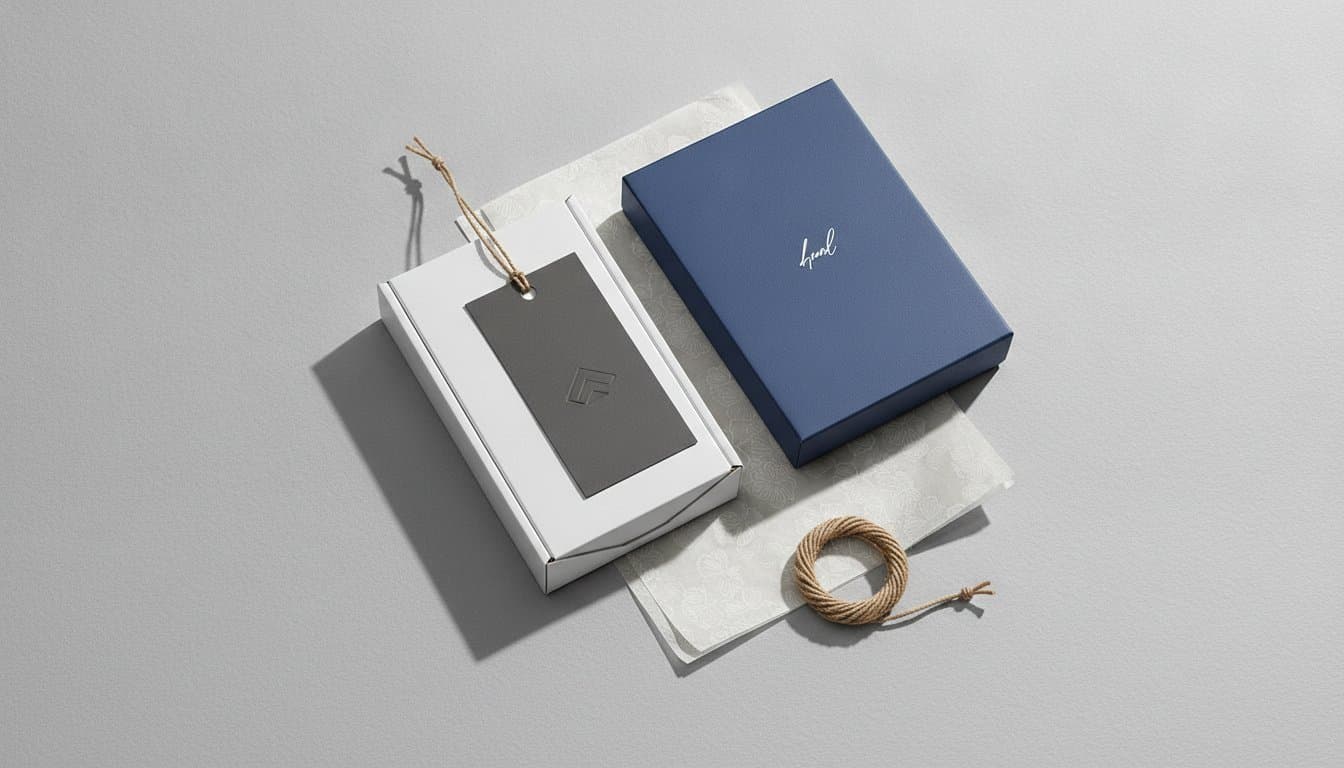
A hang tag, also called a swing tag, is a printed tag that hangs from a product. You see them on clothing, bags, candles, jars, gift sets, hardware and handmade goods. The tag is attached through a hole with a loop of string or similar, so it hangs, swings and can be read from either side.
How it differs from other print on a product:
- Sticker or label: a label is stuck to the product and stays on. A hang tag hangs, can be removed and can be bigger and richer.
- Header card: a card folded or stapled over the top of a bag. Hang tags hang from a loop, and our cards and flyers page covers header cards. For cards that go inside the box instead, see what product inserts are.
- Packaging sleeve: a band that wraps a box. A tag does not wrap. See what a packaging sleeve is.
What Hang Tags Are For
- Branding. A tag gives you a surface for your logo, a short line about the brand and a color or pattern that matches the pack.
- Information. Price, size, materials, care instructions, usage steps, ingredients or scent notes.
- Trust and story. Where and how it is made, a thank-you note or a promise you can stand behind.
- Action. A QR code or web address that links to a care guide, a video or a review page.
- Presentation. A tag adds a finished, retail look to items that have no box.
Types of Hang Tags
Tags differ by structure, purpose and shape.
By Structure
| Type | How it works | Best for |
|---|---|---|
| Flat tag | One card, printed on both sides | A clean look, brand plus a few details |
| Folded tag | A card folded in half, with an inside spread | More text: care, story, instructions |
We make both. A folded tag gives you double the printing space, which suits detailed descriptions and care instructions. Both are described on the hang tags page, where you will find the current minimum order and starting price.
By Purpose
- Brand tags carry the logo and a short line, and set the tone.
- Information tags carry details such as size, materials and care.
- Price tags show the price and a barcode for the till.
- Gift tags carry a name or a message for presents and favors.
- Promotion tags offer a code, a QR link or a coupon.
By Shape
Most tags are rectangles with rounded or square corners. Others are round or die-cut into a shape that suits the brand, such as a leaf for a plant product. A special shape needs extra tooling, so it is worth asking for a quote before you commit. Our free hang tag dieline and round tag dieline show the flat pattern at real size.
Hang Tag Sizes
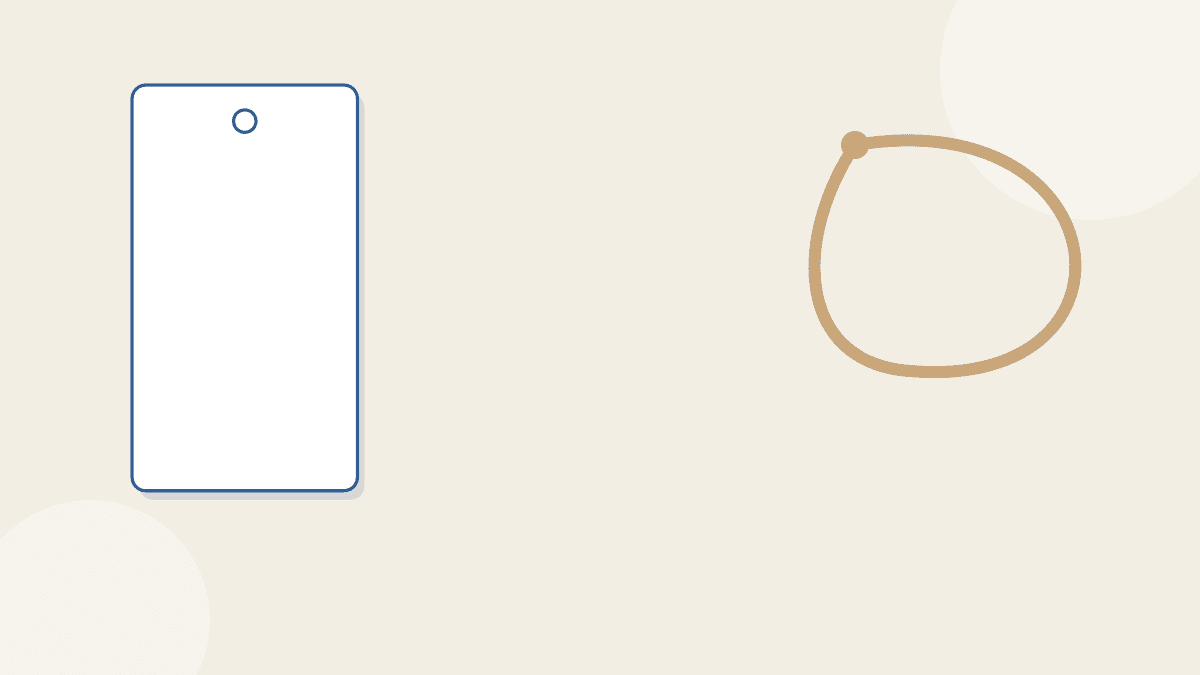
There is no single standard size. The best size is large enough to read and small enough not to hide or overpower the product. The tags below are drawn to scale next to a business card, to give you a feel for it.
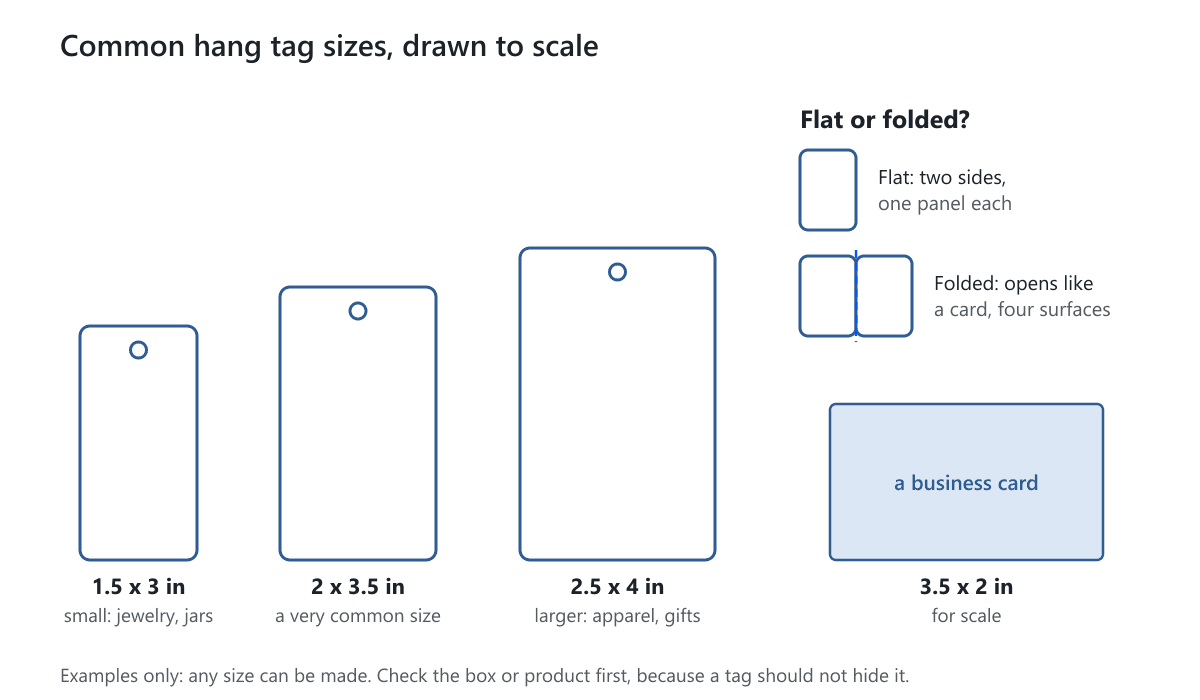
- Small tags, roughly 1.5 x 3 inches, suit jewelry, small jars and delicate items.
- Medium tags, roughly 2 x 3.5 inches, are a common size for apparel, candles and gift goods.
- Large tags, roughly 2.5 x 4 inches or more, suit bigger products and tags with a lot of text.
Check the size against the real product. Hold a paper cut-out of the tag next to it and see how it looks hanging. For a product with a box, tell us the box size too, so the tag does not cover the logo.
Materials, Printing and Finishes
Our hang tags are made from paperboard, usually 300 to 500 gsm depending on size. A larger tag needs a heavier board to keep its shape. We offer two colors of board.
- White paperboard (SBS) is smooth and bright, and suits detailed, colorful print.
- Brown kraft has a natural look. It is best with black or white printing, because light colors fade on the brown.
Print is CMYK or Pantone. CMYK is the four-color process for photos and gradients, and Pantone matches a precise brand color. Our color systems guide explains the choice.
A coating protects the print from scuffs and handling: varnish is a thin liquid coat and lamination is a thin film that protects more. Finishes include matte, glossy, satin and soft touch. Foil stamping, embossing or debossing and spot UV can add detail, for example a shiny logo or a raised pattern. See varnish vs lamination for the difference.
Plain paperboard without a plastic film is generally the easiest to recycle, and laminations, foil and plastic fasteners can make recycling harder. Recycled stock options are available on request.
How to Attach a Hang Tag
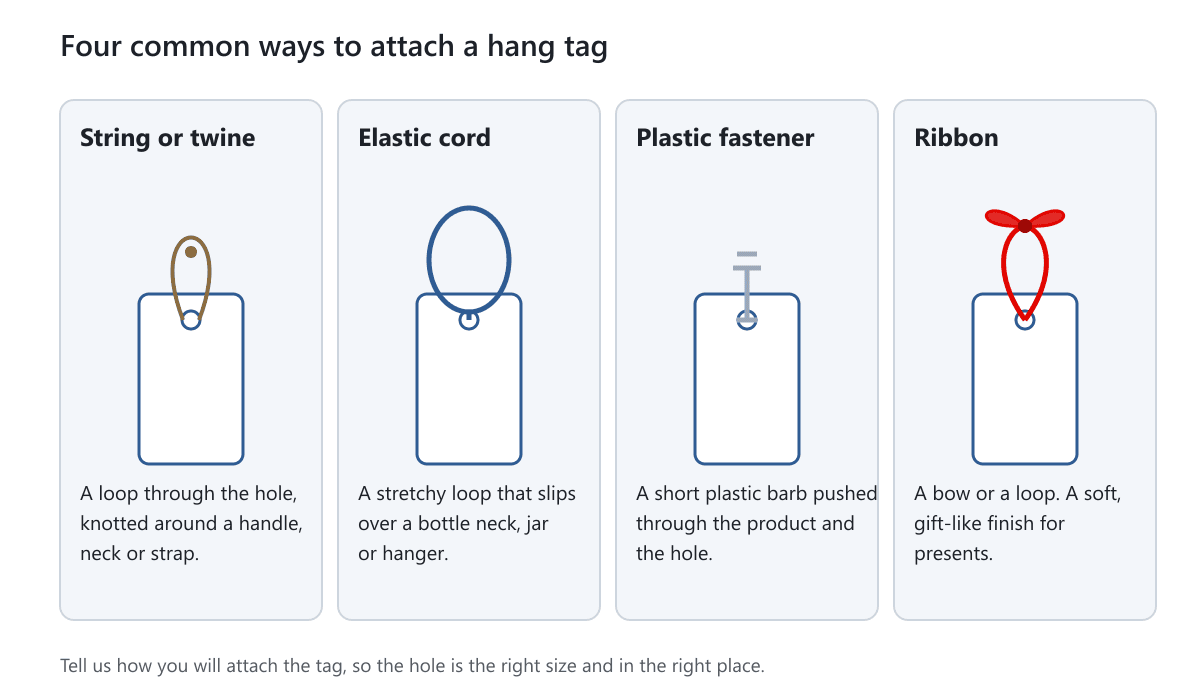
A tag is attached through its hole, and the attachment depends on the product.
| Attachment | Good for | Notes |
|---|---|---|
| String or twine | Bags, jars, candles, handmade items | Natural look; tie a knot or a loop |
| Elastic cord | Bottles, jars, hangers | Slips on and off without a knot |
| Plastic fastener | Clothing and soft goods | Quick to attach by hand; plastic can be harder to recycle |
| Ribbon | Gifts, favors, premium items | Soft, decorative look |
Hole Size and Position
The hole is typically about 1/8 to 1/4 inch wide, depending on the cord, and sits roughly 1/4 inch from the edge. Too close to the edge and the tag can tear. Too big a hole for a thin cord and the tag spins. Keep the design clear of the hole, and put the hole on the side where the tag hangs, usually the top short edge.
Tell us how you will attach the tag and what cord or fastener you will use, so we can set the hole to match. If you want us to supply the cord or fastener, ask when you request a quote and we will confirm what we can provide.
What to Print on a Hang Tag
Decide the job of each side before you design. A simple rule works well: the front is for the brand, the back is for the buyer.
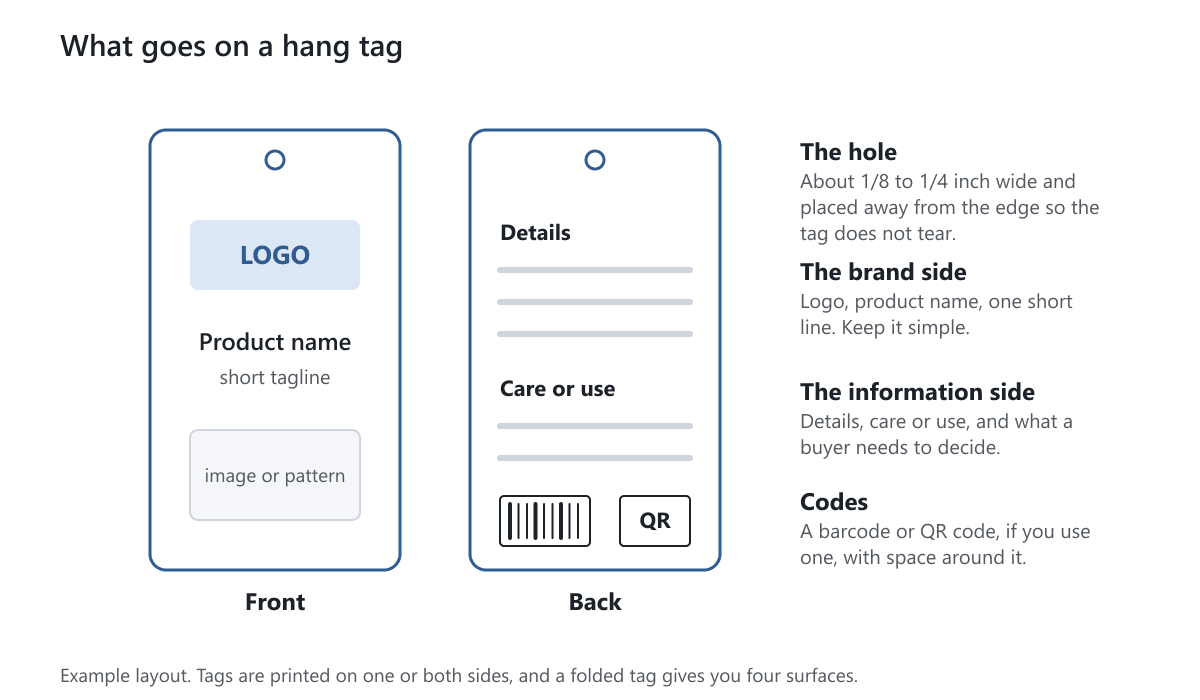
- Front: logo, product name or collection, and one short line.
- Back: the details a buyer needs, such as size, materials, care or use.
- Codes: a barcode if you scan at the till, or a QR code that links to a care guide or a page about the product.
- A call to action, such as a web address or a social handle, kept small.
Legal labeling rules differ by product and country. Items such as clothing, food, cosmetics and children's products often need required information, such as fiber content or ingredients, on a permanent label. A hang tag may not replace it. Check the rules that apply to your product before you decide what goes on the tag.
How to Choose the Right Hang Tag
Work through these questions and you will have a clear brief in a few minutes.
- What does the product need the tag to do? Brand only, information, or both.
- How much text? A little text suits a flat tag, and a lot suits a folded tag.
- What size? Large enough to read, small enough not to hide the product.
- What board and color? White for bright print, kraft for a natural look.
- How will it attach? This sets the hole and the cord.
- What finish? Matte for a calm look, soft touch for a premium feel, glossy for bright photos.
- How many? Our hang tags start from 500 units, and a larger run lowers the cost per tag.
| Product | A sensible starting point |
|---|---|
| Clothing and accessories | Medium flat or folded tag, white or kraft, string or plastic fastener |
| Candles and jars | Small to medium flat tag, kraft, string or elastic |
| Gift and favors | Small tag with a soft touch or matte finish, ribbon |
| Handmade goods | Kraft tag with one-color print, string |
| Electronics and tools | Medium tag with clear specs on the back, plastic fastener |
Hang Tag Design Tips
- Keep the type readable. Very small text is hard to read on a tag you handle. As a rule of thumb, avoid text smaller than about 7 to 8 point, and use strong contrast.
- Give the hole space. Keep text and logos about 1/8 inch clear of the hole and of every edge.
- Use bleed. Extend color or a background past the cut line so no white edge shows. See our guide to bleed in packaging.
- Make a QR code big enough to scan, typically at least about 3/4 inch square, with a blank border around it, and test it before printing.
- Match the tag to the box. The same colors, type and finish tie the tag to the pack.
- Design both sides. A blank back is a wasted surface.
Examples of Hang Tags in Use
These are invented examples, not customer stories.
- A candle maker uses a small kraft tag on twine with the scent name on the front and burn time and care on the back.
- A small clothing label uses a medium white tag in a soft touch finish with the logo, size and a QR code to a care guide.
- A gift shop uses round tags on ribbon with a thank-you message, so each item looks wrapped.
- A soap brand uses a folded tag on a jar with the scent story inside and ingredients on the back.
Common Hang Tag Mistakes
- Putting the hole too close to the edge, so the tag tears.
- Choosing a board that is too thin, so the tag curls and bends.
- Printing light colors on kraft, where they fade.
- Cramming too much text on a small flat tag, when a folded tag would fit it.
- Forgetting that a barcode or QR code needs a blank border and good contrast.
- Leaving no space for the hole in the design, so a logo is punched through.
- Skipping a proof, so a spelling or price error runs on every tag.
How to Order Hang Tags
Tell us the size, whether you want a flat or folded tag, the board (white or kraft), the printing and finish, the quantity, how you will attach it and whether your artwork is ready. We offer free design support and confirm the dieline before printing. Production takes 5 to 7 working days after artwork approval and payment, with delivery time added on top. Larger or more complex orders can take longer, and we confirm the date in your quote. Our quote includes shipping.
To feel the board, the Standard Sample Kit costs $50 with shipping included. When you are ready, get a free quote.
Frequently Asked Questions
What is a product hang tag?
A product hang tag is a small printed card with a hole, attached to a product with string, elastic, ribbon or a plastic fastener. It carries your brand and information such as the name, size, price and care instructions.
What is the difference between a hang tag and a label?
A label is stuck to the product and usually stays on it. A hang tag hangs from the product, can be removed and can be larger and richer. Required legal labeling often belongs on a permanent label, so check the rules for your product.
What size should a hang tag be?
It depends on the product. Roughly 1.5 x 3 inches suits small items, 2 x 3.5 inches suits many apparel and gift products, and larger tags suit bigger products or more text. Hold a paper cut-out next to your product to test it.
What material are hang tags made from?
Ours are paperboard in white or brown kraft, typically 300 to 500 gsm depending on size, with CMYK or Pantone printing and a choice of coating and finish. Kraft is best with black or white print.
How do you attach a hang tag?
Through the hole with string, twine, an elastic cord, ribbon or a plastic fastener, depending on the product. Tell us the attachment so the hole is the right size and in the right place.
What is a folded hang tag?
A folded hang tag is a card folded in half so it opens like a small booklet. It gives you four surfaces and suits more text, such as care instructions or a brand story. A flat tag has two printed sides.
What is the minimum order for hang tags?
Our hang tags start from 500 units. See the hang tags page for the current starting price, and ask for a quote with your size and finish.
Written by the PacksDo Team
We make custom printed packaging, from boxes and mailers to bags, labels and inserts. Questions about this guide? Ask us.