In this article
- 1Stickers and Labels: What Is the Difference?
- 2Die Cut vs Kiss Cut
- 3Rolls vs Sheets
- 4Materials: Paper, Vinyl and Kraft
- 5Adhesives and What They Stick To
- 6Sizes and Shapes
- 7Where Stickers Work on Packaging
- 8Durability: Cold, Wet and Rough Surfaces
- 9Artwork, Bleed and Cut Lines
- 10Ordering Stickers
- 11Common Sticker Mistakes
- 12Next Step
Custom stickers for product packaging come in two cuts and two formats. A die cut sticker is cut through to its backing, so each one is a separate piece. A kiss cut sticker is cut through the sticker only, so it peels off a shared sheet. Rolls suit hand or machine application at volume, and sheets suit small batches and giveaways. Choose the material by the surface and the setting, and the size by where it will sit.
This guide covers the choices you make when you order stickers and labels: cut type, rolls or sheets, materials, adhesives in general terms, sizes, where stickers work on packaging, how they hold up on different surfaces, artwork and bleed, and ordering. For the short list of our options, see the stickers and labels page.
Key takeaways
- Cut type changes how stickers are used. Die cut stickers are separate pieces. Kiss cut stickers stay on a sheet or roll liner until you peel them.
- Rolls for volume, sheets for flexibility. Rolls are easiest to apply repeatedly. Sheets are easy to store and hand out.
- The surface decides the material. Paper suits dry, smooth packaging. Vinyl suits surfaces that get damp or handled. Test on the real surface.
- Plan bleed and a safe area. Extend artwork past the cut line and keep text inside it.
- The minimum order is 500 units. Order a sample first if the surface is difficult.
Stickers and Labels: What Is the Difference?
The words overlap, and most printers use them for the same product: a printed piece with an adhesive back on a liner. In packaging, a sticker usually carries branding or decoration, such as a logo seal. A label usually carries information, such as a product name, a batch number or ingredients.
A roll label is a label supplied on a roll, which is why you will see the terms "labels on roll" and "sticker rolls" used together. The choices in this guide apply to both, so use whichever word fits your use. If you need a label for a shipping carton, our guide to where to place a shipping label on a box covers placement.
Die Cut vs Kiss Cut
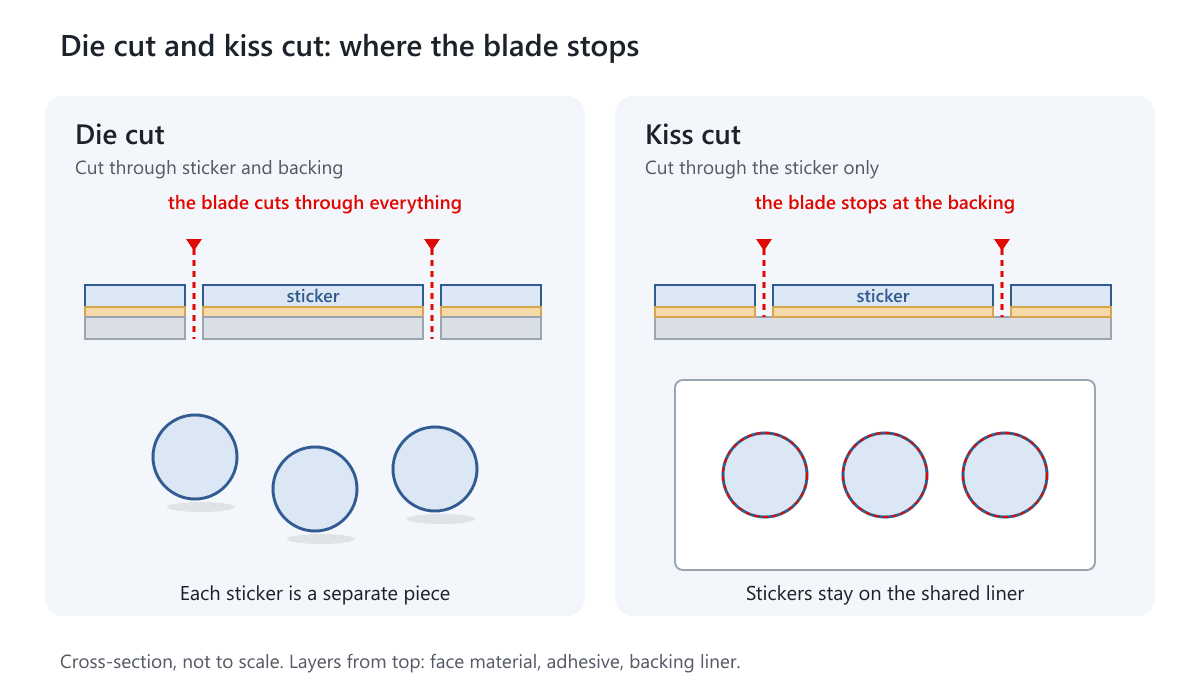
A sticker has three layers: the printed face material, a layer of adhesive and a backing liner. The cut type decides which layers are cut through.
Die Cut Stickers
A die cut sticker is cut through both the sticker and its backing, in the exact shape of your design, so each one is a separate piece. The shape can be anything: round, square, a logo outline or a custom contour. Die cut stickers are good for giveaways and for products that should stand out, because the sticker has its own outline.
Kiss Cut Stickers
A kiss cut sticker is cut through the sticker only, leaving the backing sheet intact, so each sticker peels off the sheet. The name comes from the light touch of the blade. Kiss cut suits sheets of several stickers, and it is easier to apply because the liner gives you something to hold.
| Die cut | Kiss cut | |
|---|---|---|
| Cut through | Sticker and backing | Sticker only |
| Comes as | Separate pieces | On a sheet or roll liner |
| Best for | Giveaways, shaped stickers | Sheets, rolls, packaging seals |
| Application | Peel from its own backing | Peel from the shared liner |
If you are unsure, kiss cut is the safer choice for packaging, because you apply stickers in a line and the liner keeps them organized. Choose die cut when each sticker leaves your hands separately.
Rolls vs Sheets
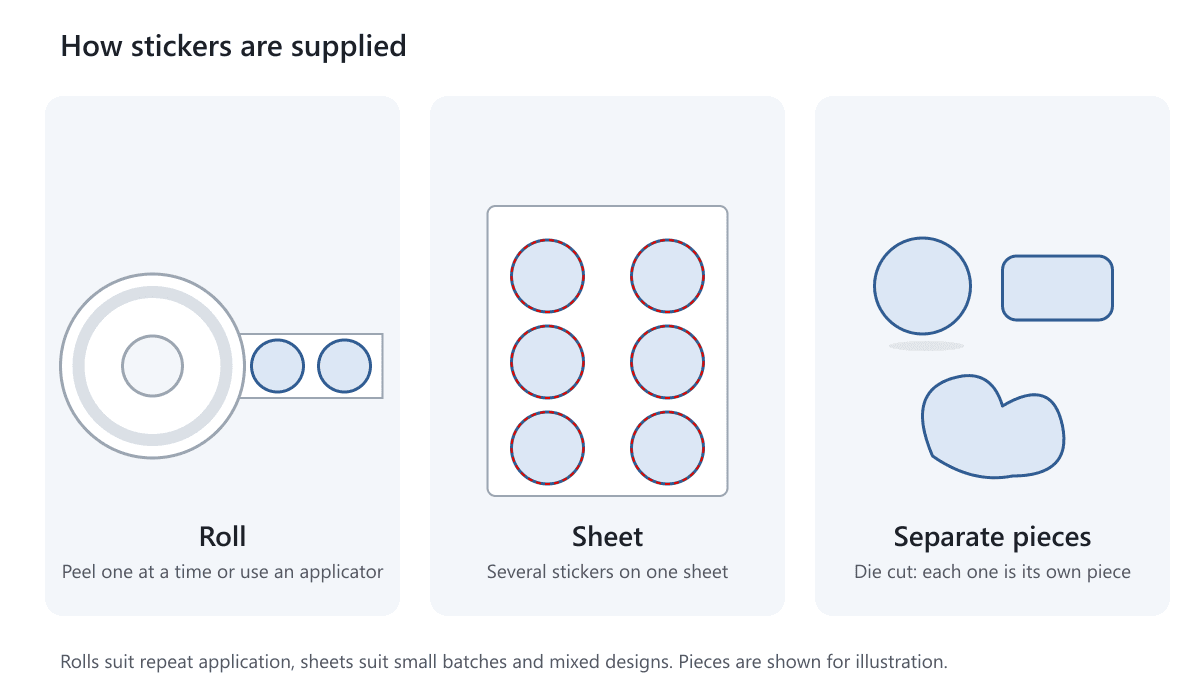
The other choice is how the stickers are supplied. It affects how you store and apply them more than how they look.
Sticker Rolls
Sticker rolls, also known as roll labels, store neatly and are made for quick application. They suit shops that seal or label many packages, because you peel one at a time or use an applicator. If you use a machine, the core size and roll width must match it. See our labels on roll page.
Sticker Sheets
Sticker sheets are pre-spaced and easy to keep on hand. They suit small batches, mixed designs on one sheet and stickers you give away with orders. See our labels on sheets page.
As a rule of thumb, if you apply the same sticker more than a few hundred times a month, rolls save time. If you use several designs, or hand them out, sheets are more flexible.
Materials: Paper, Vinyl and Kraft
The face material determines how the sticker looks, feels and survives. Our standard paper stickers range from 80 to 128gsm, where gsm means grams per square meter, so a higher number is thicker.
- White paper. Made from solid bleached sulfate (SBS) paper. It prints bright and clean and suits dry, indoor packaging. It is the usual choice for boxes, bags and tissue paper.
- White vinyl. Also called PVC (polyvinyl chloride). It is a plastic film that tolerates moisture and handling better than paper. It suits bottles, jars and items that may get damp.
- Brown kraft. Unbleached, natural-looking paper. It prints in black or white only, so it suits simple one-color designs and handmade or natural brands.
Plastic films are harder to recycle than paper, and a plastic sticker on a paper box can make recycling harder. If sustainability matters, use paper stickers on paper packaging. Rules differ by town, so check local guidance.
Printing, Coatings and Finishes
Stickers can be printed in CMYK for full color or in Pantone for an exact brand color. See our guide to color systems. A coating helps a sticker survive scuffs. Varnish is a thin coating, and lamination is a protective film, which our varnish vs lamination article compares. Finishes include matte, glossy, satin and soft touch.
Gloss makes colors bright but shows fingerprints. Matte looks calm and modern and hides scuffs. If you want a special finish on stickers, ask us what is possible.
Adhesives and What They Stick To
Adhesive is the part of a sticker nobody sees and everyone notices when it fails. The common types are:
- Permanent. Grips firmly and is hard to remove. It is the usual choice for packaging seals and labels.
- Removable. Peels off cleanly without leaving residue. It suits temporary labels and price stickers.
- Special-purpose adhesives. Some are made for cold, damp or textured surfaces. Ask what options are available for your surface.
Tell us what the sticker will stick to, how it will be stored and applied, and what conditions it will see. We confirm the adhesive and material options with your quote. A sample on your real packaging is the best test, because surfaces vary: coated paperboard, uncoated kraft, corrugated, glass, plastic and fabric all behave differently.
Sizes and Shapes
Choose size by where the sticker sits and what it has to do. Measure the space on your packaging, and leave a margin so the sticker does not touch edges, folds or seams.
| Use | Common starting size | Notes |
|---|---|---|
| Seal on a tuck flap or tissue paper | 1 to 1.5 inches, round | Small and neat, crosses the join |
| Mailer or box closing seal | 2 to 3 inches, round or oval | Large enough to show if opened |
| Front label on a jar or bottle | 2 to 3 inches, any shape | Check the curve of the surface |
| Branding on a plain kraft box | 2 to 4 inches | Keep one strong focal point |
| Thank-you sticker for a pack | 1.5 to 2.5 inches | A short message and a logo |
These are common starting sizes, not rules. Print an actual-size copy, cut it out and hold it against your packaging. A round sticker is the easiest shape to apply neatly. A rectangle needs straight edges lined up. A custom shape stands out, but it needs a cutting die. You can see the layout in our free round sticker, rectangle label and sticker sheet dielines.
Where Stickers Work on Packaging
Seals and Closures
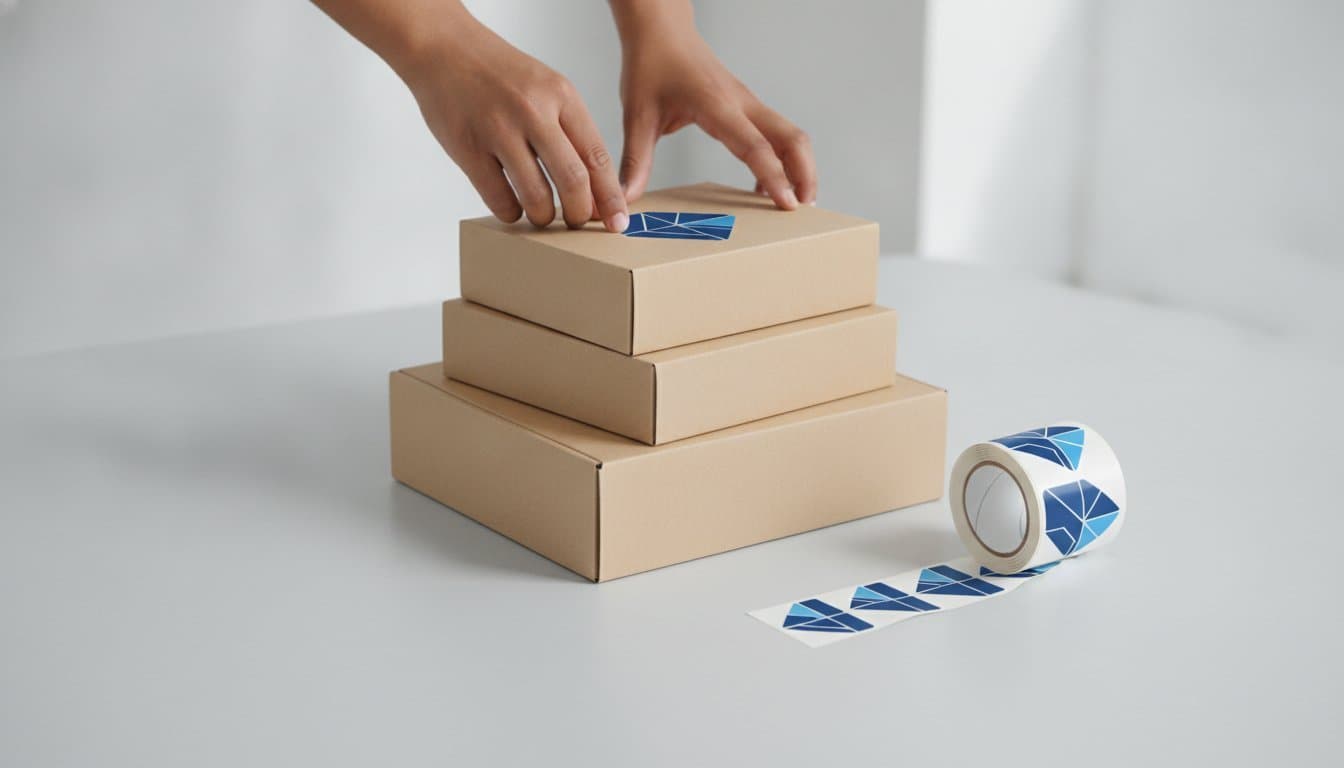
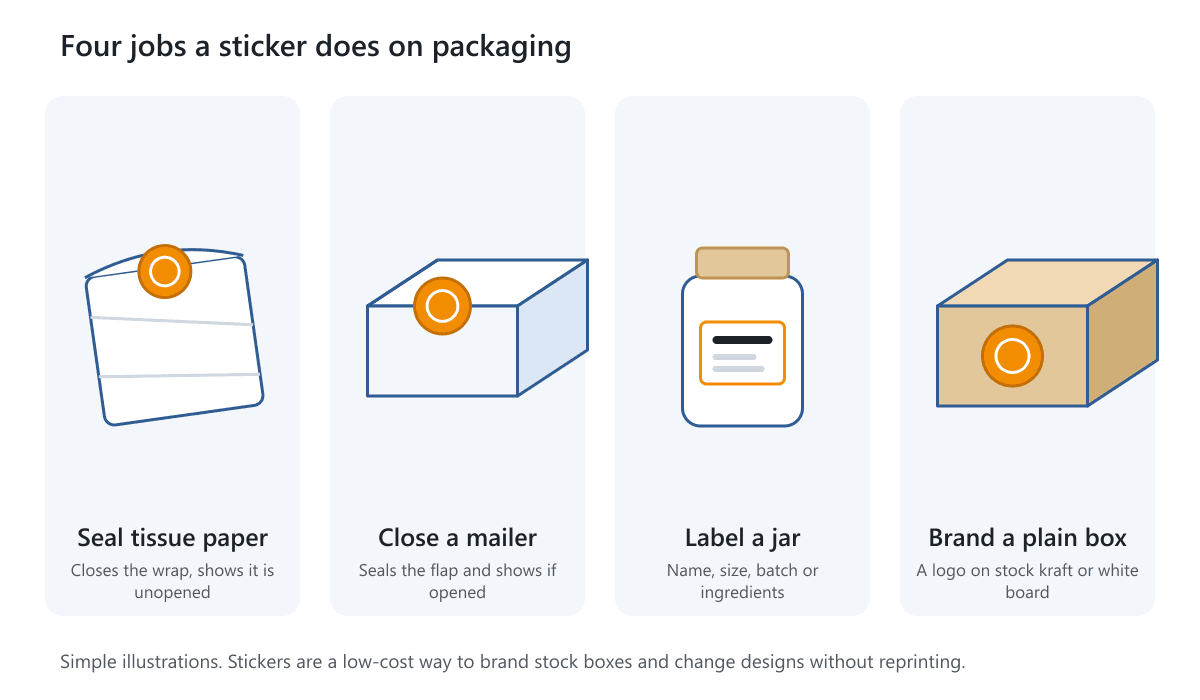
A round sticker across a flap, tissue paper or the edge of a mailer box closes the pack and shows it has not been opened. Place it so that opening it breaks or lifts the sticker. For tissue paper, see our tissue paper page.
Labels and Product Information
A label on a jar, bottle or bag carries the name, size, batch or ingredients. Check the rules for your product, because food, cosmetics and supplements often have labeling requirements, and which ones apply depends on the product and the market.
Branding on Plain Packaging
A printed sticker on a plain kraft or white box gives you a branded pack without printing the whole box. It is a good way to start with a tuck box or a mailer box in stock board, and you can print the box later when volumes grow.
Seasonal and Limited Editions
Changing a sticker is far cheaper than reprinting a box. A seasonal sticker, a new flavor label or a holiday message can turn one box into several products. Our guide to seasonal packaging without reprinting boxes shows the idea.
Thank-You and Extras
A small sticker on the inside of a flap, or on a thank-you card, adds a branded touch. Our cards and hang tags go well with it.
Durability: Cold, Wet and Rough Surfaces
Stickers fail for predictable reasons, so think about conditions before you order. We cannot promise how a sticker will behave in your exact setting, so test it.
- Cold and condensation. Moisture on a cold surface makes many adhesives let go. If the product goes in a fridge or cooler, say so and ask for a suitable material and adhesive.
- Water and handling. Paper can wrinkle or peel when wet. Vinyl, and a protective coating, hold up better, but check with a sample.
- Oils and creams. Oily surfaces weaken adhesion. A coated face material and a clean, dry surface help.
- Curved and textured surfaces. A flat sticker on a tight curve lifts at the edges. Use a smaller label, or a material that bends, and test the fit.
- Uncoated kraft and corrugated. Rough surfaces give less contact, so adhesion can be weaker. Press firmly and test.
Apply stickers to clean, dry, dust-free surfaces, and give the adhesive time to settle before the pack is moved. A sample on the real surface, left for a few days in the real conditions, is the most reliable test.
Artwork, Bleed and Cut Lines
Sticker artwork needs three zones: the artwork itself, a bleed past the cut line and a safe area inside it. Our guide to what bleed means in packaging explains the idea in detail.
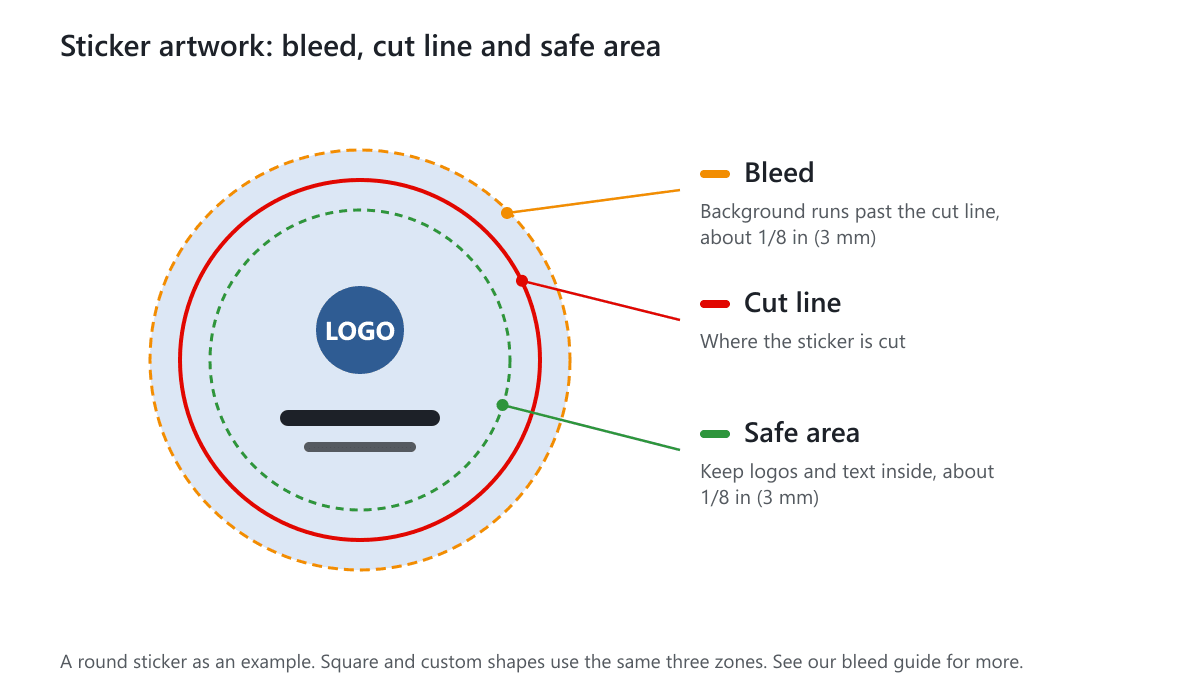
- Bleed. Extend background color and images past the cut line by about 1/8 inch (3 mm), so a small cutting shift does not leave a white edge.
- Safe area. Keep logos and text about 1/8 inch (3 mm) inside the cut line.
- Cut line. Supply the shape as a clear vector line on its own layer, or use our dieline, and we confirm it with you.
- Text size. Very small type is hard to read and may fill in. Avoid text under about 6 points.
- Color. Use CMYK for full-color artwork, or Pantone for an exact brand color. Colors can look different on kraft than on white.
- Resolution. Use vector artwork for logos, and photos at 300 dpi at actual size.
Ordering Stickers
Stickers and labels start at 500 units. Send us the size and shape, how they will be supplied, the material, the finish and the artwork, along with the surface and conditions. Production takes 5 to 7 working days after artwork is approved and payment is received, with delivery time added on top. Larger or more complex orders can take longer, and we confirm the date in your quote. Our quotes include shipping, and free design support is available if you need help preparing artwork.
If the surface is difficult, ask about a sample first. The Samples page explains what we offer, and our Standard Sample Kit costs $50 with shipping included, and we choose the samples to match your niche or packaging type.
Stickers cost less per unit as quantity rises, because setup, cutting and printing costs are spread across more pieces. Custom shapes, special finishes and several colors raise the cost. Our guide to the impact of packaging costs explains how to count it all.
Common Sticker Mistakes
- Choosing a material without testing it on the real surface.
- Ignoring cold, damp or oily conditions.
- Placing a sticker over a fold or seam that will crack it.
- Forgetting bleed, so a white edge shows after cutting.
- Putting text too close to the cut line.
- Using a plastic sticker on a paper box you want to recycle.
- Choosing rolls when you need several designs, or sheets when you apply thousands.
- Not checking labeling rules for food, cosmetics or supplements.
Next Step
Write down the surface, the size, the quantity and whether you want rolls or sheets. Then request a free quote and tell us the conditions, so we can recommend a material. We reply within 1 business day.
Frequently Asked Questions
What is the difference between die cut and kiss cut stickers?
A die cut sticker is cut through the sticker and its backing, so each one is a separate piece. A kiss cut sticker is cut through the sticker only, leaving the backing intact so the stickers peel off a sheet or roll. Kiss cut is easier to apply in batches.
Should I choose rolls or sheets?
Choose rolls if you apply the same sticker many times, because they store neatly and work with applicators. Choose sheets for small batches, several designs or giveaways. Sheets are also easy to keep on hand.
What is the best material for packaging stickers?
Paper suits dry, smooth packaging and prints bright. White vinyl suits surfaces that may get damp or handled. Brown kraft gives a natural look but prints black or white only. The surface and conditions decide, so test on your real packaging.
Will stickers stay on corrugated shipping boxes?
Often, but rough or dusty corrugated gives less contact, so adhesion can be weaker. Press firmly on a clean, dry area and test a sample. For shipping labels, use a flat area and avoid seams. Tell us the surface when you order.
Are custom stickers waterproof?
It depends on the material, the coating and the adhesive. Vinyl and a protective coating hold up better than plain paper, but we cannot promise performance in your exact conditions. Ask for a sample and test it with water, cold and handling.
Can I use stickers on food packaging?
Possibly, but food labeling and contact rules depend on the product and the market. Tell us if the sticker will touch food or sit inside the pack, and check the labeling rules for your product. We confirm suitable options with your quote.
What is the minimum order for custom stickers?
The minimum is 500 units for stickers and labels, on rolls or sheets. If you are unsure about the material or the size, order a sample first, and send us your quantity for a quote.
Written by the PacksDo Team
We make custom printed packaging, from boxes and mailers to bags, labels and inserts. Questions about this guide? Ask us.