In this article
- 1The Reuse Ladder: Go as High as You Can
- 2Check the Box First
- 3Reuse at Home: Storage and Organizing
- 4Reuse for Gifting and Presentation
- 5Crafts and Kids' Projects
- 6Pets
- 7Garden Use, With Cautions
- 8Shipping Again in a Used Box
- 9Reusing Rigid and Gift Boxes
- 10For Businesses: Designing and Using Boxes for Reuse
- 11Safety Notes
- 12Common Mistakes
- 13Your Next Step
The best ways to reuse packaging boxes are to use them again for the same job (shipping or storage), give them a new job (an organizer, a gift box or a craft box), or pass them on to someone who needs them. Only when a box is damaged, wet or greasy does it make sense to break it down or recycle it. Reuse keeps a box out of the bin and saves the material and energy needed to make a new one.
This guide gives practical ideas for home and for businesses, with notes on safety and on what not to reuse. It starts with a ladder you can follow, from the best use down to recycling. It also covers shipping in a used box, garden uses with cautions, and how designing a box to be kept makes reuse more likely. When a box has reached the end of its life, our guide on whether cardboard gets recycled covers the last step.
Key takeaways
- Follow the ladder. Reuse as is first, repurpose second, pass on third, break down fourth, and recycle last.
- Check the box before you reuse it. Firm walls and corners, no damp, no grease.
- Remove old labels before shipping. Peel or cover every old label and barcode.
- Boxes have many second jobs. Storage, organizing, gifting, crafts, kids' projects and pet use are all easy.
- Use plain cardboard in the garden. Remove tape, staples and labels, and avoid glossy or coated boxes.
- Design helps. Sturdy rigid, drawer and magnetic boxes are kept far more often than thin ones.
The Reuse Ladder: Go as High as You Can
Think of reuse as a ladder. The higher you stay, the longer the box stays in use.
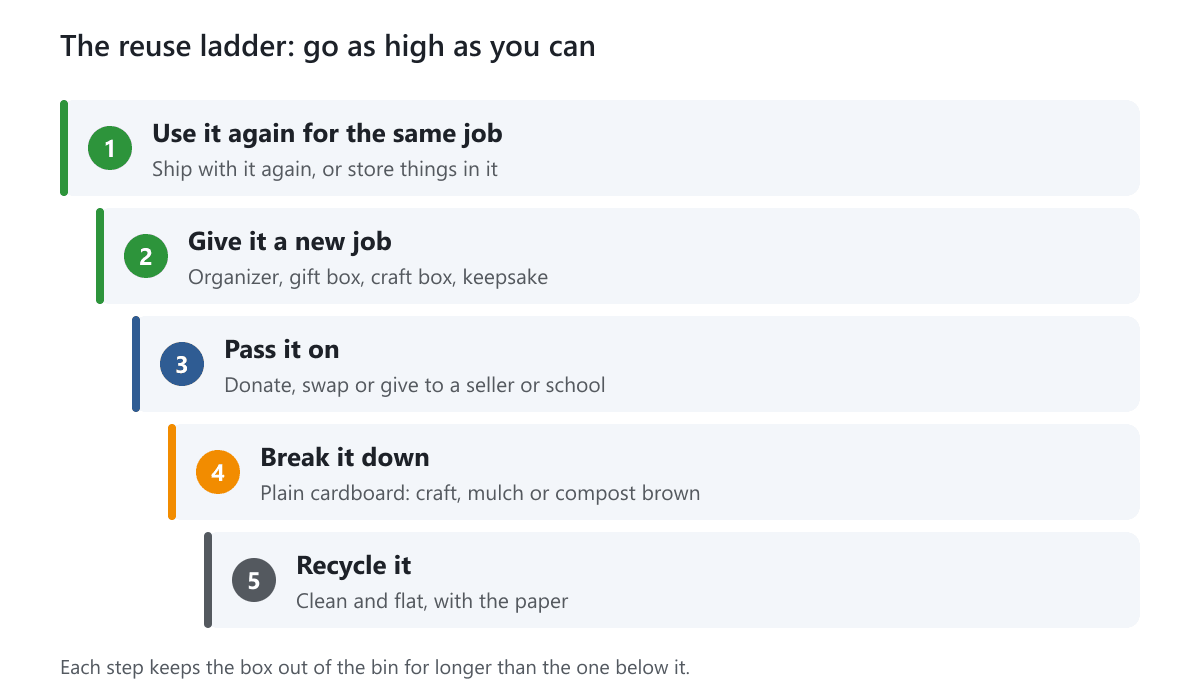
- 1. Use it again for the same job. A shipping box ships again, and a storage box stores again.
- 2. Give it a new job. An organizer, a gift box, a craft box or a keepsake box.
- 3. Pass it on. Give boxes to people who ship, move or craft, or to a school or community group.
- 4. Break it down. Plain cardboard can be used in crafts, as mulch in a garden or as a brown layer in compost.
- 5. Recycle it. Clean, flat boxes go in the paper bin where programs accept them.
Check the Box First
Not every box is worth keeping. A few quick checks tell you whether a box has more uses in it.
- Walls and corners are firm. A crushed or soft box will not protect or hold much.
- It is dry and clean. Damp boxes can grow mold, and mold can spread to what is stored in them.
- No grease or food. A box that held food is not a good choice for storing clothing or papers.
- No strong smell. Smoke, chemicals or damp can stay in cardboard.
- Size and shape suit the job. A tall narrow box is a poor shoe box.
If a box fails these checks, move down the ladder: break it down or recycle it.
Reuse at Home: Storage and Organizing
Storage is the easiest second life for a box, and it costs nothing. Here are common ideas, matched with the kind of box that works best.
| Idea | Best box | Tip |
|---|---|---|
| Drawer organizer for socks, cables or tools | Small paperboard or shoe boxes | Cut the lid off and line them up in a drawer |
| Under-bed storage | Wide, flat corrugated boxes | Label the end so you can find it |
| Seasonal and holiday storage | Sturdy corrugated boxes with lids | Do not stack too high |
| Paper and photo storage | Rigid or clean paperboard boxes | Use acid-free paper inside for long-term keepsakes |
| Desk organizer | Cereal-type cartons, cut down | Cover with paper if you want a clean look |
| Jewelry and small keepsakes | Rigid or drawer boxes | Add a layer of tissue or a felt pad |
| Moving and archive boxes | Corrugated shipping boxes | Tape the bottom twice and avoid overloading |
Label the box on the outside, and keep storage boxes in a dry place. Basements and garages can be damp, and moisture weakens cardboard.
Reuse for Gifting and Presentation
A clean, sturdy box can be a gift box with very little work.
- Wrap it. Cover the box with plain paper, fabric or a printed wrap, and finish with a ribbon.
- Line it. Add tissue paper or shredded paper to cushion the gift.
- Make a hamper or basket. Use a shallow box for a gift hamper with small items arranged inside.
- Send a care package. A small shipping box works well for mailing homemade items.
- Reuse the box a gift came in. A good-looking rigid or drawer box can be passed on as part of a new gift.
If you often give gifts in boxes, you may like our tray and sleeve boxes, which slide open like a drawer and are easy to refill.
Crafts and Kids' Projects
Cardboard is cheap, easy to cut and safe for most children's projects when an adult handles the sharp work.
- Playhouses, castles and cars. Large corrugated boxes become forts and vehicles with a craft knife and markers, handled by an adult.
- Puzzle and game boards. Cut thin cardboard into pieces and color them.
- Sorting and craft trays. Egg cartons and small boxes hold beads, paper clips and paint.
- Wall art and picture frames. Cut and glue layered cardboard into shapes.
- Stationery. Cut cardboard into bookmarks, notebook covers and gift tags.
For sharp tools, use a craft knife or scissors suited to the age of the child, and supervise. Cardboard edges can give paper cuts.
Pets
Many cats like to sit in boxes, and small animals can use a cardboard hide. Choose a clean box, remove all tape, staples and labels, and cut a doorway with smooth edges. Do not give pets boxes that held chemicals or food with strong smells, and replace the box when it is chewed or damp.
Garden Use, With Cautions
Plain cardboard is made from plant fiber and can be useful in the garden when you use it carefully.
- Weed barrier. Lay flat plain cardboard over weeds, wet it, and cover it with mulch. The cardboard blocks light and slowly breaks down.
- Compost. Shred plain, uncoated cardboard and add it to a compost pile as a brown material, in balance with green material.
- Seed-starting pots. Cardboard tubes cut into short lengths work as pots for seedlings.
Cautions: remove tape, staples, plastic labels and shipping stickers first. Avoid glossy, waxed, plastic-coated or heavily printed boxes, because the coatings and inks do not belong in soil. Avoid boxes that held chemicals or oil. Do not stack cardboard against the walls of your house, where it can attract pests and trap moisture. If you plan to grow food, use only plain brown cardboard.
Shipping Again in a Used Box
Reusing a shipping box is the most direct kind of reuse, but it only works if the box is still strong and the carrier can read the new label.
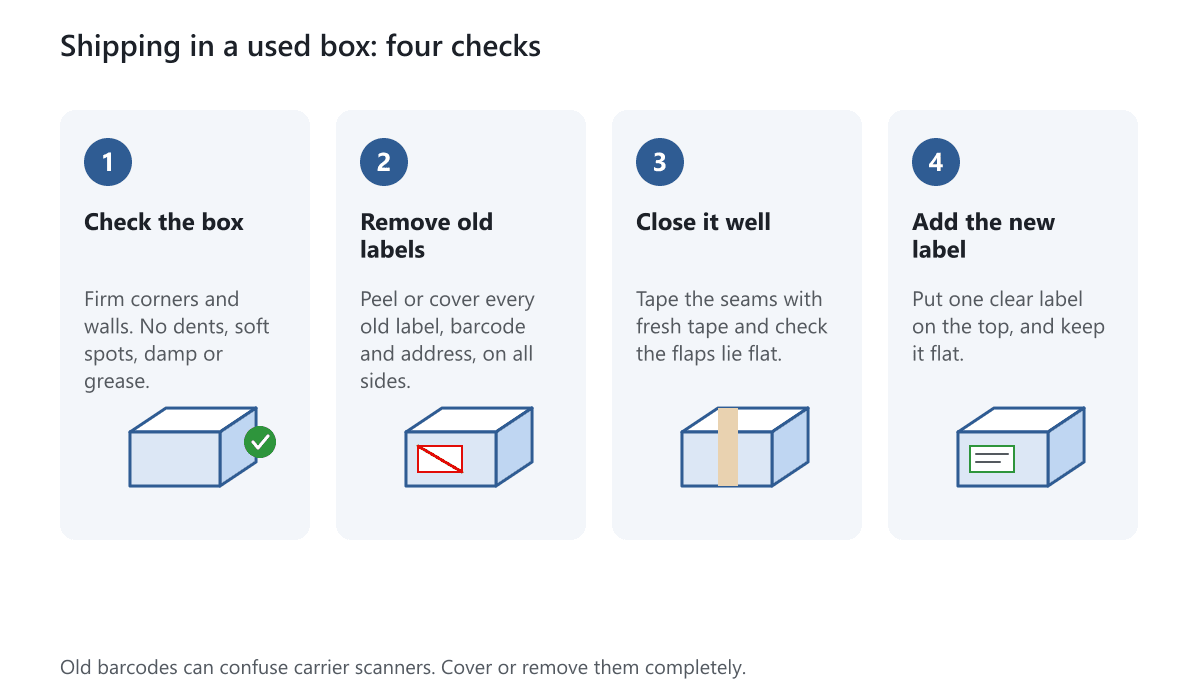
- Check the box. Firm corners and walls, no dents or soft spots, and no damp or grease.
- Remove old labels. Peel or cover every old label, barcode and address on all sides. Old barcodes can confuse scanners.
- Close it well. Use fresh tape on all seams, and check that the flaps lie flat.
- Add one new label. Put a single label on the top, on a flat area, and keep it clear.
- Size it properly. A used box that is too big wastes space and filler. See our measuring guide if you are not sure.
Boxes with printed brand names can be reused, but cover or remove old marks if they could confuse the delivery. A heavy item may need a new box, because corrugated board gets weaker each time it is used.
Reusing Rigid and Gift Boxes
Rigid boxes, drawer boxes and magnetic boxes are made to feel good, and people tend to keep them. They are among the easiest boxes to reuse, because they are sturdy and attractive.
- Keepsakes and memories. Store letters, photographs and small treasures.
- Jewelry and accessories. Use as a case for rings, watches and cufflinks.
- Desk and dresser organizers. A small rigid box holds stamps, cards and pens.
- Gift again. Wrap a new gift in a good box and pass it on.
- Craft supplies. Keep beads, thread, buttons and tools in a labeled box.
If you make products, think about this when you choose a box. A box that people want to keep carries your brand for longer, and the extra use also spreads its environmental cost over more days. See our rigid boxes, magnetic rigid boxes, drawer boxes and two piece foldable boxes for styles that suit reuse.
For Businesses: Designing and Using Boxes for Reuse
Reuse is not only a customer habit. A business can plan for it.
Reuse What You Receive
Delivery boxes that arrive in good condition can ship your own orders. Check strength, remove old labels, and reuse them for lighter, non-fragile products. For fragile or valuable items, use new boxes.
Design a Box People Keep
- Choose a sturdy structure. Rigid, drawer and magnetic closures last longer than thin boxes.
- Make the inside tidy. An insert or a clean interior invites storage.
- Keep branding simple. A box that looks good on a shelf is more likely to stay out.
- Add a note. A short line such as "Keep me for storage" gives people permission.
- Ship flat when you can. Boxes that ship flat save freight space before they are put together. See our page on eco-friendly packaging for more ideas.
Our box inserts hold products in place and give the inside a finished look. A pack that fits and protects the product also lasts longer in the home. Our guide to choosing the right box helps you decide between styles.
Safety Notes
- Keep cardboard away from heat. Do not store boxes near a stove, a heater or an open flame.
- Do not reuse boxes that held chemicals, pesticides or fuel.
- Handle cutting tools carefully. Craft knives and box cutters need a cutting mat and adult supervision for children.
- Watch for staples and nails that stick out of old boxes.
- Avoid food contact. Do not use used cardboard to hold unwrapped food, and do not reuse boxes that held raw meat.
- Check for mold. If a box smells musty or has spots, do not store things in it.
- Lift safely. Do not overload boxes, and bend your knees.
For related packaging and what to do when reuse is over, see our guides to bubble mailers and packing peanuts.
Common Mistakes
- Shipping in a box with the old label still visible.
- Storing items in a damp box in a basement.
- Using a greasy food box for clothing or papers.
- Putting glossy or coated boxes in the garden.
- Using a crushed box for a heavy or fragile shipment.
- Letting boxes pile up without a plan, so they end up in the bin anyway.
Your Next Step
Pick three boxes you have today and decide where each sits on the ladder. If you sell products and want a box people keep, the Standard Sample Kit costs $50, shipping included, and lets you compare structures in your hands. To discuss a custom box, get a free quote.
Frequently Asked Questions
What can I do with old packaging boxes?
Reuse them for shipping or storage, turn them into organizers, gift boxes or craft boxes, or pass them on. Plain cardboard can also be used in the garden as a weed barrier or composted. Recycle boxes that are damaged, as long as they are clean and dry.
Can I reuse a cardboard box for shipping?
Yes, if it is still strong. Check that the corners and walls are firm and the box is dry, remove or cover all old labels and barcodes, close it with fresh tape and add one new label. For heavy or fragile items, use a new box.
Do I need to remove old labels from a box before shipping it again?
Yes. Peel off or fully cover every old label, barcode and address on all sides. Old barcodes can confuse carrier scanners and send a parcel to the wrong place.
Can I compost cardboard boxes?
Plain, uncoated cardboard can be shredded and added to a compost pile as a brown material. Remove tape, staples and labels first, and avoid glossy, waxed or heavily printed boxes.
How many times can a shipping box be reused?
There is no fixed number. Corrugated board weakens each time it is handled, so check the box every time. Reuse it while it is firm, dry and clean, and use it for lighter items as it ages.
Are rigid boxes easier to reuse than regular boxes?
Usually, yes. Rigid, drawer and magnetic boxes are sturdy and look good, so people keep them for storage and gifts. If you want customers to reuse your box, a sturdy structure and a tidy interior help.
Is it safe to use old boxes for storing food?
Not for unwrapped food. Used cardboard may carry dust, moisture or residues. Keep food in food-safe containers, and use boxes for dry non-food items such as papers, tools and clothing.
Written by the PacksDo Team
We make custom printed packaging, from boxes and mailers to bags, labels and inserts. Questions about this guide? Ask us.