In this article
The best way to get rid of packing peanuts is to reuse them, or to give them to someone who ships. Polystyrene peanuts are not accepted in most curbside recycling bins, and they do not break down on their own. Starch-based peanuts are different: they dissolve in water, and that is how you can tell the two apart.
This guide covers how to identify which kind you have, why the foam type is tricky, the options in order from best to last resort, what is true and untrue about composting peanuts, and what shippers can use instead. It is written for people who have a pile of peanuts in a box today and for sellers who want to stop creating the problem.
Key takeaways
- Identify the type first. Drop one peanut in water. Polystyrene stays solid, and starch-based peanuts soften and dissolve.
- Reuse is the best answer. Peanuts can be used many times if they stay clean and dry.
- Ask before you drop off. Some pack-and-ship shops and local sellers take clean peanuts, but policies change.
- Foam peanuts are not compostable. The word "biodegradable" belongs only to some starch types, and even those need local guidance.
- Do not scatter them. Light peanuts blow away and are hard to clean up. Bag them.
- Shippers have alternatives. Paper void fill, right-sized boxes and inserts do the same job with a simpler end of life.
Two Kinds of Packing Peanuts
Packing peanuts are small shaped pieces used as loose-fill cushioning. They look alike, but they are made of different materials and are handled differently.
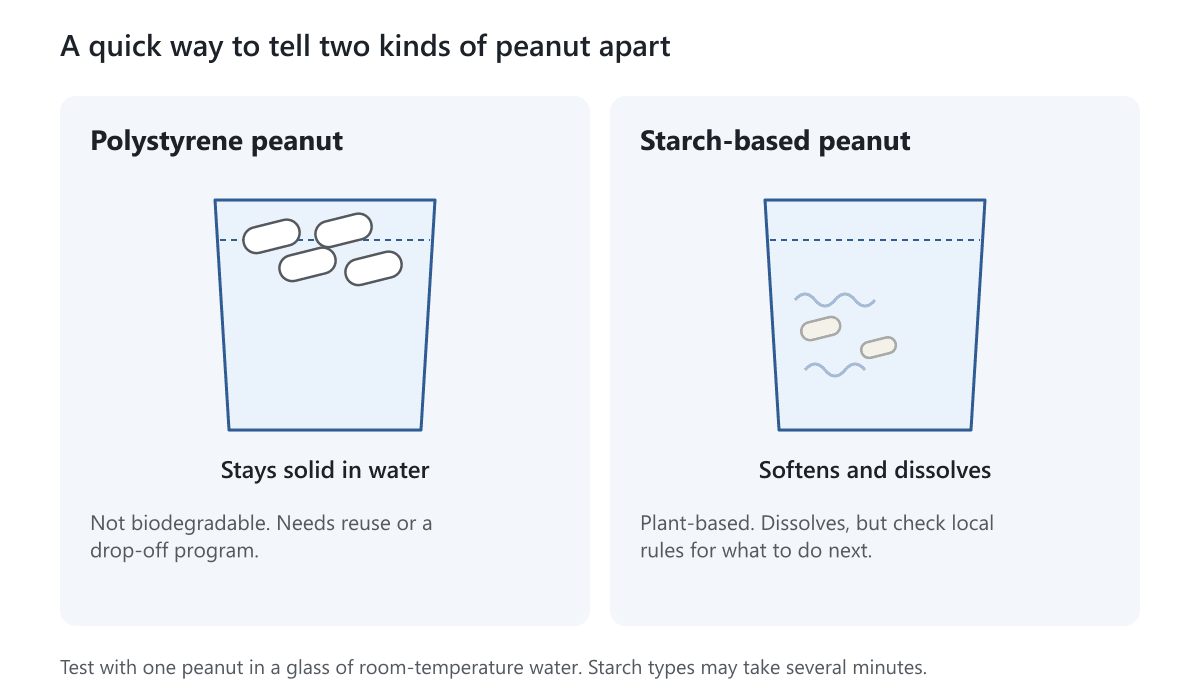
| Type | Made of | In water | What to do |
|---|---|---|---|
| Polystyrene (foam) | Expanded polystyrene plastic | Stays solid | Reuse, donate or use a drop-off program |
| Starch-based | Starch, often from corn or similar plants | Softens and dissolves | Reuse, or dissolve, as local advice allows |
The Water Test
- Step 1: Fill a glass with room-temperature water.
- Step 2: Drop in one peanut and wait. Starch types can take a few minutes, and warm water is faster.
- Step 3: If it softens or starts to dissolve, it is starch-based. If it stays solid, it is polystyrene.
- Step 4: Treat the pile as the type you found. Do not mix them, and do not assume that a pack of mixed peanuts is all one type.
Some peanuts carry a mark or a note such as "biodegradable". Treat that as a clue, not a proof, and test one.
Why Polystyrene Peanuts Are Tricky
Polystyrene is a plastic that is mostly air. That makes it very light and very good at cushioning, and also hard to handle as waste.
- Not accepted curbside. Most curbside recycling programs do not take foam, and loose pieces slip through sorting equipment.
- Takes up space, weighs little. Collecting and moving air is costly compared to the value of the material.
- Does not break down. In a landfill it stays for a very long time, and loose pieces can blow away and break into smaller bits.
- Static makes them hard to control. They stick to clothes, floors and each other.
Some specialized programs and drop-off points recycle or reuse clean foam, but availability is limited and varies by location. That is why reuse is the best answer.
Ways to Get Rid of Packing Peanuts
Follow this order. The first options keep the peanuts in use, and the last ones treat them as waste.
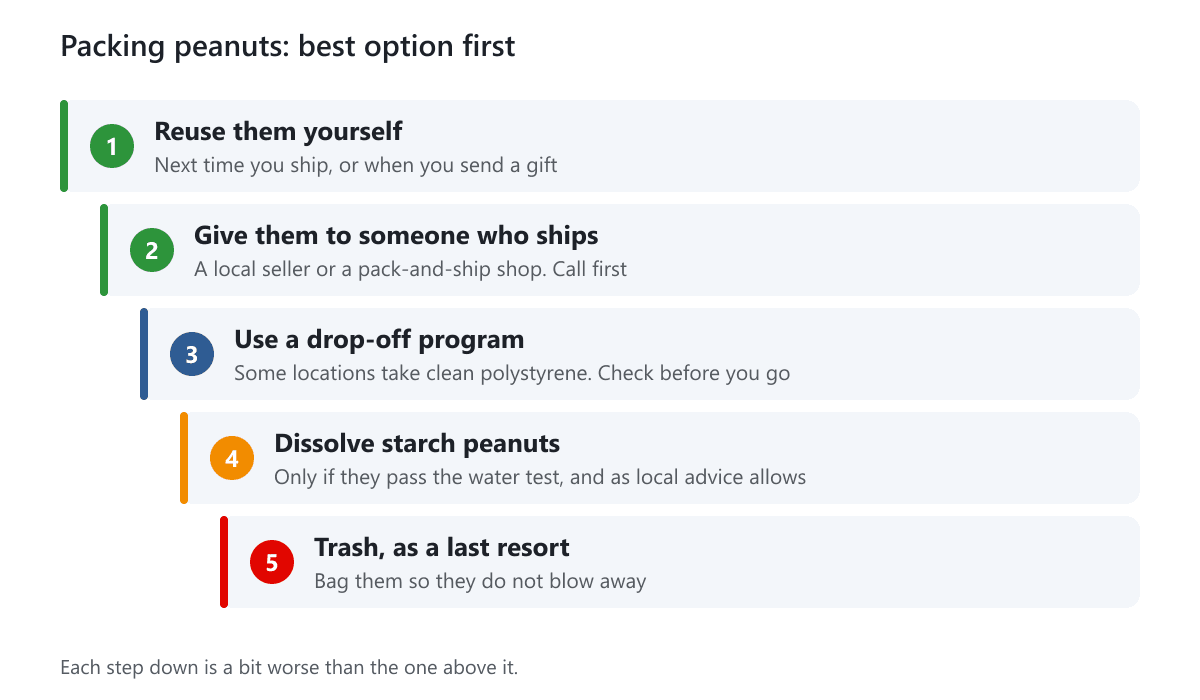
1. Reuse Them Yourself
Clean, dry peanuts can be used many times. Keep them in a large bag or a box in a closet, and use them the next time you ship a gift or a sale. Check each time that they are not damp, torn or dusty.
2. Give Them to Someone Who Ships
Small online sellers, craft sellers, schools and community groups often need cushioning. Many independent pack-and-ship shops accept clean peanuts for reuse as well. Policies change, so call before you go. Never leave a bag at a business without permission.
3. Use a Drop-Off Program
Some recycling centers and specialty programs take clean polystyrene foam, sometimes including peanuts. Search for your area, and look at what the program accepts. Some will take only blocks and not loose peanuts. A few mail-back options exist, but the cost of shipping can outweigh the benefit, so treat them with caution.
4. Dissolve Starch-Based Peanuts
If the water test shows that your peanuts are starch-based, you can dissolve them in water. Many sources say a small amount of the resulting mixture can go down a household drain, but local advice differs, and large amounts of starch can clog pipes. If you have a septic system, check first. When in doubt, ask your local waste authority.
5. Trash Them, as a Last Resort
If nothing else works, put polystyrene peanuts in a sealed bag and put them in the trash. Do not put them in the recycling bin unless your program says it accepts them. Bagging stops them blowing around the street.
Composting Myths
Composting is where most of the confusion comes from.
- Polystyrene is not compostable. It does not break down in a compost pile or a composting facility.
- "Biodegradable" does not mean the same everywhere. Starch-based peanuts may break down in water or in the right conditions, but the term says little about time, place or what is left. Our guide to biodegradable packaging materials explains the differences.
- Dissolving is not composting. A peanut that melts in water has changed form, but that is not the same as being accepted by a compost program.
- Check the supplier. If you want to compost starch peanuts, ask the manufacturer what they are made of and how they recommend disposal.
Tips for Easy Disposal
- Sort by type with the water test before you do anything else.
- Keep peanuts dry, because damp starch peanuts stick and dissolve.
- Store them in a large bag or a box with a lid, and label it.
- Take out other packing material, such as tape and paper, so the peanuts are clean.
- Reuse the box and the packaging you received first. Our guide to ways to reuse packaging boxes has ideas.
- Call a drop-off before you carry a big bag there.
Alternatives for Shippers
If you ship products, the easiest way to deal with packing peanuts is to stop creating them. There are several alternatives, and the right one depends on what you ship.
| Option | Good for | Trade-offs |
|---|---|---|
| Right-sized box | Almost everything | Needs the right size on hand |
| Cardboard or molded pulp insert | Fragile items of a fixed shape | Made to fit one product |
| Crinkled paper or void fill | Odd shapes and gaps | Takes a little more time to pack |
| Packing paper wrap | Glass, ceramics, candles | Needs more sheets for heavy items |
| Tissue paper | Light items and presentation | Offers little cushioning on its own |
A better-fitting box often removes the need for filler. See our guide to measuring a box correctly. Paper-based fill, such as packing paper and void fill, is recycled with paper where it is accepted, and box inserts hold a product in place without loose pieces. Our mailer boxes and shipping boxes are made from corrugated board, so they go in the paper bin after use. Read more about the paper route in our guide on whether cardboard gets recycled.
How to Choose
- Weight. Heavy items need firm support, such as an insert or a snug box, not loose fill.
- Fragility. For glass and ceramics, wrap each item and fill the gaps, then test the box with a drop.
- Volume. A machine that dispenses paper fill saves time at higher volume.
- Brand look. Colored or printed paper adds to the unboxing, and loose peanuts rarely do.
- Customer disposal. Customers can recycle paper. They cannot easily dispose of foam.
Common Mistakes
- Putting foam peanuts in the recycling bin.
- Assuming every white peanut dissolves in water.
- Scattering them loose in a garden or composter.
- Leaving a bag at a shipping store without asking.
- Pouring large amounts of dissolved starch down a drain without checking.
- Sending peanuts to customers as filler when the product could fit a smaller box.
Your Next Step
If you have peanuts now, run the water test and then reuse or hand them on. If you are a seller, try one order with paper fill or a snug box and see whether it protects as well. The Standard Sample Kit costs $50, shipping included, and our box inserts are another route. For a custom fit, get a free quote.
Frequently Asked Questions
How do I get rid of packing peanuts?
Reuse them first, then give them to a local seller or a pack-and-ship shop that accepts them, or use a drop-off program for clean foam. If they are starch-based, you can dissolve them in water as local advice allows. Use the trash only as a last resort, and bag the peanuts.
Can I recycle packing peanuts?
Not in most curbside bins. Some specialty programs and drop-off locations take clean polystyrene, and many shipping shops reuse them. Check before you go, because programs change.
How can I tell if packing peanuts are biodegradable?
Drop one in water. Starch-based peanuts soften and dissolve. Polystyrene peanuts stay solid. A label that says "biodegradable" is a clue, but the water test is more reliable.
Can I put packing peanuts in my compost?
Polystyrene peanuts cannot be composted. Starch-based peanuts may break down, but check with the manufacturer and your compost program before adding them. Dissolving in water is not the same as composting.
Can I pour dissolved packing peanuts down the drain?
Many sources say a small amount of dissolved starch peanuts is fine in a household drain, but large amounts can clog pipes and rules vary. If you have a septic system or you are unsure, ask your local waste or water authority.
What is a good alternative to packing peanuts?
A right-sized box is the best first step. For cushioning, use crinkled paper or void fill, wrap items in packing paper, or use a cardboard or molded pulp insert. All are paper-based and easy for customers to recycle.
Why are packing peanuts so hard to dispose of?
Polystyrene peanuts are very light and mostly air, so they are costly to collect and move, and they slip through sorting machines. They also do not break down. That is why reuse and drop-off are better than curbside recycling.
Written by the PacksDo Team
We make custom printed packaging, from boxes and mailers to bags, labels and inserts. Questions about this guide? Ask us.