In this article
- 1What Cheap Means for a Custom Box
- 2Where to Get Affordable Custom Packaging Boxes
- 3What Drives the Price of a Custom Box
- 4Ways to Cut Cost Without Looking Cheap
- 5What to Do When You Are Under the Minimum
- 6Test Before You Commit: Samples
- 7How to Compare Custom Box Quotes Fairly
- 8What to Avoid When Buying Custom Boxes
- 9A Checklist Before You Request Quotes
- 10Next Step
You can get affordable custom packaging boxes by ordering from a custom packaging manufacturer, keeping the design simple, choosing a size and board that suit the product, and ordering a quantity that brings the price per box down. The lowest-cost route is rarely the lowest quote: it is the box that protects your product, looks right and costs the least per order you ship.
This guide is about custom boxes, meaning boxes made to your size and printed with your design. It explains what drives the price, where to get quotes, how to cut cost without making the box look cheap, what to do when your quantity is below the minimum and how to compare quotes fairly. We do not list prices, because they change with every detail of an order.
Looking for plain stock boxes instead? See where to buy cheap shipping boxes. For a deeper look at how packaging cost affects your retail price, read our guide on the impact of packaging costs on product pricing.
Key takeaways
- Cost depends on the details. Size, board, printing, finishes, structure and quantity each move the price.
- Smaller and simpler costs less. A smaller flat pattern, fewer colors and fewer finishes lower the price without hurting the look.
- Quantity matters most. The price per box falls as the order grows, but only buy what you will sell.
- Minimums are real. They start at 50 to 500 units depending on the product, and below that, stock boxes plus branding are the smarter route.
- Compare like with like. Make every quote state the same size, board, print, finish, quantity and shipping.
What Cheap Means for a Custom Box
A low price per box can hide a high cost per order. Three numbers matter, and they do not always point the same way.
- Price per box. What you pay for each box at a given quantity.
- Total order cost. The price per box times the quantity, plus shipping and any setup, sample or tooling charges.
- Cost per sale. The packaging cost you carry on each product you sell, including damage, filler and extra postage.
A cheaper box that crushes in transit, or one that is too large and raises your shipping bill, is not cheap. A slightly dearer box that fits well and arrives intact usually wins on cost per sale. Keep that in mind as you read the tips below.
Where to Get Affordable Custom Packaging Boxes
There are a few kinds of sources, and each suits a different order. We name no companies because the right choice depends on your quantity, product and deadline.
| Kind of source | Good for | Watch for |
|---|---|---|
| Custom packaging manufacturers like us | Your own size, structure, print and finishes; quotes with shipping included | Minimum order and production time |
| Local printers and converters | Short runs, face-to-face help, fast proofs | Limited structures and finishes |
| Wholesale or trade distributors | Large runs of standard styles | Big minimums, less design help |
| Online short-run print sites | Very small runs of simple boxes | Limited sizes, higher cost per box |
| Stock boxes plus branding | Tiny quantities, testing a product | Not your exact size, plain look unless branded |
Our minimums depend on the product and each product page states its own. Shipping boxes and rigid boxes have a low minimum. Most other boxes, such as tuck boxes and mailer boxes, start at 100 units. Paper bags, poly mailers, stickers and hang tags start at 500 units. We offer free design support and reply to quotes within 1 business day.
What Drives the Price of a Custom Box
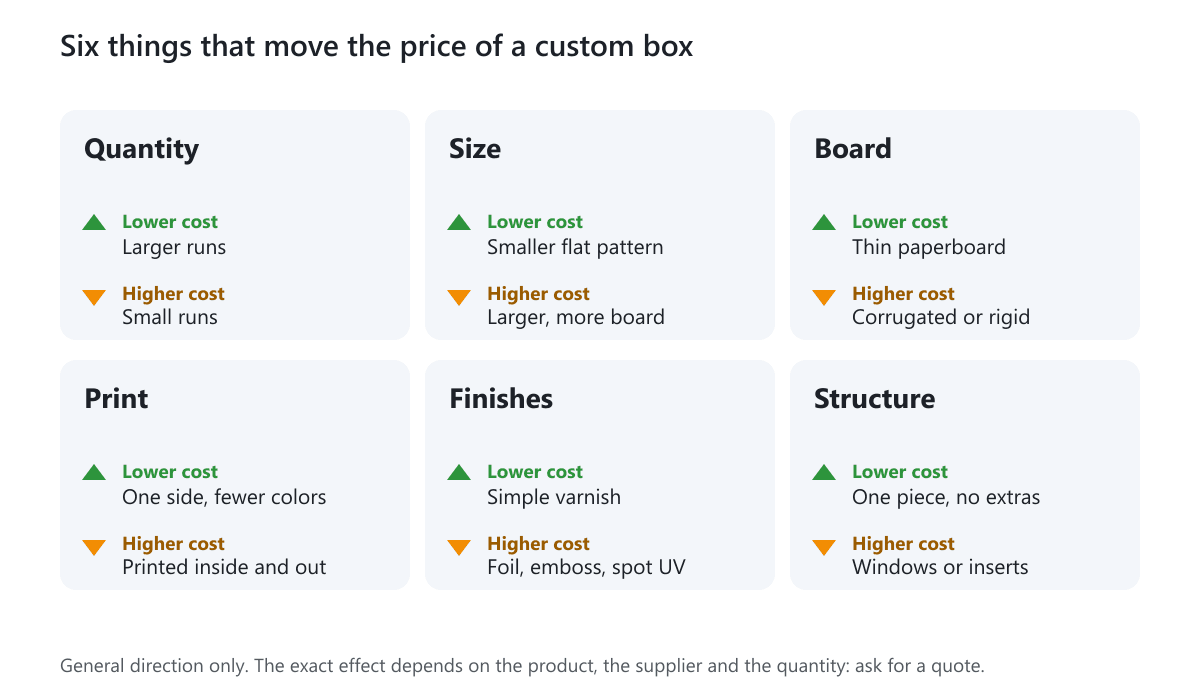
Here is what each lever means in plain words.
Quantity
Making any box has setup work, such as preparing the artwork, the cutting die and the press. That work is spread across the whole run, so a larger run means a lower price per box. The trade-off is cash tied up in stock and the risk that the design changes before you use them all.
Size and Open Size
The open size is the flat size of the box before it is folded. A larger open size uses more board and fits fewer boxes on a printing sheet, so it costs more. Shaving a few millimeters off a box can matter more than you expect.
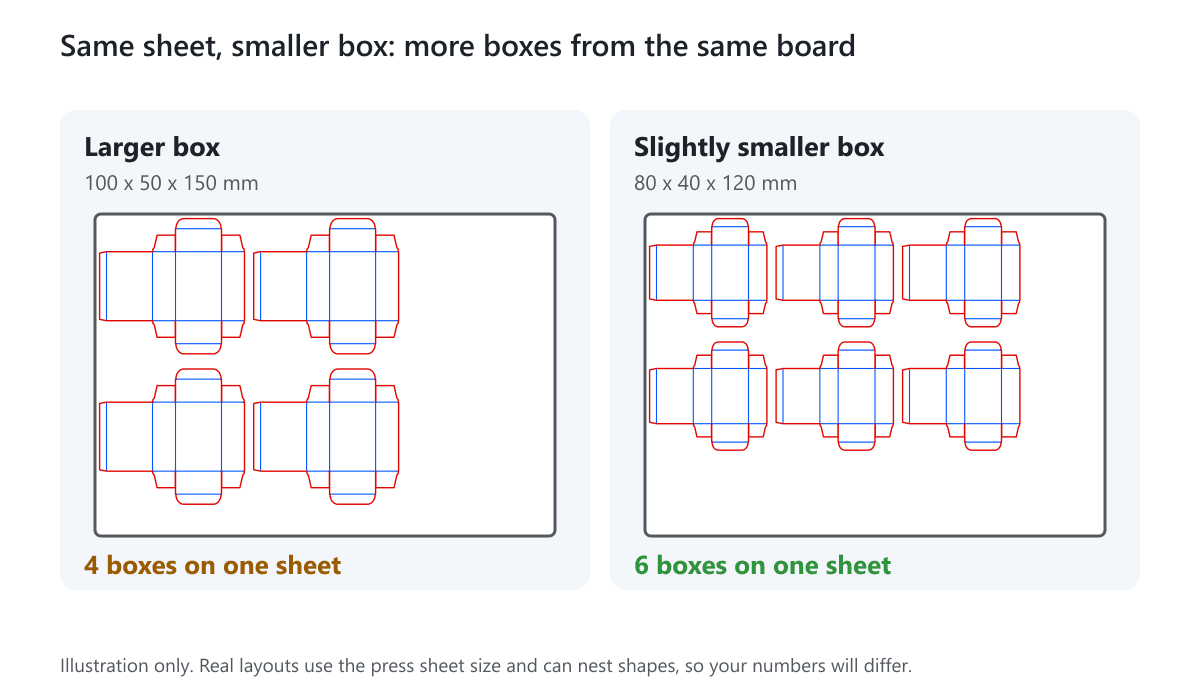
The picture shows the idea with two tuck box patterns on one sheet. Real layouts depend on the press sheet and can nest shapes together, so your numbers will differ. Our guide to measuring a box correctly helps you find the smallest size that still fits.
Board
Thin paperboard costs less than corrugated board, and corrugated costs less than rigid board wrapped in printed paper. Choose the board for the job: paperboard for retail shelves, corrugated for shipping, rigid for premium gifts.
Print and Coverage
Printing on the outside only costs less than printing inside and out. Fewer colors cost less than many. Ask whether Pantone colors cost extra in your quote. We print in CMYK or Pantone.
Finishes
A matte, glossy, satin or soft touch coating through varnish or lamination adds a little. Foil stamping, embossing or debossing, spot UV and window patching add more, because each is an extra step. Use them where they count.
Structure and Extras
A simple one-piece box costs less than one with a window, an insert, a magnet closure or a ribbon. Each extra part adds material and labor.
Ways to Cut Cost Without Looking Cheap
Cutting cost does not mean cutting quality. These changes keep a box looking good and lower its price.
- Right-size the box. Remove empty space. A snug box uses less board and lowers shipping weight.
- Choose the simpler structure. A tuck box or a mailer box costs less than a rigid box with a magnet closure, and many products do not need more.
- Print one strong surface. One bold color on kraft board, or full print only on the front panel, can look deliberate.
- Use one finish well. A soft touch coating or a small foil logo looks richer than three finishes crowded together.
- Brand a plain box with a sleeve. A printed packaging sleeve over a simple box gives you a brand look at a lower cost, and you can change the sleeve each season.
- Use one size for several products. A shared box size means one larger order instead of three small ones.
- Order the neutral box in quantity. Add stickers or tags for variations. Stickers and labels start at 500 units.
- Plan ahead. Rush work can add cost and risk. Production takes 5 to 7 working days after artwork approval and payment, plus delivery time. Larger or more complex orders can take longer, and we confirm the date in your quote.
- Send clean artwork. Files that follow the dieline avoid proof rounds. See our guide to preparing dielines for prepress.
- Think about reorders. If your design stays the same, a repeat order can be simpler to plan.
Examples
These are invented examples to show the thinking, not customer stories.
- A candle brand wants 300 tuck boxes. It drops the foil and inside print, keeps a one-color outside print on kraft and adds a printed sticker. The look stays natural and the order costs less.
- A clothing start-up wants 100 mailer boxes. It prints outside only and adds a branded tissue sheet. The reveal still feels designed.
- A skincare brand wants 2,000 folding cartons. It trims the box height by 5 mm after a sample test, so more patterns fit on each sheet. The saving comes from the size, not from lower quality.
What to Do When You Are Under the Minimum
If your quantity is below the minimum for custom boxes, you have good options.
- Stock box plus branding. Buy plain boxes and add a sticker, tape and tissue paper.
- Start at the lowest-minimum item. Shipping boxes and rigid boxes have a low minimum.
- Combine products. If several products can share one box size, you reach the minimum sooner.
- Print a sleeve or a label first. Brand a stock box with a printed sleeve or sticker, then move to custom printed boxes when volume grows.
- Test in the market. Sell a first batch in stock packaging to learn demand before you order a large custom run.
Our guide to choosing the right box for your product helps you pick a style, and our article on the five mistakes small brands make when ordering packaging lists traps to avoid.
Test Before You Commit: Samples
A sample is an inexpensive way to avoid a costly mistake. A structural sample is an unprinted prototype that shows the size and form of your box, so you can test the fit. A printed proof shows how colors and finishes look. Our Standard Sample Kit costs $50 with shipping included, and it may not include rigid boxes or boxes that ship assembled, so ask us about rigid samples. The samples page lists every sample type. The free dieline templates let you check proportions before you request a quote.
How to Compare Custom Box Quotes Fairly
Two quotes can look far apart simply because they describe different boxes. Ask every supplier to fill in the same rows.
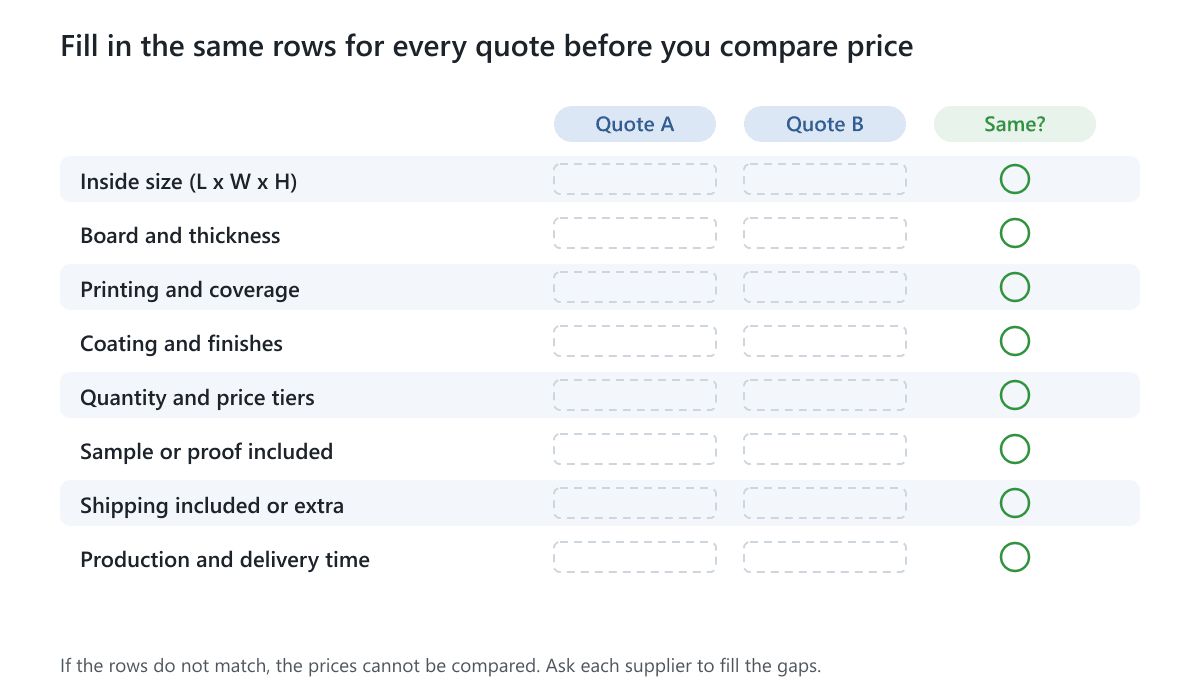
| Row | What to check |
|---|---|
| Inside size | Is it the inside size you asked for, in the same order? |
| Board | Same board type and thickness, such as paperboard gsm or flute |
| Printing | Same colors and the same coverage, outside only or inside too |
| Finishes | Same coating and any foil, embossing or spot UV |
| Quantity | Same quantity, and price tiers for more |
| Samples and proofs | What is included before the full run |
| Shipping | Our quotes include shipping to the US and Canada; check taxes, duties and extras on others |
| Time | Production time and delivery time, which are two separate numbers |
If two quotes differ on any row, the prices cannot be compared yet. Ask each supplier for a revised quote.
What to Avoid When Buying Custom Boxes
- Quotes that do not state the board. The board decides strength and thickness.
- No dieline or proof step. You should see the layout and artwork before production.
- Prices without shipping or setup costs. Ask what is included.
- A very low price with a vague lead time. Ask for the production time and what it starts from.
- Skipping the sample for a large order. A fit problem at full quantity is costly.
- Over-specifying. Do not pay for finishes your customer will never notice.
- Buying too many. An unused box is wasted money, so order what you will use in a season.
A Checklist Before You Request Quotes
- Product measured and inside size chosen.
- Box style and board chosen for the job.
- Print plan decided: colors, coverage, one finish.
- Quantity set, with a note of any higher quantity to price.
- Sample plan: structural sample, kit or template check.
- Same questions ready for each supplier.
- Timeline worked back from your launch date.
Next Step
Tell us what you are packaging, its size, the quantity you have in mind and how much print you want, and we will recommend a style and quote it with shipping included: get a free quote. If you are comparing, use the table above to keep quotes comparable.
Frequently Asked Questions
Where can I get cheap custom packaging boxes?
Custom packaging manufacturers, local printers, trade distributors and online short-run print sites all make them. Compare the total cost per order, not only the price per box. Our rigid boxes have a low minimum, shipping boxes start at 50 units and most other boxes at 100.
How can I lower the cost of custom boxes?
Right-size the box, choose a simpler structure, print outside only or with fewer colors, use one finish well, and order a larger quantity of one neutral box. A printed sleeve or sticker can give a brand look on a simple box.
What is the minimum order for custom boxes?
It depends on the product. Our shipping boxes and rigid boxes have a low minimum, most other boxes at 100, and paper bags, poly mailers, stickers and hang tags at 500. Each product page states its own minimum.
Why do custom box quotes differ so much?
Quotes often describe different boxes: a different size, board, print coverage, finish, quantity or shipping term. Ask each supplier to quote the same specification so you can compare prices fairly.
Does a smaller box cost less?
Usually yes. A smaller open size uses less board, and more patterns fit on each printing sheet. It can also lower shipping weight. Keep enough room for the product and any insert.
Can I order a sample before a large run?
Yes. A structural sample is an unprinted prototype showing size and form, and our Standard Sample Kit costs $50 with shipping included. See our samples page for every sample type.
Are custom boxes worth it for a small business?
They can be if you ship or sell the same product regularly and can reach the minimum. If your volume is small, stock boxes plus a branded sticker or sleeve are cheaper while you test demand. Compare the cost per sale, not just per box.
Written by the PacksDo Team
We make custom printed packaging, from boxes and mailers to bags, labels and inserts. Questions about this guide? Ask us.