In this article
- 1Cheap Is Not the Same as Low Cost Per Parcel
- 2Where to Buy Cheap Shipping Boxes
- 3Box Strength: Single Wall or Double Wall
- 4Right-Size the Box to Cut Shipping Cost
- 5Buying in Bulk: When It Helps and When It Hurts
- 6Used and Free Boxes: What Can Go Wrong
- 7When Custom Shipping Boxes Pay Off
- 8Other Ways to Cut the Cost of Shipping Packaging
- 9How to Compare Shipping Box Offers
- 10Common Mistakes When Buying Shipping Boxes
- 11A Checklist Before You Buy
- 12Next Step
The lowest-priced shipping box is not always the lowest-cost way to ship. Buy stock corrugated boxes from a local packaging supplier, an online packaging retailer or a wholesale distributor, and choose a size that fits your product closely. That combination keeps both the price of the box and the cost of the postage down.
This guide is for small sellers, makers and online shops. It explains where to buy shipping boxes, how to read box strength, how right-sizing lowers shipping cost, when buying in bulk helps, why used boxes are risky and when it is worth moving to custom boxes. It sticks to ideas that stay true even when prices change, so you will not find price tables here.
If you need very large boxes for moving or oversized goods, read where to buy large cardboard boxes. If you want printed boxes with your logo, see where to get cheap custom packaging boxes.
Key takeaways
- Judge the cost per parcel. Box price, filler, tape, postage and damaged orders all count, not only the price on the box.
- Right-size first. A box that fits your item can cut dimensional weight, the size-based charge many carriers use.
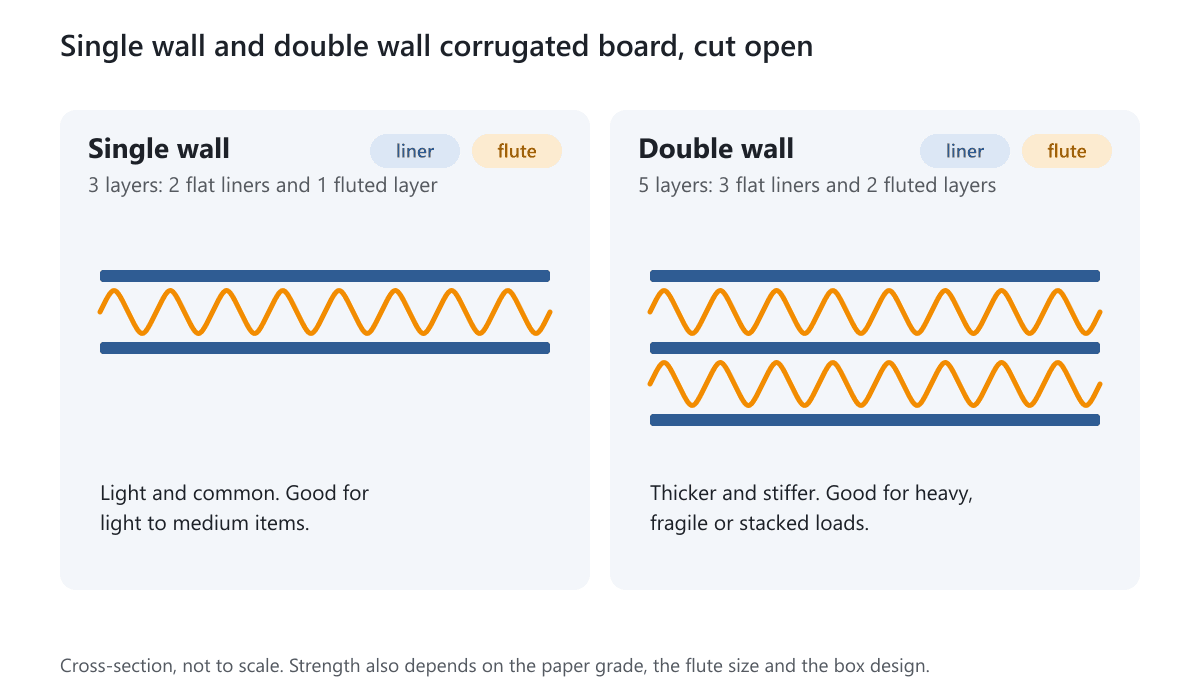
- Match strength to the load. Single wall suits light and medium items. Double wall suits heavy, fragile or stacked loads.
- Stock wins at small quantities. Custom boxes start to make sense when you ship the same product often and can reach the minimum.
- Avoid worn boxes. Reused boxes lose strength and carry old labels, so use them only for light, low-risk parcels.
Cheap Is Not the Same as Low Cost Per Parcel
A box that costs a few cents less can cost much more once you count everything around it. That is false economy, and it is the most common trap in this search.
- Damage. A weak box that crushes means a refund or a resend, plus an unhappy customer.
- Filler. A box that is too big needs more paper or air pillows to stop the item moving.
- Postage. Carriers charge by weight or by size, whichever is higher. An oversized box can bill like a heavier parcel.
- Time. Packing an awkward box slowly costs labor, even if it is your own.
- Storage. A pallet of boxes you cannot use up takes space and cash.
So the real question is what a box costs you once it is packed, sealed and delivered. Start with the box that protects the item and fits it closely, then look for a fair price on that box.
Where to Buy Cheap Shipping Boxes
These are the kinds of places that sell shipping boxes. We name no stores on purpose, since the best choice depends on your quantity and location.
| Kind of source | Good for | Watch for |
|---|---|---|
| Local packaging suppliers | Same-day pickup, a few boxes, feeling the board strength | Narrow size range, little or no printing |
| Online packaging retailers | Wide choice of sizes, packs of 10 to 100, quick dispatch | Shipping cost on bulky boxes, plain look |
| Wholesale distributors | Bulk quantities of standard sizes | Large minimums, pallet storage |
| Warehouse clubs and carrier stores | Convenience for a few boxes | Few sizes, limited board choice |
| Online marketplaces | Quick comparison of many sellers | Quality varies, check the board rating |
| Custom packaging manufacturers like us | Boxes in your exact size, with printing | Minimums, production and delivery time |
For the first four, ask for the strength rating of the box, not only its size. For the last, ask for the minimum order. Our shipping boxes start at 50 units, and we reply to quotes within 1 business day.
Box Strength: Single Wall or Double Wall
Most shipping boxes are made from corrugated board. Corrugated board is paper made of flat layers called liners with a wavy layer between them called the flute. The flute acts like tiny arches and gives the board its stiffness. More layers mean a stronger box.
Reading the Strength Rating
Stock boxes often carry a stamp on the bottom flap, called the box maker's certificate. It usually shows one of two ratings.
- ECT (edge crush test). It measures how much pressure the board edge takes before it crushes, in pounds per inch. It tells you how well boxes stack and survive pressure.
- Burst or Mullen strength. It measures how much pressure the board takes before it bursts, in pounds per square inch. It is an older rating that still appears.
- Maximum gross weight. Many certificates also show the heaviest load the box is rated for, including its contents.
As a rough guide, common single-wall boxes run from about 32 ECT to 44 ECT, and double-wall boxes are rated higher still. Treat those figures as typical, and check the stamp on the boxes you are buying.
| What you ship | Box strength to look at |
|---|---|
| Soft goods, clothing, light retail items | Single wall, standard rating |
| Books, candles, jars, medium-weight items | Single wall with a higher rating, or add dividers |
| Heavy, fragile or stacked loads | Double wall |
| Items that travel long distances or by pallet | Double wall, with cushioning or inserts |
Board thickness also matters for fit: thicker walls take room from the inside. Our guide to measuring a box correctly explains inside and outside sizes. For what to pack in them, see what boxes are good for shipping.
Right-Size the Box to Cut Shipping Cost
Many carriers charge by dimensional weight, often called DIM weight. It is the weight a carrier assigns to a parcel from its size: length x width x height, divided by a number called the divisor. The carrier bills the higher of the real weight and the DIM weight. Divisors differ by carrier and rate type and change over time, so check the current one with yours.
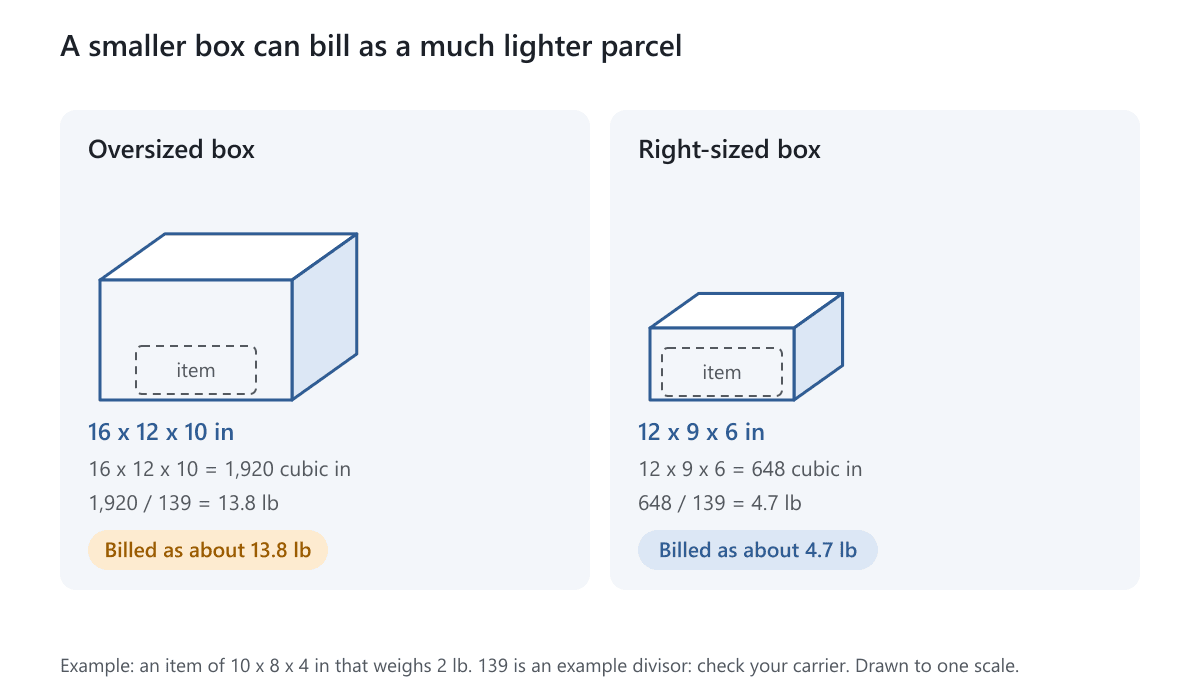
In the example above, an item of 10 x 8 x 4 inches that weighs 2 pounds sits in two boxes. With an example divisor of 139, the big box works out to about 13.8 pounds and the right-sized box to about 4.7 pounds. The item has not changed, but the first parcel bills at a much heavier weight.
How to Right-Size in Five Steps
- Measure the packed item. Include its wrap, cap and any insert, as in our measuring guide.
- Add room for cushioning. Allow about an inch or less on each side for paper or air pillows, more for fragile items.
- Pick the closest stock size. Round up to the next size that fits.
- Test one parcel. Pack it, shake it, drop it from table height and weigh it.
- Limit your sizes. Two or three box sizes cover most sellers, and fewer sizes mean better prices and less storage.
Soft goods do not need a box at all. Clothing and other flexible items can ship in poly mailers, which are light and take little room.
Buying in Bulk: When It Helps and When It Hurts
Larger quantities usually lower the price per box, because the supplier spreads setup and handling over more boxes. That helps only if you can use them up.
- Check storage. Boxes ship flat in bundles but take a lot of room. Measure your shelf or floor space first.
- Keep them dry. Corrugated board absorbs moisture and weakens, so store boxes off the floor in a dry place.
- Count your use. Buy about two to three months of supply for a size you use daily, and less for a size you use rarely.
- Ask for price tiers. Many suppliers quote several quantities. Compare the steps, not only the biggest.
- Add delivery. Bulky boxes can cost a lot to ship, so a lower box price with high freight may not save anything.
Buying a few different sizes in small packs is a smart first step before committing to a large run.
Used and Free Boxes: What Can Go Wrong
Free boxes from stores, friends or recycling bins look like the lowest-cost option. They suit light, low-risk parcels, such as a handmade card or a soft item, if you take care.
- Lost strength. A box that has been used once, stacked or wet can be much weaker than a new one, even if it looks fine.
- Old labels and marks. Cover or remove old barcodes and addresses so scanners do not read them. See our guide to where to place a shipping label on a box.
- Odd sizes. A random box often fits badly, which brings back the filler and DIM weight problem.
- Hygiene. Boxes that held food or chemicals can leave smells or residue. Do not use them for food, cosmetics or clothing.
- Brand impression. A scuffed box with another company's logo does not look like you.
For anything heavy, fragile, valuable or sold under your brand, use new boxes.
When Custom Shipping Boxes Pay Off
Custom boxes cost more per box than stock at small quantities, but they can lower the cost per parcel. They pay off when:
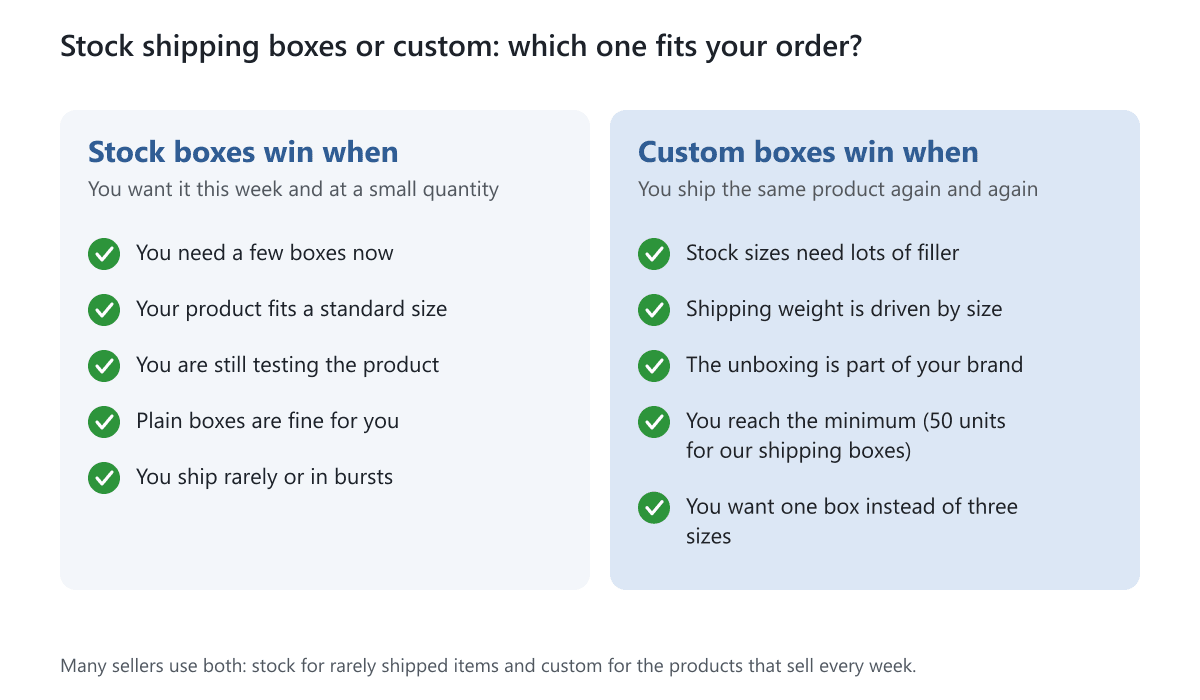
- your product has an unusual size and every stock box needs lots of filler;
- you ship the same product every week, so one custom size replaces three stock sizes;
- your brand matters on the doorstep, and printing the box means you skip the extra sticker, tape and tissue;
- you can reach the minimum. Our shipping boxes start at 50 units, and our mailer boxes at 100 units.
For a plain look with a perfect fit, our corrugated boxes page explains the board and the styles. For a deeper cost comparison, read are custom shipping boxes worth it.
A Worked Example
Take a small candle brand that ships 150 jars a month. Its jar is 3 x 3 x 4 inches. It uses two stock boxes to fit gift sets and singles, and adds crumpled paper to stop movement. A custom shipping box sized to hold one jar with a divider could remove the filler and one stock size from the storeroom. This is an example, not a customer story: the saving depends on your quotes and your carrier rates.
Other Ways to Cut the Cost of Shipping Packaging
- Use paper filler. Crumpled kraft paper or packing paper protects well and is easy to recycle.
- Use dividers and inserts. Box inserts hold items still and replace bulky void fill.
- Seal well, but not too much. Use the H-tape method, with strips along the center seam and both edges, rather than a dozen random strips.
- Standardize. If you sell twelve products, group them into two or three box sizes.
- Check carrier rates. Compare two carriers for your usual parcel size and weight, and ask about discounts for volume.
How to Compare Shipping Box Offers
Put each offer next to the others and check the same points.
| Check | What to ask |
|---|---|
| Size | Inside dimensions, in the order length x width x height |
| Strength | Single or double wall, ECT or burst rating, maximum gross weight |
| Quantity | Pack size, minimum order and price tiers |
| Printing | Plain, one color or full color, and any setup charges |
| Delivery | Freight cost, lead time and where it ships from |
| Support | Samples, returns and how damage is handled |
Order a small test pack before a large run. Our Standard Sample Kit costs $50 with shipping included, and the samples page lists other sample types such as a structural sample, an unprinted prototype that shows size and form.
Common Mistakes When Buying Shipping Boxes
- Choosing by price alone and ignoring the strength rating.
- Measuring the item, not the packed item with cushioning.
- Using one big box size for everything.
- Reusing a worn box for heavy or fragile goods.
- Ordering a pallet before testing one box.
- Forgetting that carriers measure the outside of the box.
- Not asking about freight on bulky boxes.
A Checklist Before You Buy
- Packed item measured and weighed.
- Box size chosen with room for cushioning and no more.
- Strength chosen for the load: single or double wall, rating checked.
- Carrier DIM divisor checked for your usual parcel.
- Quantity worked out, with storage space planned.
- Test parcel packed, shaken and weighed.
- Stock or custom decided by your quantity and brand needs.
Next Step
If you ship a few parcels a week, buy stock boxes in your two or three most common sizes and test them. If you ship the same product often, tell us what it is, its size and how many you ship, and we will recommend a style: get a free quote. You can also read our guide to choosing the right box for your product.
Frequently Asked Questions
Where can I buy cheap shipping boxes?
Local packaging suppliers, online packaging retailers, wholesale distributors, warehouse clubs and marketplaces all sell them. Compare the cost per parcel, not only per box: include strength, size, filler and freight. For printed boxes in your own size, a custom manufacturer like us can quote from 50 units.
Is single wall or double wall better for shipping?
Single wall suits light and medium items. Double wall suits heavy, fragile or stacked loads and long journeys. Check the strength rating on the box stamp, such as ECT, and the maximum gross weight.
What does ECT mean on a box?
ECT is the edge crush test. It measures how much pressure the edge of the corrugated board takes before it crushes, in pounds per inch. A higher number generally means a stronger box that stacks better.
Does a smaller box really lower shipping cost?
Often yes. Many carriers charge by dimensional weight, calculated from the box size, and bill the higher of that and the real weight. A box that fits the item can bill at a lower weight. Check your carrier's current divisor.
Is it safe to reuse old shipping boxes?
For light, low-risk parcels it can work if the box is dry, clean and undamaged and you remove old labels. Reused boxes lose strength, so use new boxes for heavy, fragile, valuable or branded shipments.
When should I switch from stock to custom shipping boxes?
Consider custom when you ship the same product regularly, stock sizes leave a lot of empty space, or branding on the box matters. Our shipping boxes start at 50 units, so check that your volume reaches it and compare the cost per parcel.
How many shipping boxes should I buy at once?
Buy enough for about two to three months of the sizes you use most, within your storage space. Test a small pack first, ask for price tiers and keep boxes dry and off the floor.
Written by the PacksDo Team
We make custom printed packaging, from boxes and mailers to bags, labels and inserts. Questions about this guide? Ask us.