In this article
- 1Common Large Box Sizes and What They Are For
- 2Moving Boxes, Shipping Boxes and Wardrobe Boxes
- 3Wall Strength: Single, Double and Triple Wall
- 4How Carriers Treat Large and Oversized Parcels
- 5Where to Buy Large Cardboard Boxes
- 6How to Measure Before You Buy
- 7Protecting Fragile Items in Large Boxes
- 8Moving and Storage Tips
- 9Reuse and Recycle Large Boxes
- 10When Custom Large Boxes Make Sense
- 11Common Mistakes When Buying Large Boxes
- 12A Checklist Before You Buy
- 13Next Step
Where you buy large cardboard boxes depends on what you are doing with them. For a move or a one-off, buy stock boxes from a home improvement store, a moving supply store, an office supply store or an online packaging retailer. For a product you ship again and again, a custom corrugated box in your exact size, from a manufacturer like us, can fit better and cost less per parcel.
This guide covers the sizes that exist, how to tell moving boxes from shipping boxes and wardrobe boxes, how wall strength works, why large parcels can cost more to ship, where to buy by use, and how to protect fragile items and reuse boxes afterward. It does not list prices, because they change.
If your box is small to medium and you are shipping a product, read where to buy cheap shipping boxes instead. If you need to size a custom box, see our guide to measuring a box correctly.
Key takeaways
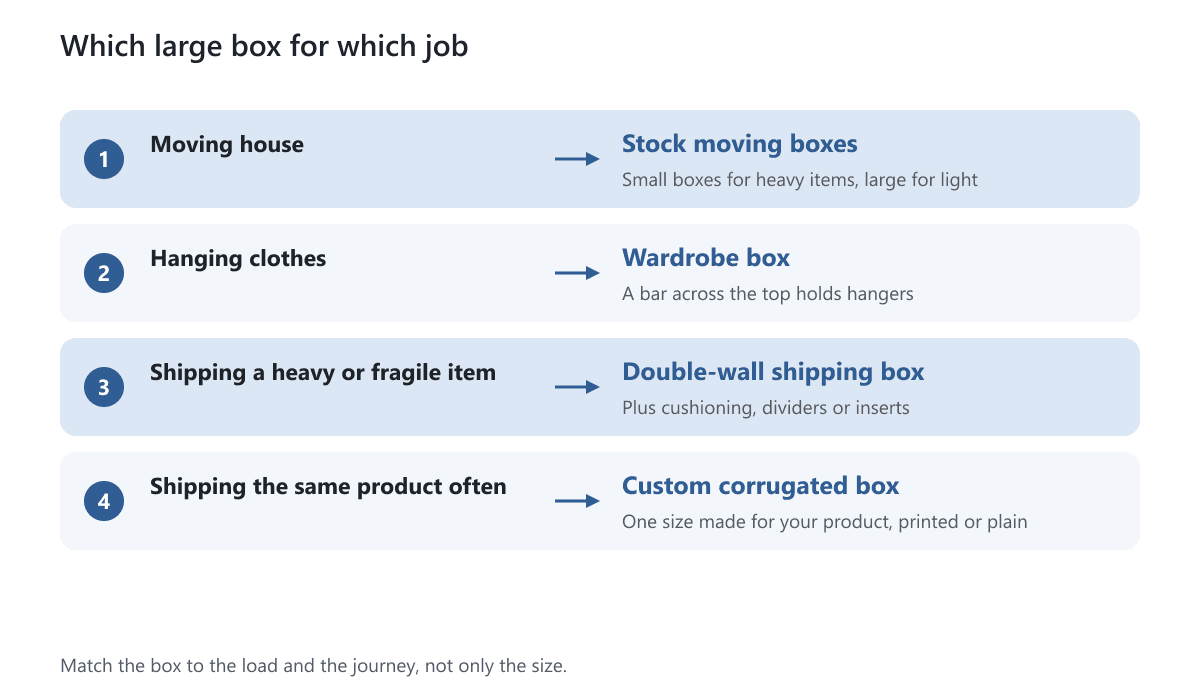
- Pick by the job. Moving, storing, shipping and hanging clothes each need a different kind of large box.
- Match strength to weight. Single wall suits light bulky items, double wall suits heavy or fragile ones, and very heavy loads may need triple wall.
- Large boxes can cost more to ship. Carriers add charges for size and shape, so check their rules before you buy.
- Stock for one-offs, custom for repeats. Custom boxes need a minimum quantity and lead time but fit your product.
- Measure twice. Measure the item, add cushioning and check the inside size of the box.
Common Large Box Sizes and What They Are For
There is no single standard, because each seller chooses its own sizes. The sizes below are typical examples that show how large boxes are grouped by use.
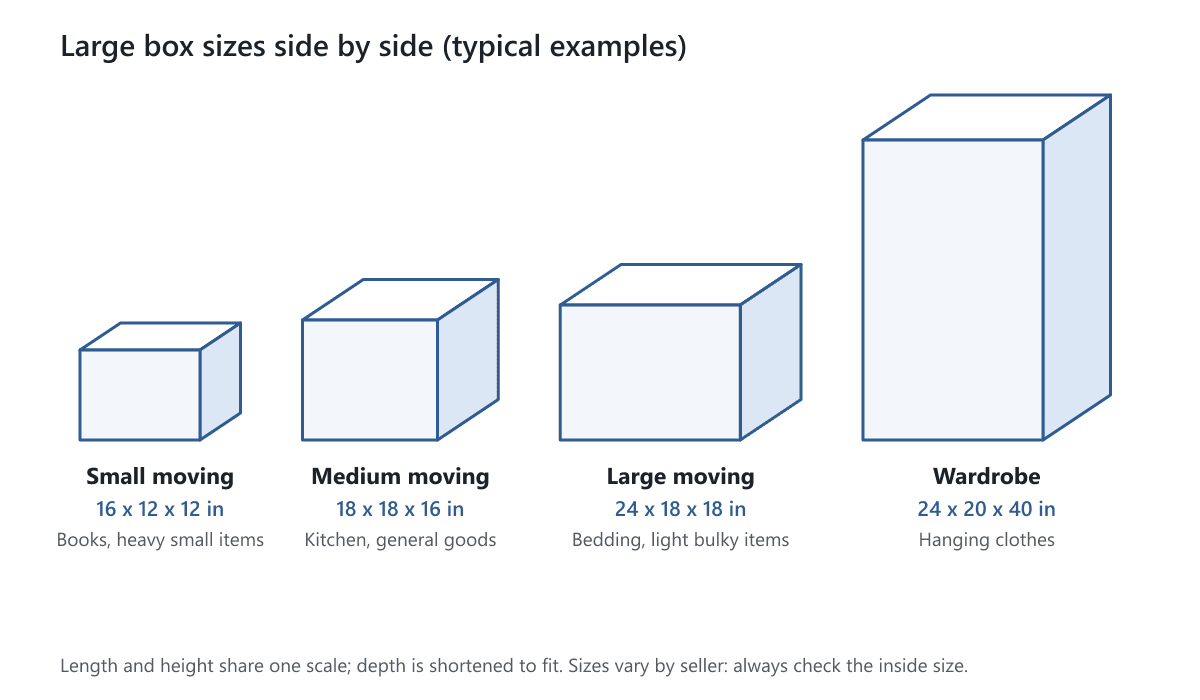
| Box | Typical size (inches) | Best for |
|---|---|---|
| Small moving or book box | About 16 x 12 x 12 | Books, tools and heavy small items |
| Medium moving box | About 18 x 18 x 16 | Kitchen items, toys, general goods |
| Large moving box | About 24 x 18 x 18 | Bedding, pillows, light bulky items |
| Wardrobe box | About 24 x 20 x 40 | Hanging clothes, with a bar to hold hangers |
| Flat or picture box | A wide, thin shape | Mirrors, frames, artwork, tabletops |
A rule of thumb for packing is to use small boxes for heavy things and large boxes for light things. A large box filled with books is too heavy to lift and can split at the bottom.
Moving Boxes, Shipping Boxes and Wardrobe Boxes
These three can look alike, but they are built for different jobs.
Moving Boxes
Moving boxes are designed to be carried by hand and stacked in a truck. They usually have handle holes and come in a few standard sizes. They are made to be used once or a few times.
Shipping Boxes
Shipping boxes are made to be handled by machines and carriers, so strength and a clean, square shape matter more than handles. Our shipping boxes are custom size and can be printed, and our mailer boxes suit products that go flat-packed to customers.
Wardrobe Boxes
A wardrobe box is tall and has a metal or cardboard bar across the top, so clothes hang as they would in a closet. It is built for a move or for storing clothes, not for sending a product to a customer.
Special Boxes
Some stores sell dish packs, TV boxes, mirror boxes and mattress boxes. These are made for one product shape, usually with double-wall board. They suit that one job and are often a poor fit for anything else.
Wall Strength: Single, Double and Triple Wall
Corrugated board is made of flat liners with a wavy flute between them. The more layers it has, the stiffer and heavier it gets.
| Board | Layers | Typical use |
|---|---|---|
| Single wall | 2 liners and 1 flute | Light to medium items, general moving and shipping |
| Double wall | 3 liners and 2 flutes | Heavy, fragile, stacked or long-distance loads |
| Triple wall | 4 liners and 3 flutes | Very heavy or bulk loads, often on pallets |
Our guide to where to buy cheap shipping boxes shows the cross-section of single and double wall board and explains the strength ratings printed on box stamps, such as ECT. Look for the stamp on the bottom flap: it usually shows the board rating and the heaviest load the box is built for, including its contents.
Large boxes need more strength, not less, because a larger panel flexes more and a heavier load presses on the bottom. As a general rule, choose double wall for large boxes that carry heavy or fragile goods.
How Carriers Treat Large and Oversized Parcels
Large boxes can cost more to ship than you expect. The details change by carrier and year, so treat this as a map of what to check rather than a rule.
- Dimensional weight. Carriers bill the higher of the real weight and the weight worked out from the box size. A large, light box often bills by size.
- Length plus girth. Girth is the distance around the box, measured as 2 x (width + height). Carriers add it to the length, and parcels above certain totals can be charged extra or refused.
- Longest side and weight. Very long or very heavy parcels can attract handling surcharges.
- Packaging and shape. Parcels that are not in a sturdy, regular box, or that have an odd shape, can attract extra fees.
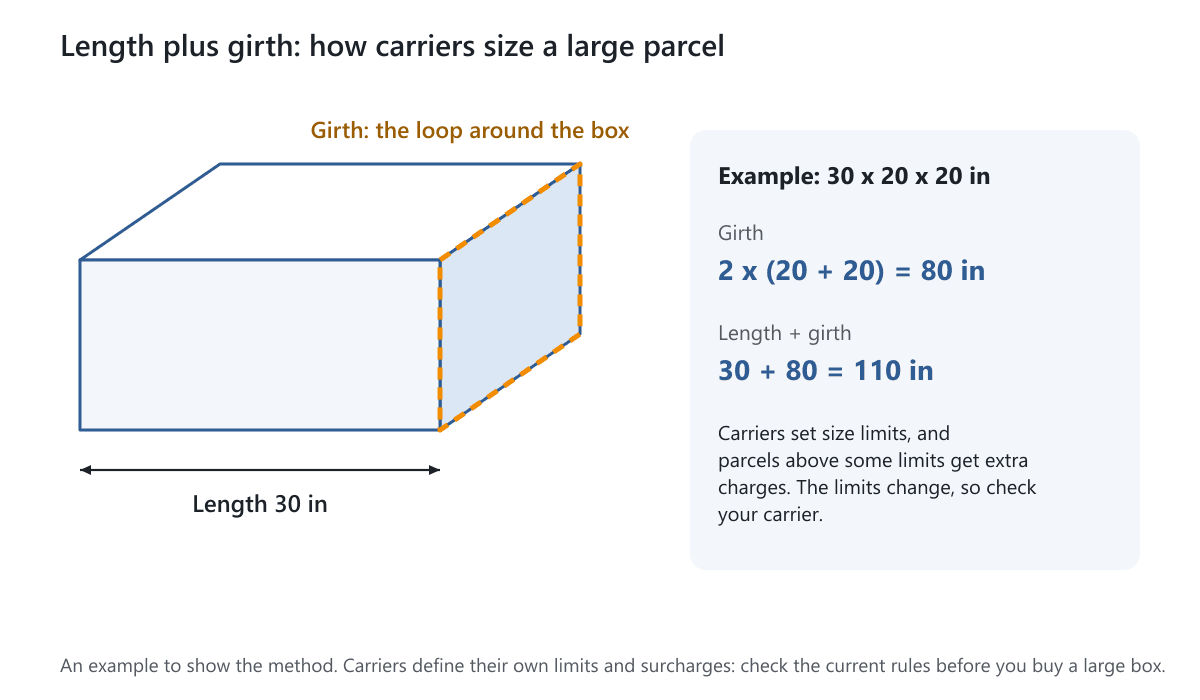
In the example above, a box of 30 x 20 x 20 inches has a girth of 2 x (20 + 20) = 80 inches, so its length plus girth is 110 inches. The numbers are an example to show the method. Ask your carrier for its current limits and surcharges before you buy a large box, and use the carrier's rate calculator with the packed size and weight.
The practical lesson is to use the smallest box that protects the item. Right-sizing a large box saves more than shopping around for its price.
Where to Buy Large Cardboard Boxes
These are the kinds of places that sell large boxes. We do not name stores because the best option depends on your location and quantity.
| Kind of source | Good for | Watch for |
|---|---|---|
| Home improvement stores | Moving boxes, wardrobe boxes and tape in one trip | Limited sizes, price per box adds up |
| Moving supply and truck rental stores | Moving kits and special boxes | Higher price for small quantities |
| Office supply stores | A few boxes, quick pickup | Few large sizes |
| Online packaging retailers | Wide choice of sizes and strengths, bulk packs | Freight cost on large boxes |
| Wholesale distributors | Pallet quantities of one size | Large minimums and storage space |
| Local stores and classifieds | Free or low-cost used boxes | Weaker boxes, mixed sizes, old labels |
| Custom packaging manufacturers like us | Your size, strength and print, repeat orders | Minimum quantity, production and delivery time |
For a one-off move, a store or an online retailer is the quickest route. For regular shipments of a large product, custom boxes can be sized to remove empty space and can carry your branding. Our shipping boxes start at 50 units, and we reply to quotes within 1 business day. See our corrugated boxes page for the board and styles.
How to Measure Before You Buy
Measure the item, not the box you hope it fits. Our guide to measuring a box correctly covers the order of length, width and height and the difference between inside and outside size.
- Measure the item at its longest, widest and tallest points. Include handles, legs or anything that sticks out.
- Add room for cushioning. About 2 inches on each side is a common starting point for a fragile item, and less for a sturdy one.
- Check inside dimensions. Seller sizes are often outside sizes, and the walls take room from the inside.
- Check the weight limit. The box must be rated for the weight of the item plus packing.
- Check carrier limits. Work out the girth and the DIM weight before you order.
A Worked Example
Say a seller ships a framed mirror that measures 40 x 30 x 1.5 inches. With 2 inches of cushioning on each side, the inside of the box needs to be about 44 x 34 x 5.5 inches. A 44 x 34 x 6 inch box has a volume of 8,976 cubic inches, which with an example divisor of 139 is about 64.6 pounds of dimensional weight. The mirror may weigh far less, so the size is what the carrier would bill. The seller should compare a thinner cushion, a different packing method and a custom size before buying. This is an example, not a customer story.
Protecting Fragile Items in Large Boxes
A large box leaves a lot of empty space, and empty space is where damage happens. Fix it with structure, not just filler.
- Use double wall for fragile loads. The extra layers resist crushing and punctures.
- Fill voids. Crumpled paper or packing paper stops the item moving.
- Use dividers and inserts. Box dividers and box inserts hold the item away from the walls.
- Protect corners and edges. Corner pieces or folded cardboard shield the weakest points.
- Use the box-in-box method for valuable goods. Pack the item in a snug box, then place that box in a larger one with cushioning around it.
- Seal like you mean it. Use the H-tape method, with strips along the center seam and both edges, and add extra tape on heavy boxes.
A Fragile sticker alone does not protect an item, because parcel systems are largely automated. Pack as if the box will be dropped and stacked.
Moving and Storage Tips
- Keep each box to a weight you can lift, and label the room and contents.
- Put heavy items at the bottom and light ones on top, with no empty gaps.
- Tape the bottom with extra strips before you fill the box.
- Store boxes off the floor and away from damp, since corrugated board weakens when wet.
- Do not stack filled boxes higher than the weaker, lower boxes can bear.
If you only need boxes for a move, ask local stores or neighbors for good used boxes, and pay for new boxes only for heavy or valuable items.
Reuse and Recycle Large Boxes
A large cardboard box is easy to reuse. Flatten it and store it for the next move, use it for storage, use it as a protective layer in garden or craft projects, or pass it on. Our guide to ways to reuse packaging boxes has more ideas.
When a box is worn out, cardboard is widely collected for recycling where local facilities accept it. Flatten it, remove plastic tape and labels where you can, and keep it dry. Our guide on whether cardboard gets recycled explains the details. Recycling rules differ by town, so check yours.
When Custom Large Boxes Make Sense
Custom boxes cost more per box at small quantities but can lower cost per parcel when you ship regularly. They tend to pay off when:
- the product has a fixed size that stock boxes never fit well;
- you ship at least weekly and can reach the minimum;
- stock boxes need heavy filler or force you into a larger size and a higher bill;
- your brand matters on delivery, and printing the box skips a sticker or tape.
Our guide to are custom shipping boxes worth it compares costs in more detail. A structural sample, an unprinted prototype that shows size and form, helps you test the fit before a full run. See the samples page.
Common Mistakes When Buying Large Boxes
- Filling a large box with heavy items so it is too heavy to lift.
- Choosing single wall for a heavy or fragile load.
- Ignoring carrier size limits until the label shows a surcharge.
- Using the outside size as the inside size.
- Not leaving room for cushioning.
- Storing boxes in a damp garage or basement.
- Buying a pallet of boxes before testing one.
A Checklist Before You Buy
- Item measured, packed size worked out with cushioning.
- Job decided: moving, storage, shipping or hanging clothes.
- Wall strength chosen for the load, with the box stamp checked.
- Carrier girth, DIM weight and surcharge rules checked.
- Source chosen by quantity: store for one-offs, retailer or manufacturer for volume.
- Tape, void fill and dividers bought with the boxes.
- Storage and reuse plan ready.
Next Step
For a move or one-off shipment, buy stock boxes and use the checklist above. For a product you ship often, tell us its size, weight and how many you send, and we will recommend a style: get a free quote. You can also read our guide to choosing the right box for your product.
Frequently Asked Questions
Where can I buy large cardboard boxes?
Home improvement stores, moving supply stores, office supply stores, online packaging retailers and wholesale distributors all sell them. For a one-off move, a store is quickest. For repeat shipments, custom corrugated boxes from a manufacturer like us can fit your product exactly, with a minimum of 50 units for our shipping boxes.
What size is a large moving box?
Sellers differ, but a large moving box is often around 24 x 18 x 18 inches, a medium one around 18 x 18 x 16 and a small one around 16 x 12 x 12. Wardrobe boxes are taller, often around 40 inches. Check the inside size of the box you buy.
Should I use single wall or double wall for large boxes?
Single wall suits light bulky items. Choose double wall for heavy, fragile, stacked or long-distance loads, because large panels flex more and heavier loads press on the bottom. Very heavy loads may need triple wall.
Why does shipping a large box cost more?
Carriers bill the higher of the real weight and the dimensional weight, which comes from the box size, and they may add charges for length plus girth, long sides, heavy weight or awkward shapes. Check your carrier's current rules before you buy a large box.
What is girth on a box?
Girth is the distance around the box, usually worked out as 2 x (width + height). Carriers add the length to the girth to check a parcel against their size limits. A box of 30 x 20 x 20 inches has a girth of 80 inches and a length plus girth of 110 inches.
How do I pack a fragile item in a large box?
Use a double-wall box, fill empty space with paper, hold the item with dividers or inserts and protect corners. For valuable goods, pack the item in a snug box and put that box inside a larger one with cushioning all around.
Can I reuse large cardboard boxes?
Yes, if they are clean, dry and undamaged. Remove old labels, and use new boxes for heavy or valuable shipments, because used boxes lose strength. When a box is worn out, flatten it and recycle it where local facilities accept cardboard.
Written by the PacksDo Team
We make custom printed packaging, from boxes and mailers to bags, labels and inserts. Questions about this guide? Ask us.