In this article
- 1The Ten Ideas on One Sheet
- 21. Window Cutouts
- 32. Die-Cut and Custom Shapes
- 43. Drawer and Slide Boxes
- 54. Magnetic Closures
- 65. Nested and Reveal Packaging
- 76. Handle and Structure Twists
- 87. Inside Print
- 98. One-Color Minimal
- 109. Pattern Wraps
- 1110. Reusable Second-Life Boxes
- 12How to Choose Which Idea Fits
- 13Finishes That Make Ideas Stand Out
- 14How to Brief a Designer
- 15Common Mistakes With Unique Boxes
- 16Your Next Step
The box designs that make a product stand out are the ones with one clear, surprising idea that suits the product: a window that shows what is inside, a shape that echoes the product, a drawer that slides open, a magnet that closes with a click, or a bold pattern. This guide covers ten such ideas, with when to use each, what it costs in general terms and one practical tip.
Unique does not have to mean complicated. Some of the ideas below are among the simplest and cheapest to make. The aim is not to use all ten, but to pick the one that fits your product and your budget. If you first need the basics, read what custom packaging boxes are, and for the brand side see what branded boxes are.
Key takeaways
- Pick one hero idea. One strong move plus clean basics beats five effects together.
- Match the idea to the product and the buyer, not to a trend.
- More complex usually costs more. Custom shapes, magnets and nested builds take more design time and more steps to make.
- Simple can still be distinctive. A one-color box in a strong color, or a bold pattern, costs little.
- Test with a sample. Unusual structures need a physical check before a full run.
- Write a clear brief for the designer, and use a dieline template for the right shape.
The Ten Ideas on One Sheet
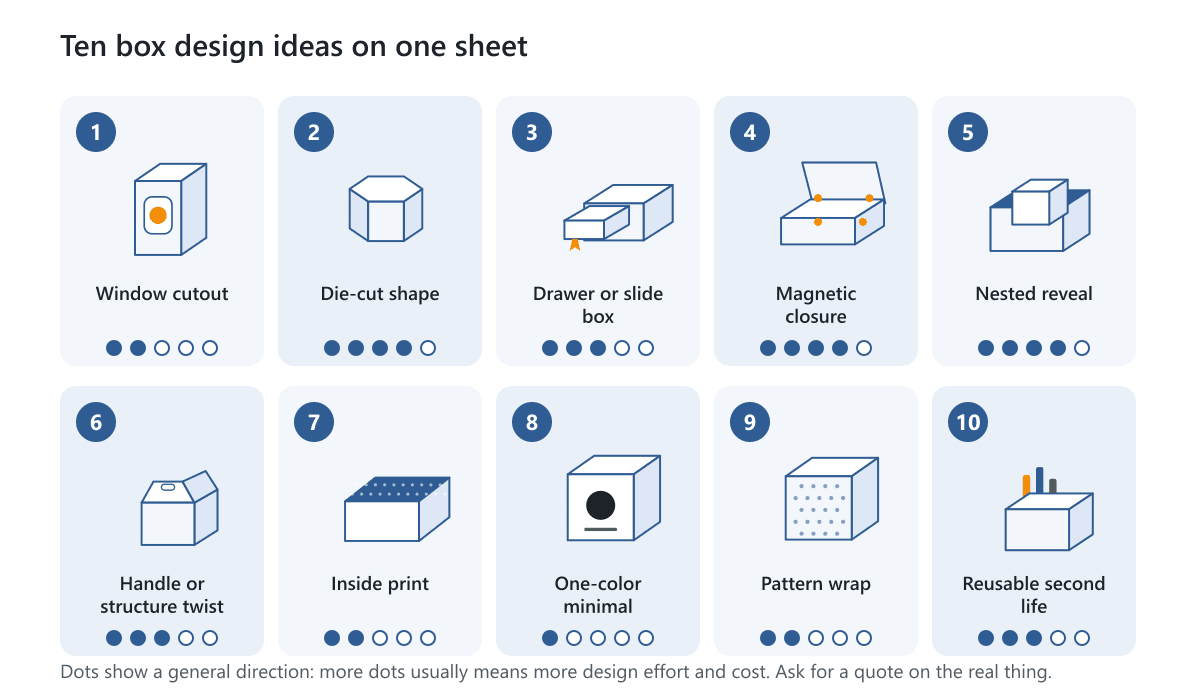
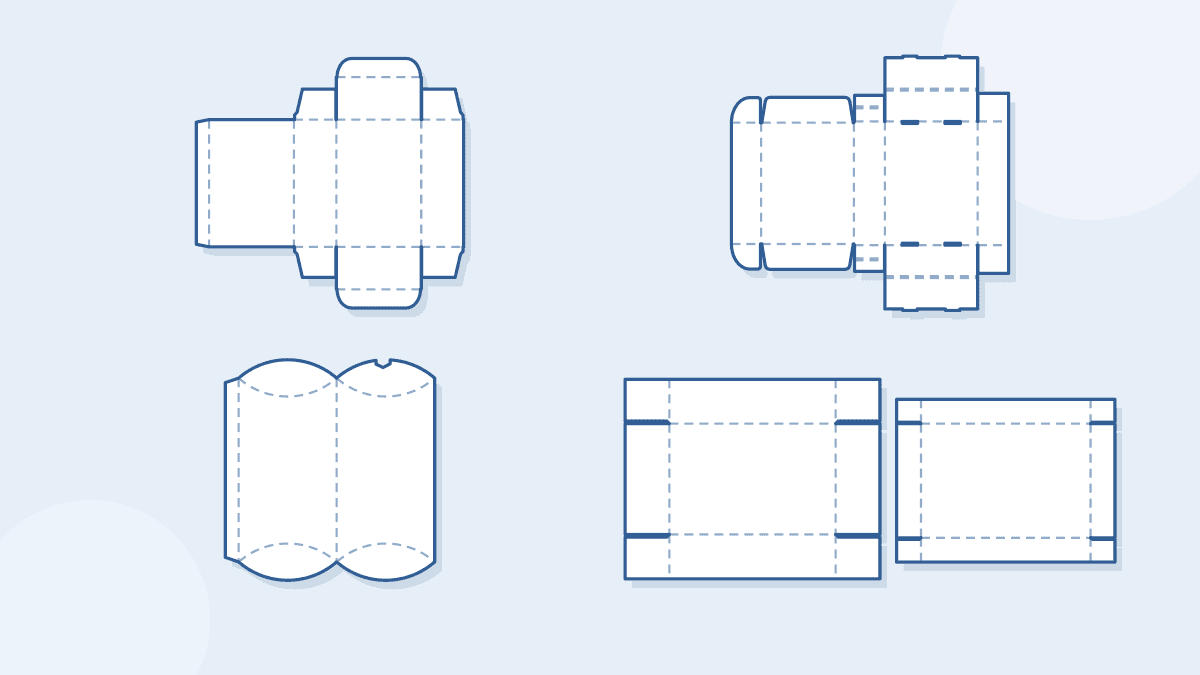
The dots on the sheet show a general direction: more dots usually means more design effort and cost. Exact prices depend on size, quantity, board and finish, so ask for a quote on the real thing. Our guide to the impact of packaging costs on product pricing explains what drives them.
| # | Idea | Best for | Effort |
|---|---|---|---|
| 1 | Window cutout | Products worth seeing: soap, candles, food, accessories | Low to medium |
| 2 | Die-cut or custom shape | Products with a memorable shape, gifts | High |
| 3 | Drawer or slide box | Gifts, beauty, jewelry, subscription sets | Medium |
| 4 | Magnetic closure | Premium gifts, keepsakes, high-value items | High |
| 5 | Nested reveal | Sets, kits, special editions | High |
| 6 | Handle or structure twist | Take-home food, gifts, small retail items | Medium |
| 7 | Inside print | Online orders and unboxing | Low to medium |
| 8 | One-color minimal | Modern brands, kraft board, small budgets | Low |
| 9 | Pattern wrap | Brands with a strong visual identity | Low to medium |
| 10 | Reusable second life | Gifts, storage-worthy products | Medium |
1. Window Cutouts
A window is a cut-out in the box that lets the product show through, usually covered with a thin clear film. Window patching is the name for adding that film behind the cut-out. It is a simple way to make a box more honest and more attractive, because the shopper can see what they are buying.
When to Use It
- The product looks good: colorful soap, candles, snacks, small gifts.
- Shoppers hesitate without seeing it, as with food and handmade goods.
- You want to show color or texture that print cannot copy.
Cost and Trade-Offs
A window adds a cutting step and a film. It costs more than a plain box, but less than most structural changes. The film is plastic, so it can make recycling harder, and you may need to think about how you describe the box to customers.
Tip: make the window a shape that suits the brand, such as a circle, a rounded rectangle or a shape from your logo. Keep it away from folds and edges. Window patching is available on our tuck boxes and other cartons: ask us for your style.
2. Die-Cut and Custom Shapes
A die cut is a shape cut out of the board with a custom tool called a die. It can be a small detail, such as a curved flap, or the whole outline of the box. Custom shaped boxes go all the way: hexagons, triangles, pyramids, cubes, round boxes and more, in forms such as hexagonal and pyramid.
When to Use It
- The product has a distinctive silhouette that the box can echo.
- It is a gift, a launch or a special edition where the box is part of the product.
- You want a box that gets photographed and shared.
Cost and Trade-Offs
This is one of the higher-effort ideas. Shaped boxes need a custom pattern, careful sampling, and often more board per box. They can be harder to store, stack and ship than a rectangle.
Tip: start with a simple shape and get a sample. A shaped box has to fit the product inside it, so measure carefully. See how to measure a box correctly. Our dieline templates include several shaped boxes, so you can try sizes before you ask for a quote.
3. Drawer and Slide Boxes
A drawer box has an outer sleeve and an inner tray that slides out, like a matchbox. The opening is slow and deliberate, which is why it suits gifts. We make it in two ways: tray and sleeve boxes in paperboard, and rigid drawer boxes with thick board.
When to Use It
- Gifts, beauty sets, jewelry and small tech accessories.
- Products you want to present rather than just store.
- Subscription sets with several small items.
Cost and Trade-Offs
Two parts cost more than one. A rigid drawer box costs more again, but feels premium. Check that the tray slides smoothly and does not slip out by itself, which is a fit problem a sample shows quickly.
Tip: add a ribbon pull or a thumb notch on the tray so it is easy to open, and print the inside of the tray or sleeve for a second reveal.
4. Magnetic Closures
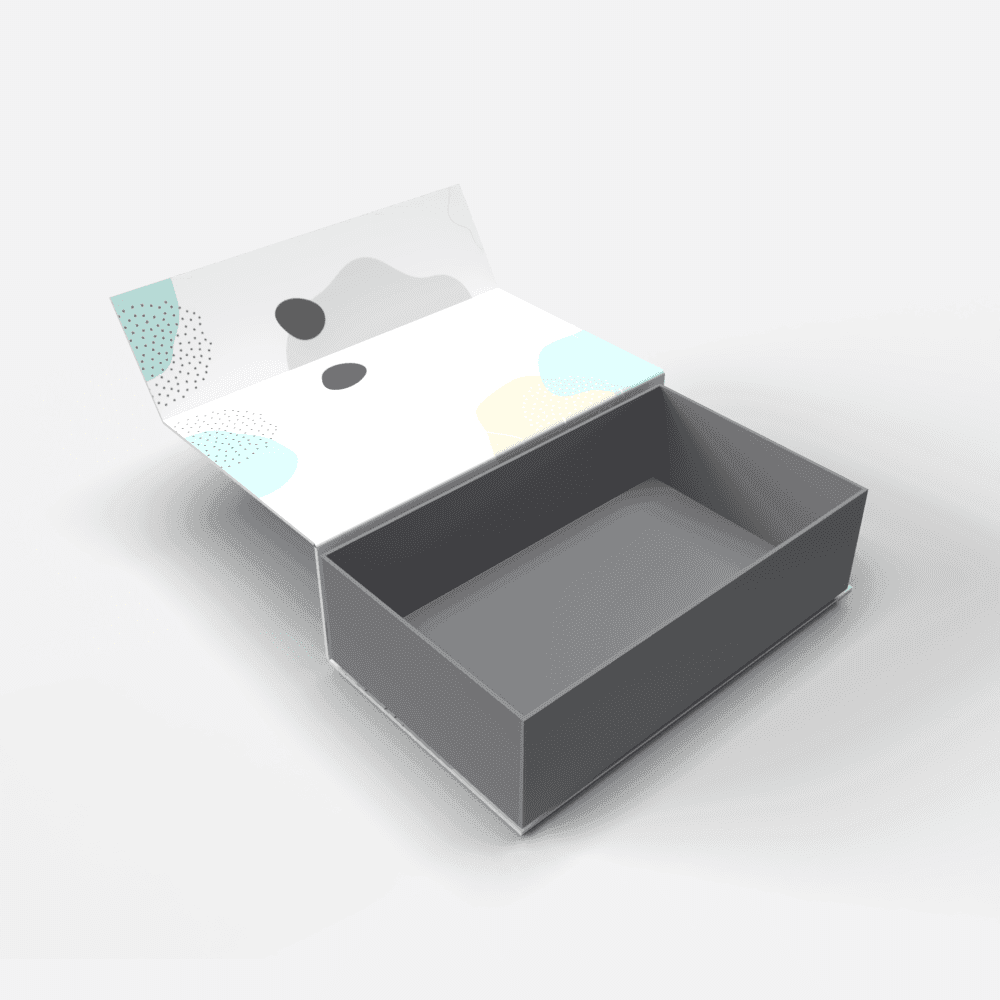
A magnetic box closes with hidden magnets in the lid and the base, so it shuts with a soft click. Many have a lid that is hinged to the base like a book. It is the classic premium gift box, and it is reusable.
When to Use It
- High-value products and gifts where a premium feel is part of the price.
- Products customers will keep the box for.
- Sets and limited editions.
Cost and Trade-Offs
Rigid board, wrapping and magnets all add cost, and rigid boxes are bulky to store and ship unless they fold flat. See our magnetic rigid boxes and our guide to luxury packaging.
Tip: print the inside of the lid. It is the first thing the customer sees when the box opens. If you want the rigid look but need to ship flat, ask about two piece foldable boxes.
5. Nested and Reveal Packaging
Nested packaging puts one structure inside another, so the customer unwraps in stages: an outer sleeve, then a box, then an insert holding the product. Each layer is a small reveal. It is closer to a design approach than a single box type, and it is built from structures we already make, such as a sleeve over a tray and an insert inside it.
When to Use It
- Kits and sets with several items.
- Special editions, gifts and launch boxes.
- Products where the unboxing is part of the experience.
Cost and Trade-Offs
More parts mean more cost, more storage and more assembly. It can also create more waste, which some customers notice, so keep the layers purposeful. Ask us whether your idea is possible, and test with a sample.
Tip: use box inserts and a packaging sleeve before you add more boxes. They give the layered feel with fewer parts.
6. Handle and Structure Twists
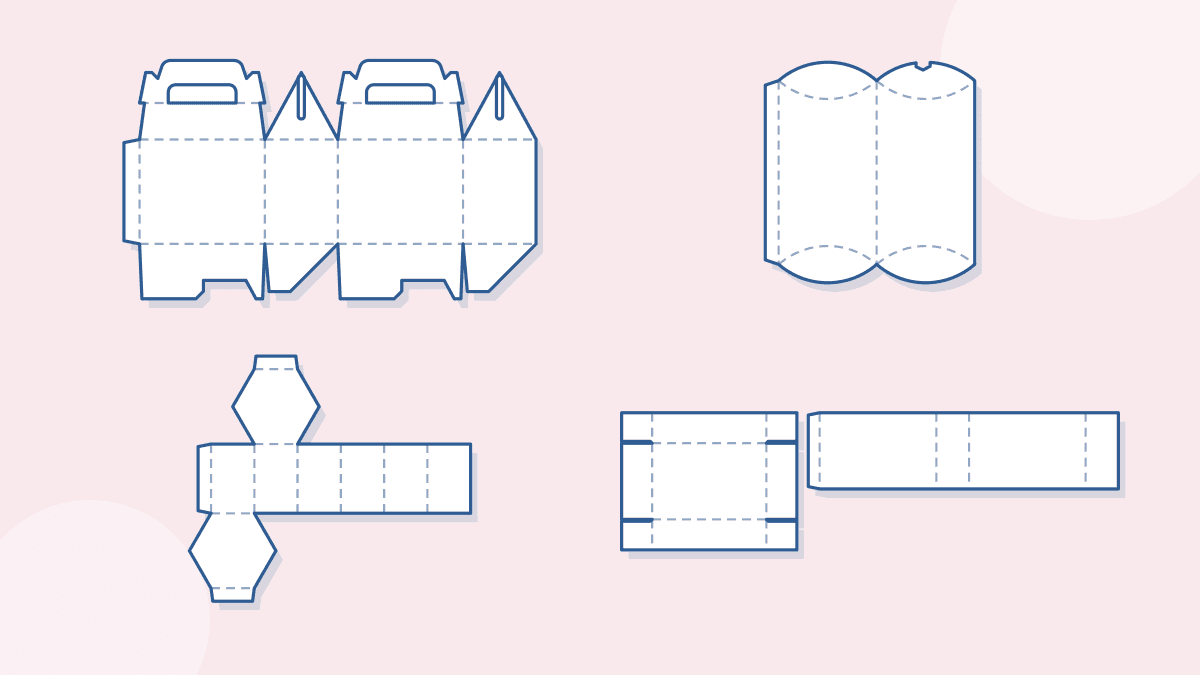
Not every unique box needs a new material. A small structural change can set a box apart: a carry handle, a curved top, a tapered shape or a flip lid. Gable boxes have a handle built into the top, so the box is also the bag. Pillow boxes have a curved shape that looks softer than a rectangle.
When to Use It
- Take-home food, favors and small gifts.
- Products sold at events or in stores where people carry them.
- Brands that want a playful, friendly look.
Cost and Trade-Offs
These are paperboard boxes, so the cost is moderate. The handle needs the right board strength for the weight, so say how heavy the product is.
Tip: check the handle against the weight with a sample, and print the handle area in a contrasting color so it reads as a feature.
7. Inside Print
Inside print puts artwork on the inside of the lid or the walls, so the customer finds a surprise when they open the box. It is one of the best value-for-money ideas, because the outside can stay simple.
When to Use It
- Online orders, where opening the box is the main event. See our mailer boxes.
- Gift boxes and subscription boxes.
- Brands that want a contrast between a plain outside and a vivid inside.
Cost and Trade-Offs
Printing a second side adds cost, but it is usually far less than a new structure. Check that the inside print is not scuffed by the product, and that there is a coating if you need one.
Tip: use a bold color or a pattern inside, and a short message such as a thank-you or an instruction. Ask us about inside print for your style.
8. One-Color Minimal
A box with one color, a logo and plenty of empty space can stand out, especially among crowded shelves. It is also one of the cheapest options, because it uses fewer inks.
When to Use It
- Modern, premium or craft brands that want calm.
- Kraft board, where a dark single ink looks natural.
- Small runs with tight budgets.
Cost and Trade-Offs
The risk is looking plain instead of confident. The design has to be good: strong type, a well-placed logo, careful spacing and a good fit. Add one detail, such as a foil logo or a matte coating, to lift it.
Tip: pick a strong color and let it do the work. Our guide to choosing colors for packaging shows how kraft and white boards change the result.
9. Pattern Wraps
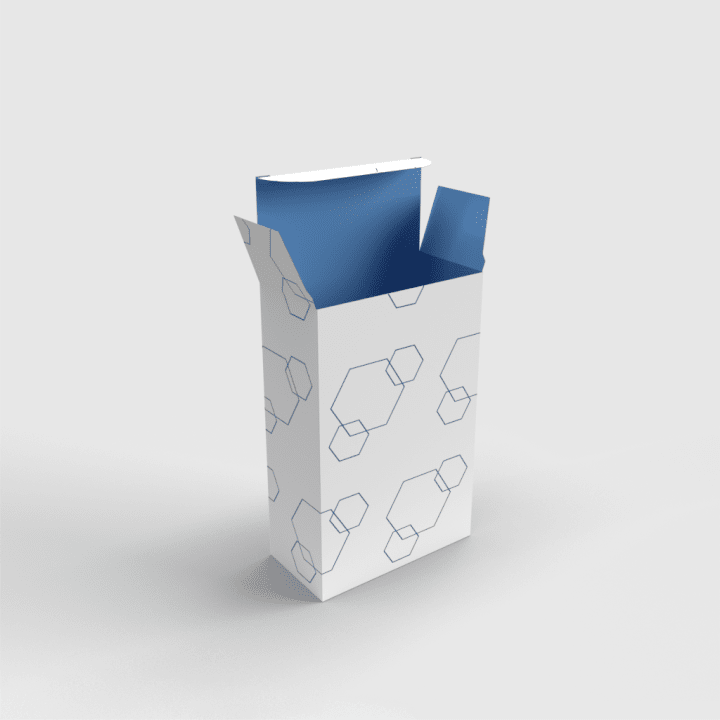
A pattern wrap covers the box with a repeating design, such as shapes, lines or an illustration. It becomes your signature, and it looks the same from every angle.
When to Use It
- Brands with a strong visual identity or illustrations.
- Ranges where each variant has its own pattern or color.
- Shipping boxes that you want to recognize at a glance.
Cost and Trade-Offs
Full-color print costs more than one color, but the pattern needs no extra structure. A pattern also hides small scuffs and misalignments better than a plain color. Make sure the pattern lines up over the folds and that you have bleed so no white edge shows.
Tip: use a simple repeat that still looks good if it shifts a little. Place the logo on a clear area so the pattern does not fight it.
10. Reusable Second-Life Boxes
A box worth keeping stays out of the bin and in the customer's home, which keeps your brand in view. It might hold jewelry, tea, stationery or tools. The design supports that: a sturdy build, a good lid and an attractive inside.
When to Use It
- Gifts and premium products.
- Sets, kits and keepsakes.
- Brands whose customers value sustainability and keepsakes.
Cost and Trade-Offs
A sturdier box costs more per unit. It may or may not be recycled afterwards, so avoid claims about the environment that you cannot support. Rigid boxes and two piece foldable boxes suit this idea. See rigid boxes.
Tip: suggest a second use on the box or a card, such as keep your tea in here. A line of copy turns a box into a gift.
How to Choose Which Idea Fits
Use these questions to narrow it down.
- What does the product look like? If it looks good, show it with a window or a shaped box.
- How is it sold? Shelf products need front-of-box impact. Online products need an opening moment.
- What is the price of the product? A premium product can carry a magnetic rigid box. A low-price product needs ideas that cost little, such as a pattern or one color.
- How many will you order? Complex builds make more sense at higher quantities.
- Will it ship flat? Flat-packing saves storage and freight.
- What can you test? Complex ideas need a sample first.
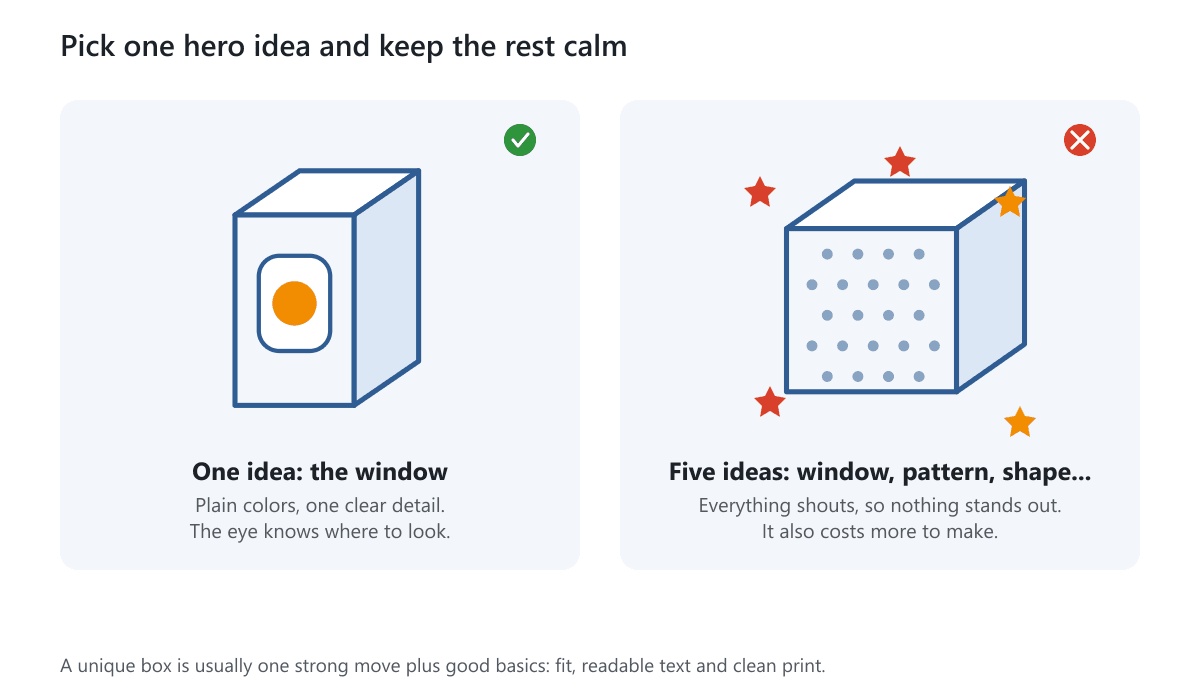
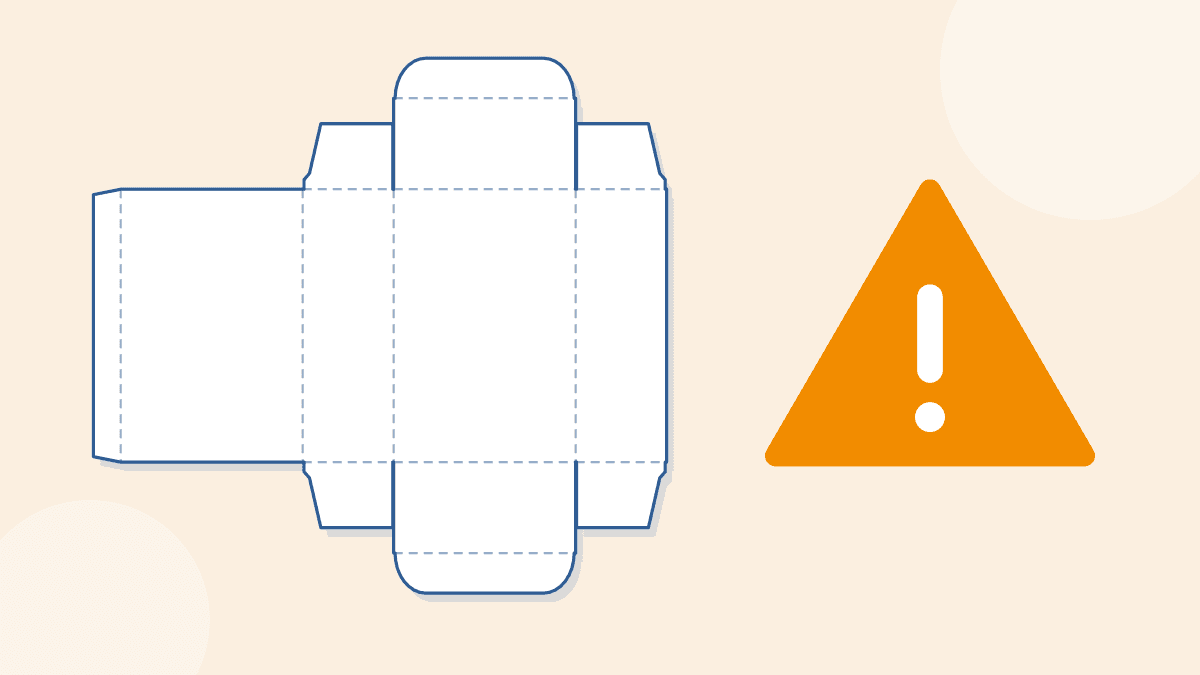
The picture shows the main rule. A unique box usually has one hero idea and clean basics. Mixing five ideas makes the box noisy and more expensive.
Finishes That Make Ideas Stand Out
Finishes work with the ideas above. We offer foil stamping, embossing or debossing, spot UV and window patching, plus varnish or lamination in matte, glossy, satin and soft touch.
| Finish | What it adds | Pairs well with |
|---|---|---|
| Foil stamping | A metallic logo or border | Magnetic, rigid, one-color minimal |
| Embossing or debossing | A raised or pressed texture you can feel | One-color minimal, magnetic |
| Spot UV | Glossy highlights on a matte background | Patterns, logos, minimal designs |
| Soft touch coating | A velvety feel | Premium gifts, drawers |
| Window patching | A clear window over a cutout | Window cutouts, food, candles |
Use finishes lightly. Laminations, foils and plastic windows can make a box harder to recycle, so weigh that if recyclability matters to your customers. See varnish vs lamination for the coating options.
How to Brief a Designer
A clear brief is the quickest way to a good result. Give your designer or us the information below.
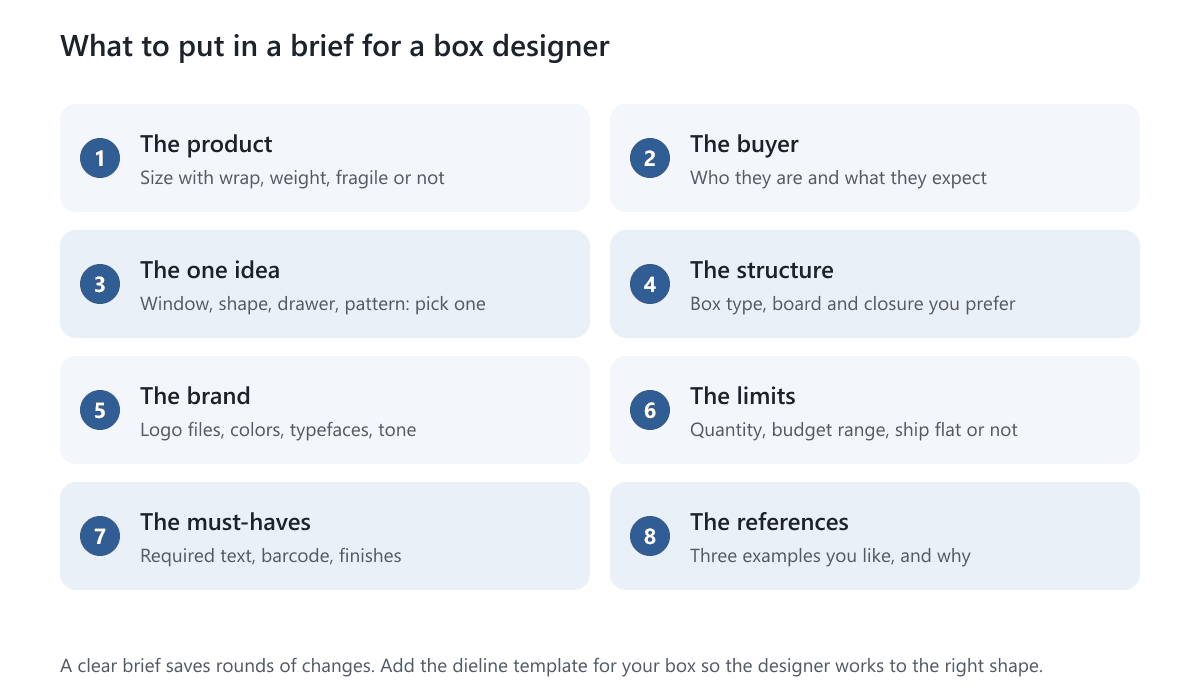
- The product, with its size, weight and whether it is fragile.
- The buyer, and where the product is seen.
- The one idea you want to try, from the list above.
- The structure and board you prefer, or the job it must do.
- Your brand files: logo, colors and fonts.
- The limits: quantity, budget range and whether it must ship flat.
- The must-haves: required text, barcode and any finishes.
- Three references you like, and what you like about them.
Add a free dieline template for the box so the design is built to the right shape. We include free design support.
Common Mistakes With Unique Boxes
- Choosing the idea before the product. The product comes first.
- Using too many ideas at once. Pick one.
- Ignoring fit. A beautiful shape that does not hold the product is a failure.
- Skipping the sample. Unusual structures need testing.
- Forgetting storage and shipping. A rigid or shaped box can cost far more to store and send than to print.
- Making unsupported claims about the environment or materials on the box.
Your Next Step
Choose the one idea that fits your product and budget, and sketch it on a dieline. Our guide to choosing the right box for your product helps with the structure, and the page on custom product boxes shows the range. When you are ready, get a free quote. We include free design support and reply within 1 business day. You can also order the Standard Sample Kit, $50 with shipping included, to compare boards and structures first. It may not include rigid boxes or boxes that ship assembled.
Frequently Asked Questions
What makes a box design unique?
A unique box has one clear, surprising idea that suits the product, such as a window, a custom shape, a drawer, a magnetic closure or a bold pattern. The best ones combine that idea with good basics: a snug fit, readable text and clean print.
Are unique box designs more expensive?
Usually, the more complex the idea, the higher the cost. Custom shapes, magnets and nested builds cost more than a plain box. Simple ideas such as a pattern, inside print or one-color minimal can cost little. See the starting price on each product page and request a quote.
Which unique box design is the cheapest to make?
One-color minimal, a simple pattern and inside print are generally the lowest effort, because they do not need a new structure. Windows come next. Shaped boxes, magnetic closures and nested builds take the most effort.
Can I make a custom-shaped box for my product?
Yes. We make custom shaped boxes in shapes such as hexagonal, triangular, pyramid, cube and round. Send us your product size and idea, and we will advise. Order a sample before a full run.
Can you add a window to my box?
Window patching is available. A window is a cutout covered with clear film so the product shows. Ask us which box styles suit a window for your product, and keep the cutout away from folds and edges.
What finishes make a box look special?
Foil stamping, embossing or debossing, spot UV and soft touch coating are the main ones. Use one or two. A matte box with a single foil logo often looks more refined than a box with many effects.
How do I brief a designer for a new box?
Give the product size and weight, the buyer, the one idea you want, the structure, your brand files, the quantity and budget range, the required text and three reference examples. Add a dieline template so the design matches the box shape.
Written by the PacksDo Team
We make custom printed packaging, from boxes and mailers to bags, labels and inserts. Questions about this guide? Ask us.