In this article
- 1What Makes a Box Custom?
- 2Custom Boxes vs Stock Boxes
- 3The Main Types of Custom Boxes
- 4What Custom Boxes Are Made Of
- 5Why Brands Choose Custom Boxes
- 6What You Can Customize
- 7How Ordering Custom Boxes Works
- 8What Affects the Cost of Custom Boxes
- 9An Example Order, Start to Finish
- 10Special Cases to Think About
- 11Common Mistakes When Ordering for the First Time
- 12A Short Checklist Before You Request a Quote
- 13Your Next Step
Custom packaging boxes are boxes made to your own specification. The size fits your product, the structure suits how it will be sold or shipped, and the print carries your brand. A stock box is the same for every buyer, while a custom box is built for one.
This guide is for anyone ordering packaging for the first time. It explains what makes a box custom, the main box types, what ordering involves and what drives the cost. If you already know the basics and want to pick a style, read our guide to choosing the right box for your product. If you want to know how branding shows up on a box, see what branded boxes are.
Key takeaways
- Four things can be custom: the size, the structure, the print and the finish. You can change one or all four.
- Fit is the first benefit. A box cut to your product protects it better and wastes less space than a stock box.
- Box type follows the job. Shelf boxes, shipping boxes and gift boxes are built differently.
- Minimums apply. Most of our box types start at 50 or 100 units, and rigid boxes have a low minimum and shipping boxes start at 50.
- Cost comes from a few choices: quantity, size, board, print, finish and how complex the structure is.
- Test before you commit. A sample shows size and form before you order a full run.
What Makes a Box Custom?
A box is custom when at least one part of it is made for you instead of picked from a standard range. There are four parts to think about.
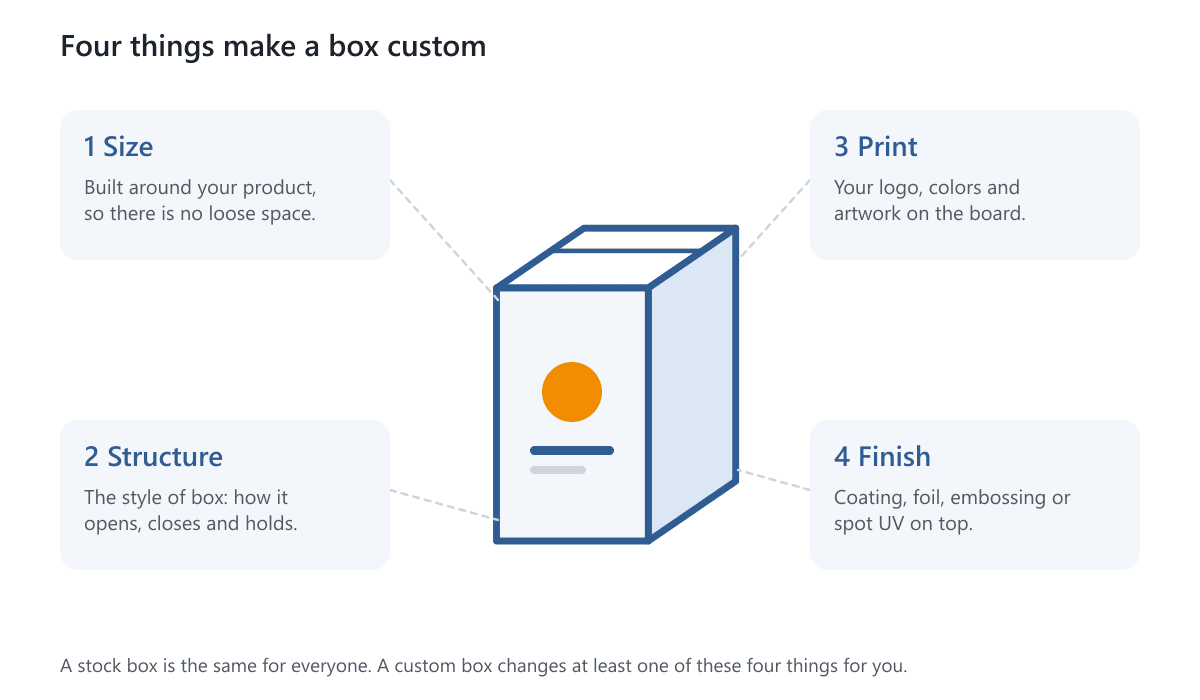
- Size. The inside dimensions are set by your product, written length x width x height. Our guide to measuring a box correctly shows how.
- Structure. This is the style of the box: how it folds, closes and opens. A tuck box closes with a flap, a mailer box has a lid that locks, and a rigid box has a thick wall and a separate lid.
- Print. Your logo, colors and artwork are printed on the board, on the outside, the inside or both.
- Finish. A coating or special effect sits on top of the print. Examples are a matte or glossy coating, foil stamping, embossing or spot UV.
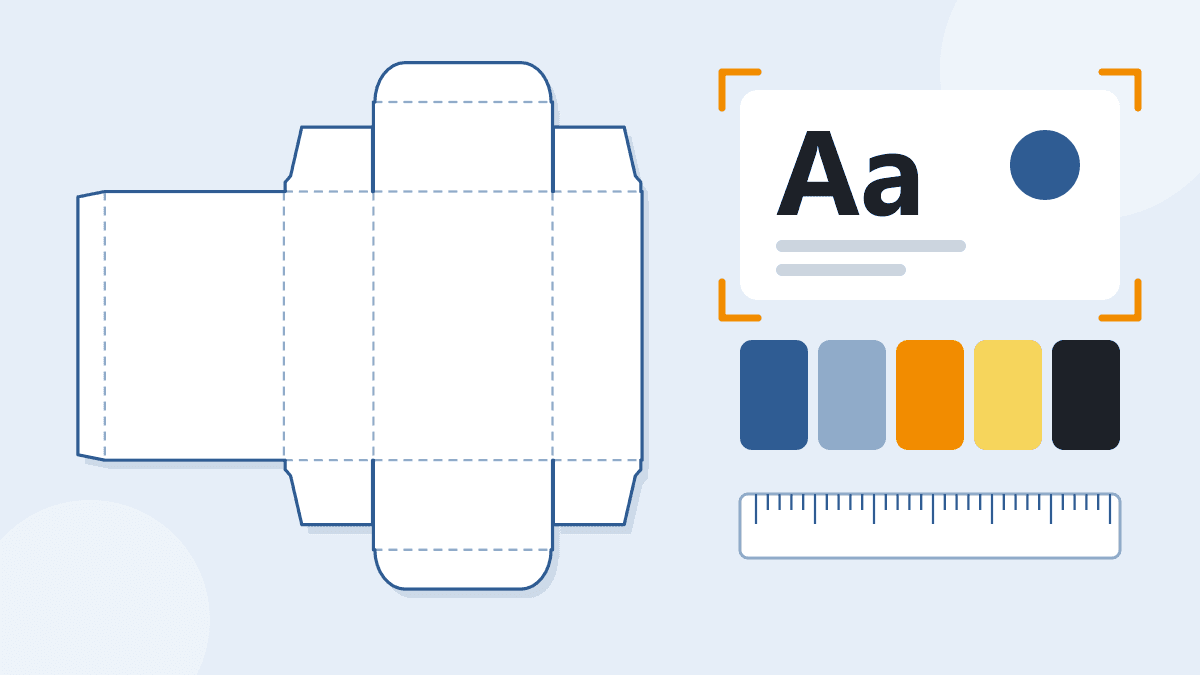
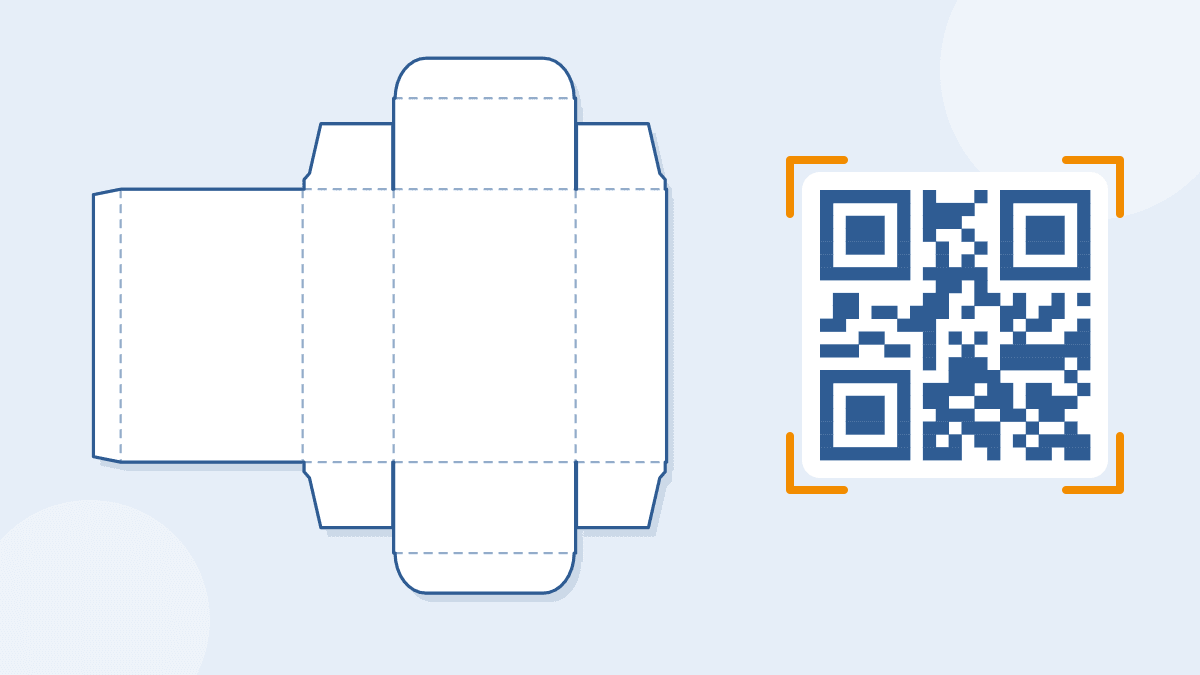
Behind all four sits a flat drawing called a dieline. It shows where the box is cut and where it folds. Every custom box starts as a dieline, and ours are free to download as dieline templates in PDF, SVG and DXF.
Custom Boxes vs Stock Boxes
Stock boxes come in standard sizes and are usually plain brown or white. They are a fine choice for a first test or a very small run. Custom boxes cost more per box at small quantities, and they give you control over fit and brand.
| Stock box | Custom box | |
|---|---|---|
| Size | Fixed sizes, you pick the closest | Made to your inside dimensions |
| Usually none, or a label or stamp | Your artwork printed on the board | |
| Structure | A few common styles | Any style we offer, plus options |
| Minimum order | Often one box | Starts at 50 units, depending on the type |
| Time to get it | Days | Production takes 5 to 7 working days, plus delivery |
| Best for | Testing, one-off needs | Products you sell again and again |
Lead time matters. Production takes 5 to 7 working days after your artwork is approved and payment is received. Larger or more complex orders can take longer, and we confirm the date in your quote. Delivery time is added on top, so plan ahead of a launch or a busy season.
The Main Types of Custom Boxes
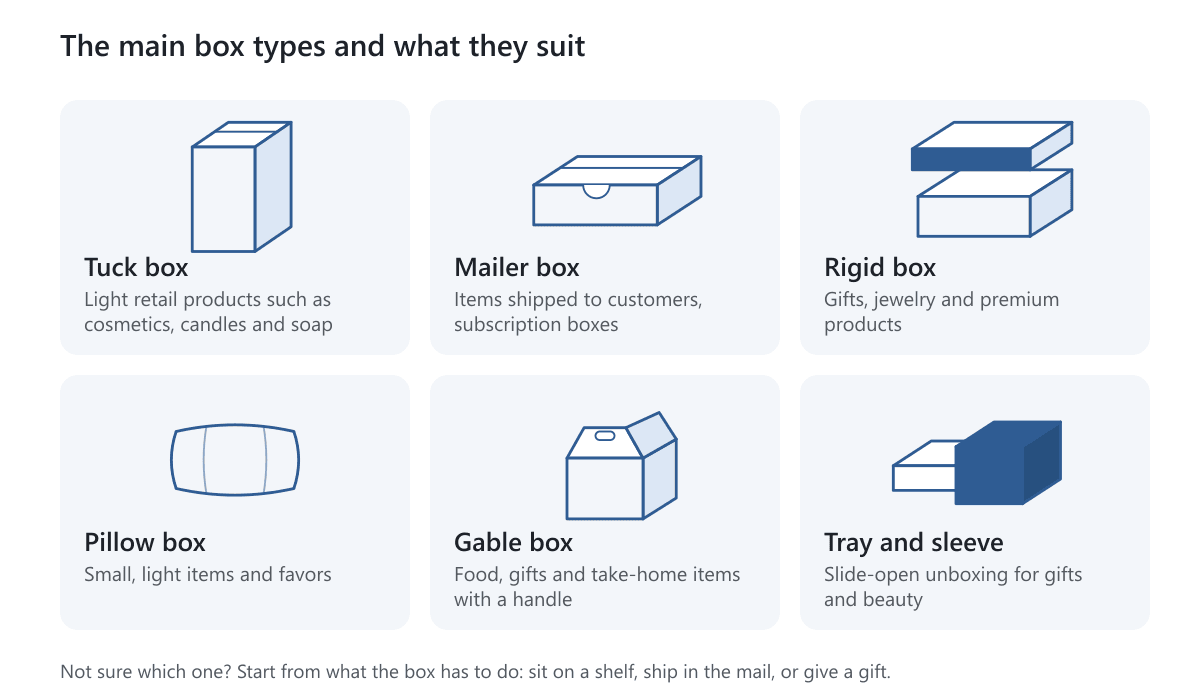
Box types differ in how they are built, what they protect and how they feel in the hand. Pick the type from the job the box has to do.
Boxes for the Shelf
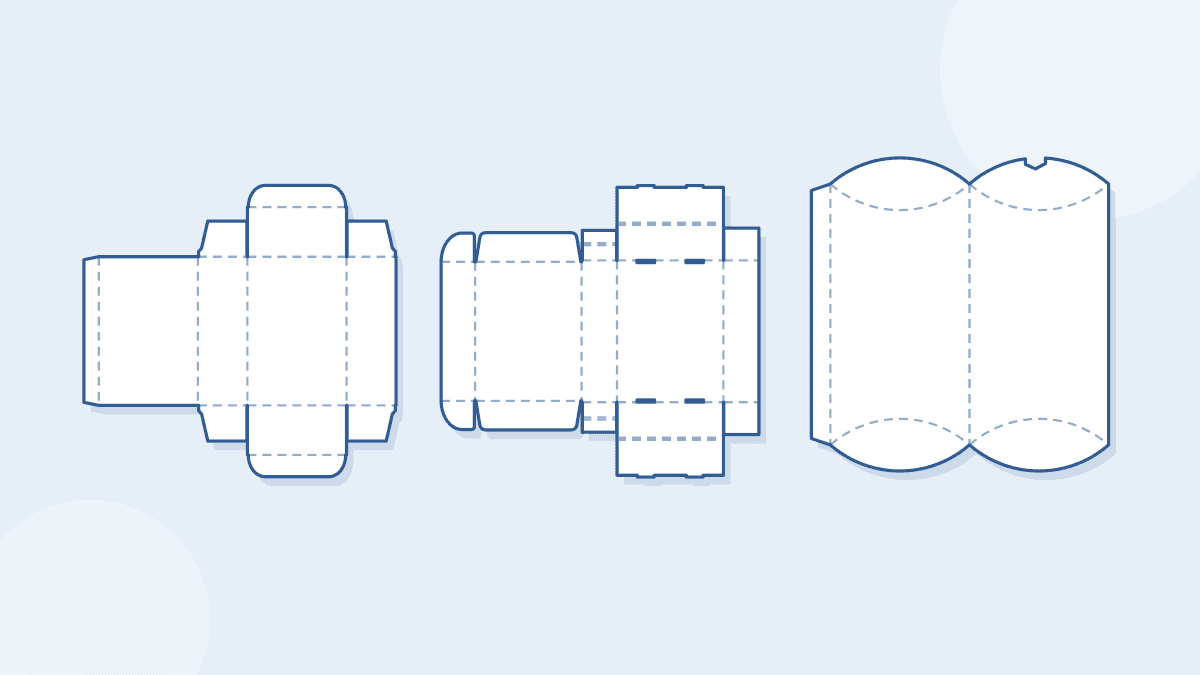
Tuck boxes are the everyday retail carton. They are made from paperboard, fold flat before use and close with a tuck flap. They suit cosmetics, candles, soap, supplements and many other light products. Pillow boxes are small and curved, and suit favors and light items. Display boxes hold products on a counter. Gable boxes have a handle on top, which makes them good for take-home items and gifts.
Boxes for Shipping
Mailer boxes and shipping boxes are made from corrugated board, which has a wavy layer between two flat layers and is much stronger than paperboard. A mailer box is also an unboxing box, because the customer opens it as the first thing they see.
Boxes for Gifts and Premium Products
Rigid boxes use thick board wrapped in printed paper. They feel heavy and premium, and they suit jewelry, gift sets and high-value items. Tray and sleeve boxes slide open like a drawer. Two piece foldable boxes have a separate lid and base but ship flat, which saves storage space.
Boxes in Special Shapes
If a standard shape does not suit your product, custom shaped boxes come as hexagons, triangles, pyramids and other forms. They stand out, and they are a bigger design job than a standard box. For a wider view of boxes made for products, see custom product boxes.
What Custom Boxes Are Made Of
Most boxes are one of three board types. Board weight is often given in gsm, grams per square meter: the higher the number, the thicker and stiffer the board.
| Board | What it is | Used for |
|---|---|---|
| Paperboard | Smooth, thin, printable board. White or brown kraft, typically 300 to 400gsm | Retail cartons such as tuck boxes and pillow boxes |
| Corrugated | Fluted board with a wavy layer inside, stronger than paperboard | Mailer boxes and shipping boxes |
| Rigid board | Very thick board, 800 to 2000gsm, wrapped in printed paper | Rigid gift and premium boxes |
All three are paper-based. Plain paperboard and corrugated without plastic film are generally the easiest to recycle, and a box can be recyclable where local facilities accept it, depending on the board, inks, coatings and adhesives. Recycled stock options are available on request. Laminations, foils and plastic windows can make recycling harder, and rules differ from town to town, so check with your local program.
Why Brands Choose Custom Boxes
People rarely order custom boxes for one reason. These are the most common ones.
- A better fit. A box that matches the product holds it still, which helps protect it. Less empty space also means less filler and a smaller shipping size.
- Brand recognition. Your logo and colors on every package make you easier to remember, on a shelf and on a doorstep.
- Perceived value. People often judge a product by its packaging before they use it. A well-made box can make a product feel more considered.
- An unboxing moment. For online sales the box is the first thing the customer touches. Inside print, tissue or an insert can make that moment feel planned.
- Control over the details. You decide the board, the closure and the finish, instead of working around what a stock box offers.
Custom is not always the right answer. If you sell a handful of items a month, a stock box with a branded sticker or sleeve may be enough, and you can move to custom boxes as sales grow.
What You Can Customize
Once you know the box type, these are the choices that shape the final result.
| Choice | Options | What it changes |
|---|---|---|
| Size | Any inside dimensions | Fit, protection, shipping size |
| Printing | CMYK or Pantone | How accurately colors match. See our color systems guide |
| Coating | Varnish or lamination in matte, glossy, satin or soft touch | Look, feel and scuff resistance. See varnish vs lamination |
| Special finishes | Foil stamping, embossing or debossing, spot UV, window patching | Shine, texture and a see-through window |
| Inserts | Cardboard inserts and dividers | How the product is held inside. See box inserts |
| Extras | Stickers, labels, hang tags, tissue | Finishing touches that add branding without changing the box |
You do not need all of these. A one-color print on kraft board with a simple tuck closure is a custom box too, and it often costs far less than a rigid box with foil.
How Ordering Custom Boxes Works
Ordering is a series of small decisions. The flow below is the one most orders follow.
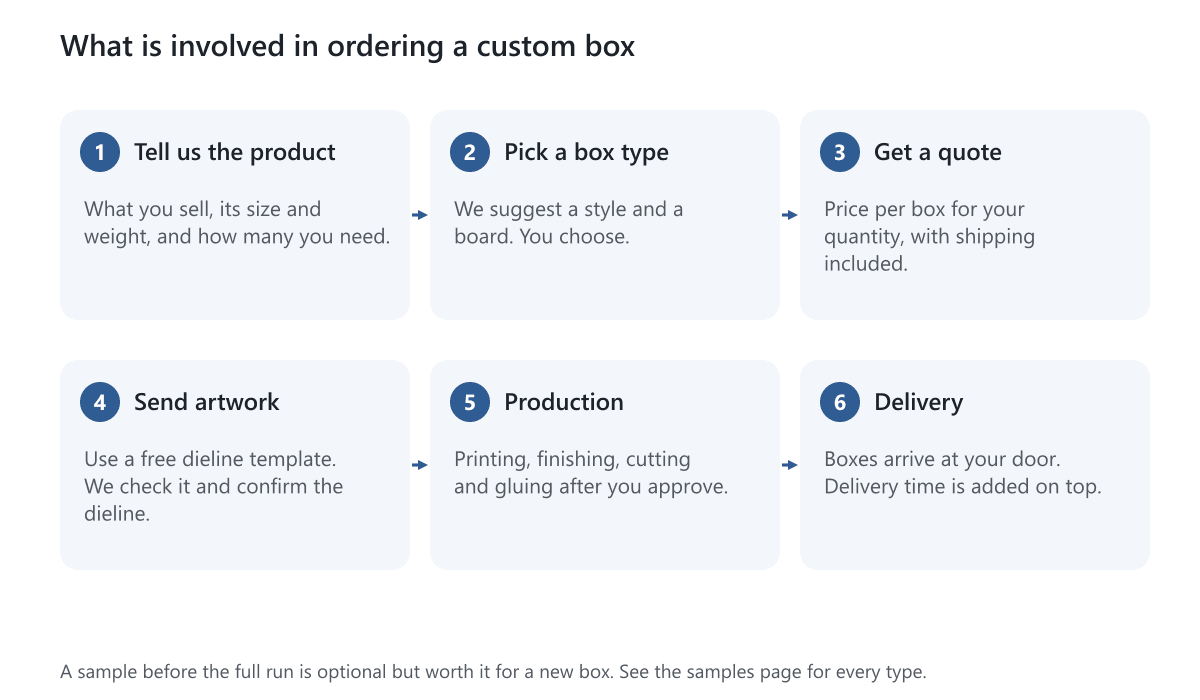
- Tell us what you are packing. Give the product size, weight and quantity, and how it will be sold or shipped.
- Choose a box type and size. We suggest a style and board, and free design support is included.
- Get a quote. The price depends on quantity, size, board, print and finish. Quotes include shipping to the US and Canada, and taxes and duties are not included.
- Check a sample if you can. A structural sample is an unprinted prototype that shows size and form. The Standard Sample Kit costs $50, shipping included, and may not include rigid boxes or boxes that ship assembled. The samples page lists every type.
- Send your artwork. Use a free dieline template so the design fits the box. Read what bleed is before you export the file.
- Approve and produce. Production starts once your artwork is approved and payment is received.
Minimum quantities depend on the product, and each product page states its own. Most of our box types start at 50 or 100 units, and rigid boxes have a low minimum and shipping boxes start at 50.
What Affects the Cost of Custom Boxes
There is no single price for a custom box, because several things change it. We do not list a price here, since starting prices live on each product page and can change. What matters is which choices push the cost up or down.
| Cost driver | Lower cost | Higher cost |
|---|---|---|
| Quantity | Larger runs, since setup is shared | Small runs, since setup is spread over fewer boxes |
| Size | Smaller flat size | Larger flat size, more board |
| Board | Thin paperboard | Corrugated, then rigid board |
| One or two colors, outside only | Full color inside and out | |
| Finish | No coating or a simple one | Foil, embossing, spot UV |
| Structure | Simple tuck or pillow | Drawer, magnetic or custom shape |
| Extras | None | Inserts, ribbons, tissue |
Our guide to the impact of packaging costs on product pricing shows how to fold these numbers into your own price.
An Example Order, Start to Finish
This is an invented example, not a real customer. Imagine a small soap maker who sells 3 bars at a time through a website and at local markets. She has been wrapping soap in paper and wants a box with her logo.
- Measure. She stacks three bars and measures 4 x 3 x 3 inches. She wants a little room, so she asks for an inside size of about 4.25 x 3.25 x 3.25 inches.
- Choose the type. A box on a shelf and in a shipping carton, so a paperboard tuck box fits. A mailer box would be too much for a light product.
- Pick the print and finish. She picks white board, a one-sided print in her brand colors and a matte coating.
- Order a sample. She checks the unprinted prototype to see that the bars slide in easily.
- Send artwork. She downloads the tuck box dieline, places her logo on the front panel and keeps text away from the folds.
- Order the run. She orders 500 boxes, since 100 would sell out within a couple of months and she wants to reorder at a lower cost per box.
Production takes 5 to 7 working days after she approves artwork and pays, and delivery is added on top. Her next order is easier, because the size and artwork are already set.
Special Cases to Think About
- Fragile products. Choose a stronger board and add an insert. A snug fit helps, and a sample drop test is worth the time.
- Food and products that touch skin. Tell us what the box will hold. We confirm suitable options and any documents you need, and you stay responsible for meeting the rules where you sell.
- Heavy or large products. Corrugated or rigid board holds weight better than thin paperboard.
- Shipping abroad. Quotes include shipping to the US and Canada. Taxes and duties are extra, and shipping to other countries is quoted separately.
- Small runs. Look at a smaller minimum, such as a low minimum for rigid boxes and 50 units for shipping boxes, or start with a sleeve or sticker on a stock box.
- Child-resistant or regulated products. Tell us early. These rules vary, and we confirm what is possible before you commit.
Common Mistakes When Ordering for the First Time
- Guessing the size instead of measuring the product with its wrap and insert.
- Skipping a sample and finding a fit problem after thousands of boxes are printed.
- Sending artwork that is not built on the dieline, so the logo lands on a fold.
- Choosing a rigid box when a simpler carton would do the job.
- Ordering more than you can sell or store.
We cover these in more detail in 5 mistakes small brands make when ordering packaging. If you are designing packaging for a new launch, read how to design packaging for a new product.
A Short Checklist Before You Request a Quote
- The product size, with wrap and any insert, in one unit.
- The product weight.
- How it is sold: on a shelf, shipped, or given as a gift.
- The quantity you want now, and a rough yearly figure.
- Your logo as a vector file, and your brand colors.
- Any finishes you like, even if you are unsure.
- The date you need the boxes, with delivery time added.
Your Next Step
Start with the product in front of you. Measure it, decide how it will be sold, and look at the box type that fits. Then get a free quote and tell us what you are packing, and we will suggest a style and a board. We reply within 1 business day. If you want to hold a few styles first, the Standard Sample Kit is a low-cost way to compare.
Frequently Asked Questions
What is a custom packaging box?
A custom packaging box is a box made to your own size, structure, print and finish instead of picked from a standard range. It is built around your product and carries your branding. You can customize one of these four parts or all of them.
What is the minimum order for custom boxes?
It depends on the product, and each product page states its own minimum. Most of our box types start at 50 or 100 units, rigid boxes have a low minimum and shipping boxes start at 50. Check the product page for the type you want.
How long does it take to get custom boxes?
Production takes 5 to 7 working days after your artwork is approved and payment is received. Larger or more complex orders can take longer, and we confirm the date in your quote. Delivery time is added on top. Plan a little extra for sampling and artwork changes.
How much do custom boxes cost?
The price depends on quantity, size, board, print, finish and structure. Larger runs usually cost less per box. See the starting price on each product page, then request a quote for your exact specification. Quotes include shipping to the US and Canada.
Can I order a sample before a full run?
Yes. A structural sample is an unprinted prototype that shows size and form. The Standard Sample Kit costs $50, shipping included, and may not include rigid boxes or boxes that ship assembled. See the samples page for every type.
Do I need a designer to make custom boxes?
No. We include free design support, and our free dieline templates show where to place your artwork. A designer helps with complex artwork, but a simple logo on a clean box works well.
What is the difference between a custom box and a branded box?
A custom box is made to your size and structure. A branded box carries your brand through print, color and finishes. Most custom boxes are branded, and most branded boxes are custom, but you can brand a stock box with a sticker or sleeve.
Written by the PacksDo Team
We make custom printed packaging, from boxes and mailers to bags, labels and inserts. Questions about this guide? Ask us.