In this article
- 1Look at the Package as the Customer Does
- 2Protection: The Product Arrives Intact
- 3Information: People Can Find What They Need
- 4Ease of Opening and Closing
- 5Perceived Value and the Unboxing Moment
- 6Trust and Honest Packaging
- 7Reuse, Recycling and Disposal
- 8Accessibility and Safety
- 9Design Choices That Help Customers: Quick Examples
- 10Test With Real Customers
- 11A Customer-First Design Audit
- 12Common Mistakes
- 13Your Next Step
Customers benefit most from packaging design when the package protects the product, tells them clearly what it is, opens easily and is simple to reuse or throw away. Looks matter, but they come after those basics. A beautiful box that is hard to open or hides the instructions is not a good design.
This guide looks at packaging from the customer's side, not the brand's. It follows the customer from the shelf or doorstep to the bin, and shows which design choices help at each step. If you want the brand side, read what branded boxes are.
Key takeaways
- Protection comes first. A product that arrives damaged cannot be enjoyed, however good the box looks.
- Clear information helps people decide and use the product safely. Put the name, benefit, size and directions where they can be found.
- Easy opening is a design feature. A thumb notch or a tear strip saves tools, time and frustration.
- Honest, right-sized packaging builds trust. Too much empty space or exaggerated claims lose it.
- Plan disposal and reuse. Simple, paper-based materials are generally easier to recycle.
- Test with real people. Ask a few customers to open, use and repack your box.
Look at the Package as the Customer Does
A package has a short life with the customer, and each stage has a different need. Think of it as a journey, and design for every step.
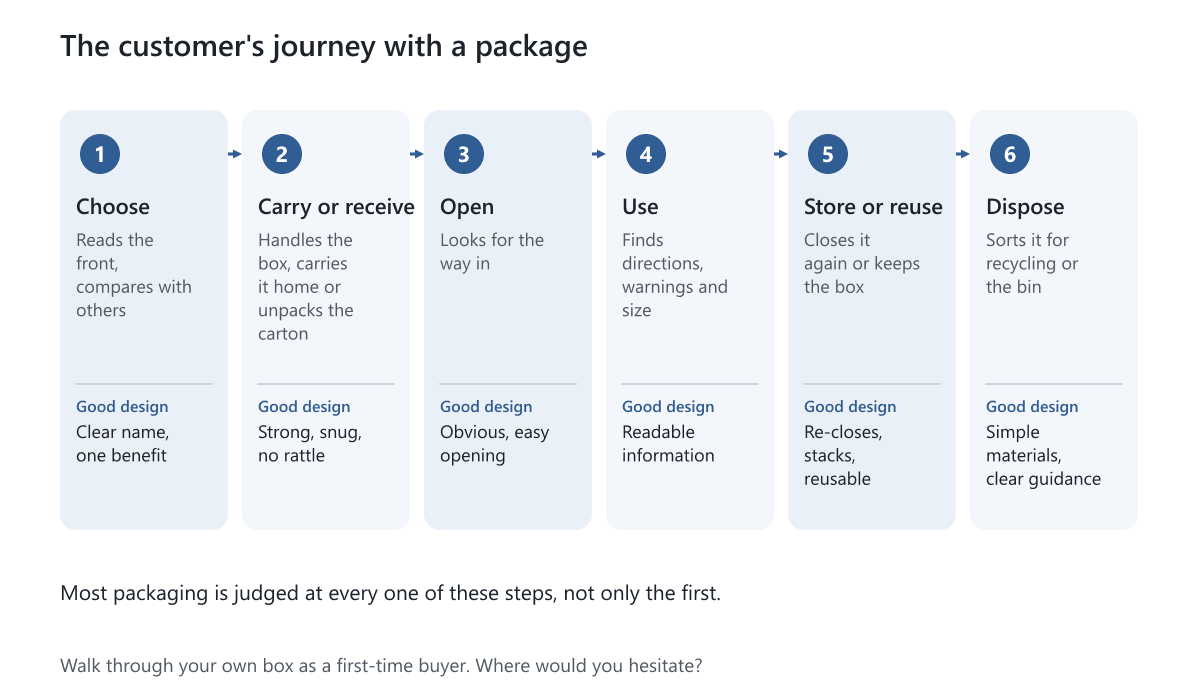
Many brands design for the first step only, the moment of choosing. The best packaging also works at the other five. The sections below go through them.
Protection: The Product Arrives Intact
The first thing a customer wants is a product in good condition. Damage hurts the customer, and it also costs you in replacements, returns and lost trust.
What Protects a Product
- A fit that holds the product still. Too much room lets it slide and knock against the walls. Too little room can crush it. Our guide to measuring a box correctly explains inside size and clearance.
- The right board. Paperboard suits light retail products. Corrugated board suits shipping, and rigid board suits premium and heavier items.
- An insert for loose or fragile items. Box inserts and dividers keep items apart and in place.
- A closure that holds. A tuck that pops open or a lid that slips off will let the product fall out.
If your product ships, test the packed box with a few drops from waist height and a squeeze test before you order. A structural sample, which is an unprinted prototype, lets you do this before printing. See the samples page for what we offer.
Information: People Can Find What They Need
A package is also a small sign. A customer should be able to tell what is inside, who it is for and how to use it without hunting.
| Where | What belongs there | Why it helps |
|---|---|---|
| Front | Brand, product name, one benefit, size or count | A shopper decides in seconds |
| Side or top | The product name again, key details | Boxes are often stacked or shelved on their sides |
| Back | Directions, ingredients, warnings, contact details | Needed after the decision to buy |
| Inside | A care card, setup steps or a thank-you note | Helps at the moment of use |
| Outside of a shipping box | Handle with care marks if needed, return details | Helps the carrier and the customer |
Make Text Easy to Read
- Use dark text on a light panel, or the reverse. Avoid pale gray on white.
- Keep important text large. Directions and warnings should not be the smallest print on the pack.
- Give text space. Crowded layouts are tiring to read.
- Do not rely on color alone to carry meaning. For example, add a word or an icon next to a red warning.
Required text is the brand's responsibility. What must appear depends on the product and where you sell it, so check with the relevant authority or your retailer. Our guide to what retail packaging is lists the usual items.
Ease of Opening and Closing
Opening is the most shared experience of any package. Nearly everyone has fought with a box they could not open. Good design removes that fight.
- A visible way in. A thumb notch, a pull tab or a tear strip shows the customer where to start.
- A clean opening. The box should open without tearing the product, the print or the customer's nails.
- A closure that can be used again. If the product is used over time, a tuck flap or a lid that closes again keeps it fresh and tidy.
- Works with one hand. Some customers have limited hand strength or a hand full of shopping. Think of them early.
For mailers, a tear strip or a pull tab can be an alternative to tape. For retail cartons, a tuck closure opens and closes many times. We cover the structures in our guide to choosing the right box for your product.
Perceived Value and the Unboxing Moment
People often judge a product before they use it, and the package is part of that judgment. A sturdy box, a clean print and a tidy layout suggest the product was made with care.
The unboxing moment is the same idea for online orders. The customer opens the box and sees the product for the first time. Planned details help: print inside the lid, a clean fit, a card with a thank-you or care steps.
Be honest here too. A box that promises luxury and delivers a loose, scuffed product disappoints. Spend where the customer looks and touches, and keep it consistent with the product.
Trust and Honest Packaging
Trust is built by small things going right. These are the ones that matter in packaging.
- A fit that matches the product. A large box with a small product inside can feel misleading. In some product categories, empty space in a package, often called slack fill, is regulated, so check the rules for yours.
- Claims you can support. Do not print a claim, such as eco-friendly, that you cannot back with evidence.
- A consistent look. When your box, bag and tag match, customers see a brand that pays attention.
- Contact details. A website or email on the pack tells customers where to go if something is wrong.
Reuse, Recycling and Disposal
What happens after the product is used matters to many customers. You cannot control the end of the package's life, but you can design it to make good choices easier.
- Right-size the box. A smaller box uses less board and leaves less to dispose of.
- Keep the materials simple. Plain paperboard or corrugated without plastic film is generally the easiest to recycle. Laminations, foils, plastic windows and mixed materials can make it harder, and rules differ by town.
- Say how to dispose of it. A short line such as flatten and recycle where facilities accept paper helps, and keep it accurate for your materials.
- Think about reuse. A sturdy box that holds jewelry, tea or craft supplies may get a second life. Our rigid boxes and two piece foldable boxes suit this.
- Ship flat when you can. Boxes that ship flat take less space in storage and transport.
Recycled stock options are available on request. We confirm what is possible for your box, and we do not make claims about recyclability that depend on your local program.
Accessibility and Safety
A package that works for the widest range of people is simply a better package. A few checks go a long way.
- Contrast and size. Many people have trouble reading small or low-contrast text. Test your design in grayscale and at arm's length.
- Tactile cues. Embossing or debossing can add a raised mark that people can feel, for example on a lid or a logo.
- Clear icons. Simple, standard symbols work across languages, but they must still be explained where the rules require it.
- Safety closures. Some products must have child-resistant packaging or safety wording by law. If yours does, tell us early, and we confirm what is possible. You are responsible for meeting the rules in the places you sell.
- Age or choking warnings. Products for children can need warnings. Check the rules for your product and market.
Design Choices That Help Customers: Quick Examples
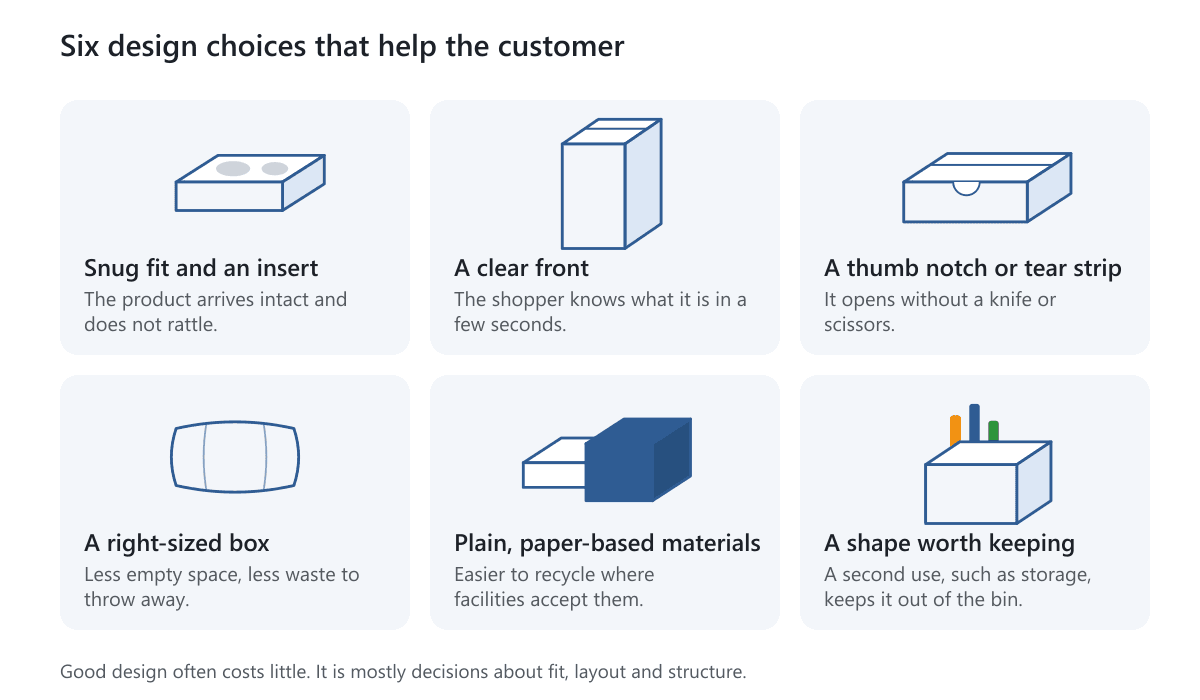
| Design choice | Customer benefit | Where it fits |
|---|---|---|
| Snug fit and an insert | No rattling, no damage | Fragile products, sets |
| Large product name on the front | Easy to choose and find again | Shelf products |
| Thumb notch or tear strip | Opens without tools | Mailers and subscription boxes |
| Window patching | Shows the product before opening | Soap, candles, food |
| Short directions on the lid | Instructions are where they are needed | Gadgets, kits |
| Right-sized structure | Less to throw away | Anything shipped |
| A sleeve instead of a full print | Easy to remove, easy to recycle separately | Simple branded packs |
Small choices like these cost little. They show up in how customers talk about a product, and in the comments and returns you see.
Test With Real Customers
You are too close to your own packaging to see its problems. A quick test with five or so people reveals most of them.
- Hand each person a sample and say nothing. Watch how they open it.
- Ask them to find the directions, the size and the ingredients or contents.
- Ask them to close it again and put it away.
- Ask what they would do with the box afterwards.
- Note where they hesitate. Fix those spots first.
A Customer-First Design Audit
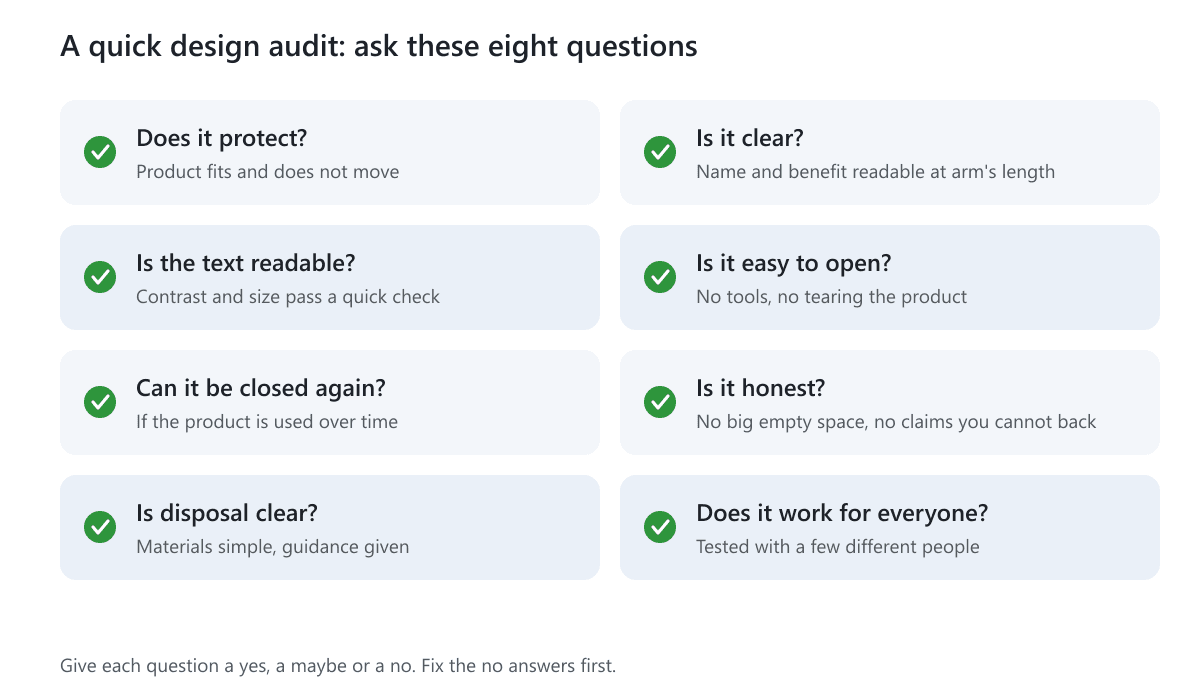
Go through the eight questions above with your sample in hand. For each, answer yes, maybe or no. Fix the no answers first, then the maybes. If you cannot decide, ask someone who has never seen the box.
Common Mistakes
- Designing for the shelf and forgetting the customer at home.
- Burying directions or warnings in small, low-contrast print.
- Choosing a closure that looks neat but is hard to open.
- Using more box and more filler than the product needs.
- Making environmental claims without evidence.
- Skipping a sample and a drop test.
Your Next Step
Take your current package, or a sample of a new one, and run the audit. Pick the two biggest problems and fix them first. If you are designing something new, use a free dieline template to plan where the information goes, and see our guide to designing packaging for a new product. Then get a free quote. We include free design support and reply within 1 business day.
Frequently Asked Questions
How do customers benefit from good packaging design?
They get a product that arrives intact, is easy to understand, opens without a fight and is simple to reuse or discard. Good design also helps them trust the brand. The benefits come from fit, clear information and sensible structure more than from decoration.
What is the most important feature of packaging for customers?
Protection is the first one, because a damaged product spoils everything else. Clear information and easy opening come next. The right order depends on the product, but a package that fails at protection fails at the rest.
How can packaging be easier to open?
Add a thumb notch, a pull tab or a tear strip so the customer can see where to start, and use a closure that opens cleanly. Test it with a few people. A sample lets you do that before you print.
How does packaging affect trust?
A good fit, accurate claims and a consistent look show that the brand pays attention. A box much larger than the product, or a claim you cannot support, damages trust. Rules on empty space and claims differ by product, so check yours.
Is eco-friendly packaging a benefit to customers?
Many customers care about waste. Simple paper-based materials, a right-sized box and a clear note on disposal help. Recyclability depends on local facilities, so state only what you can support. Recycled stock options are available on request.
Do I need child-resistant or tamper-evident packaging?
That depends on your product and where you sell it. Some products require it by law. Tell us what you are packing and where it will be sold, and we confirm what is possible. You remain responsible for meeting the rules.
How can I test my packaging with customers?
Give five or so people a sample with no instructions. Watch how they open it, find the information and close it again, and note where they hesitate. Fix those points, then repeat with a revised sample.
Written by the PacksDo Team
We make custom printed packaging, from boxes and mailers to bags, labels and inserts. Questions about this guide? Ask us.