In this article
- 1Decide These Four Things First
- 2Jewelry Box Sizes to Start From
- 3Eight Affordable Jewelry Packaging Ideas
- 4Three Budget Levels
- 5Inserts, Pads and Cards That Hold the Piece
- 6Branding on a Budget
- 7How to Keep the Cost Down
- 8Shipping Jewelry Without Overspending
- 9Sustainable Choices, Kept Honest
- 10Common Mistakes
- 11Checklist
- 12Next Step
Affordable jewelry packaging usually combines one low-cost base, such as a pouch, a kraft box or a pillow box, with a few branded details like a sticker, tissue paper and a thank-you card. You do not need a rigid luxury box to make a piece feel special. You need packaging that fits the jewelry, protects it and looks like your brand.
This guide gives eight jewelry packaging ideas for small brands, then helps you choose between them: box sizes for rings, necklaces and earrings, inserts that hold the piece, three budget levels, ways to cut costs, shipping tips and the mistakes to avoid. Where it helps, it points to the boxes, cards, stickers and tissue paper we make.
If you are choosing a custom box, our page on custom jewelry boxes lists the styles we make for jewelry brands.
Key takeaways
- Packaging has three jobs: protect the piece, show your brand and suit the price of the jewelry.
- Small details do the most work. A sticker, a ribbon and a card can lift plain packaging at a low cost.
- Fit matters more than size. A snug box with a good insert looks better and ships cheaper than a large box with filler.
- Match the packaging level to the price of the jewelry. Too plain looks cheap and too grand looks odd on low-cost pieces.
- Test one pack before you order many. Check fit, scratching and how it looks when opened.
Decide These Four Things First
Before you look at ideas, answer four questions. They narrow the choices quickly.
- What are you packing? A ring, studs, a chain and a bracelet need different sizes and holds.
- How is it sold? On a market table, in a boutique, online or as a gift.
- How does it travel? Handed over in person, posted in an envelope or shipped in a box.
- What price point is it? The packaging should feel one step above what the customer expects to pay for it.
Write the answers down. Then choose from the ideas below. You will probably end up with a mix: a box or pouch for the piece, a mailer for shipping and a few brand extras.
Jewelry Box Sizes to Start From
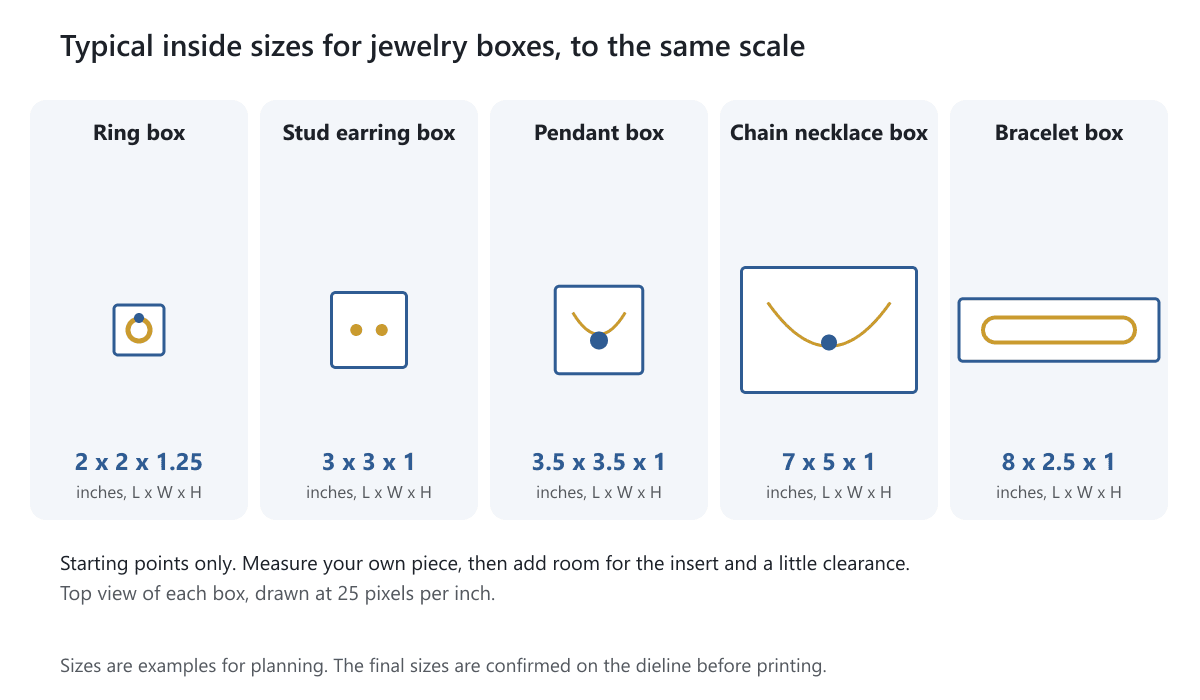
Jewelry is small, so a few millimeters decide whether a box looks right. These inside sizes are common starting points, written length x width x height in inches. Measure your own pieces, including clasps and gems, and add room for the insert.
| Piece | Typical inside size | Notes |
|---|---|---|
| Ring | 2 x 2 x 1.25 in | Height needs to clear the stone |
| Stud earrings | 3 x 3 x 1 in | A card or a pad holds the posts |
| Pendant necklace | 3.5 x 3.5 x 1 in | Chain folded flat on a pad |
| Chain necklace | 7 x 5 x 1 in | Needs room to lie without kinks |
| Bracelet | 8 x 2.5 x 1 in | Flat box; a bangle needs more height |
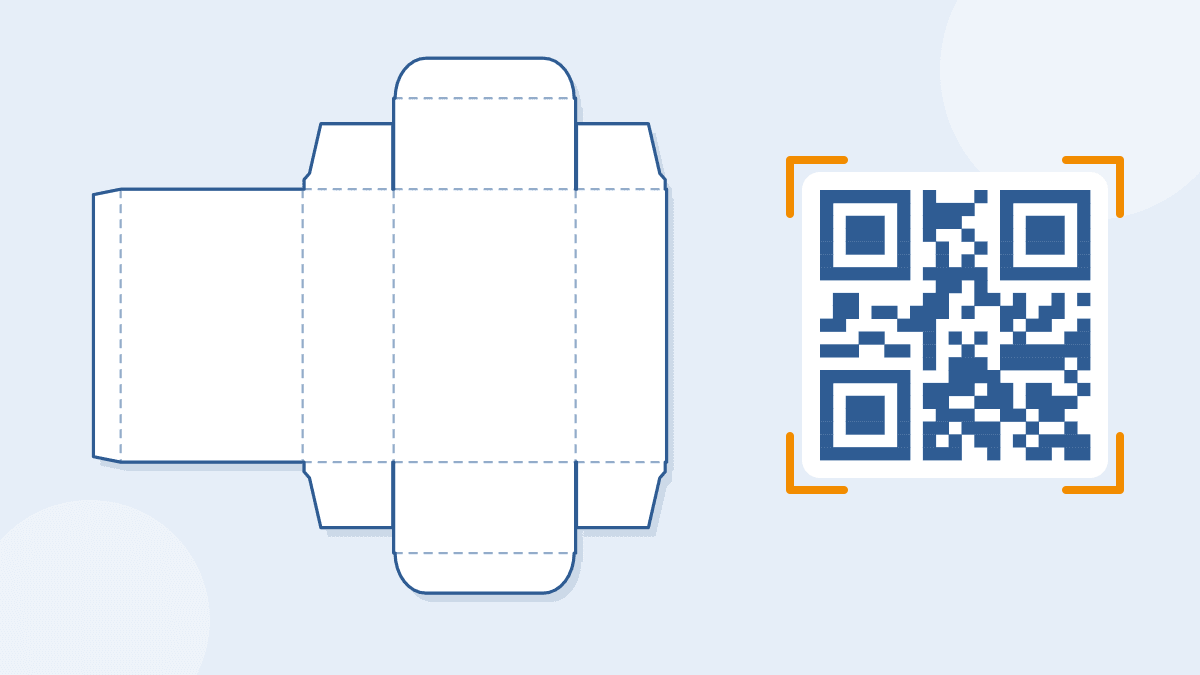
Our guide to measuring the dimensions of a box explains inside and outside sizes and how much clearance to leave. You can also check a flat pattern for a style with our free dieline templates.
Eight Affordable Jewelry Packaging Ideas
1. Pouches With a Stamped or Stickered Logo
A soft pouch in velvet, satin or cotton protects jewelry from scratches and costs little per unit. It is light to post, takes little room to store, and customers often reuse it. Pouches from specialist suppliers are usually bought in standard sizes and colors, so add your brand with a hot-stamped logo, a woven label or a round sticker.
Classic colors such as black, navy and burgundy look rich. Choose a size where the piece slips in without a squeeze. If you want a cotton option with your own artwork, ask about our cotton bags.
2. A Kraft Box With a Printed Paper Sleeve
A plain kraft box is a low-cost way to give jewelry a base. Wrap it with a printed packaging sleeve and it takes on your branding, and you can change the sleeve for each season or collection. Add twine, a wax seal or a dried flower for a handmade touch.
If you want the box itself printed, our tuck boxes come from 100 units. Kraft board takes dark inks well and gives a natural look that suits handmade and minimal brands.
3. Drawstring Cotton Bags
Cotton drawstring bags have a soft, natural feel. They hold earrings, rings and small sets, and customers keep them for travel. Choose unbleached cotton for a rustic look or colored cotton for a brighter one. A stamped logo, a screen print or a small woven tag keeps the cost low.
4. Fold-Flat Paper Boxes
Paper boxes that fold flat take almost no space until you need them, which is handy when you are short of storage. A simple pillow box or tuck box is light and cheap to ship. You can plan the size with our free pillow box dieline before you order.
Pillow boxes need a gentle fit, because they are curved. A card or a small pad inside stops the piece from sliding to one end.
5. Test Tubes for Rings and Earrings
A small acrylic or glass tube with a cork or cap shows the piece and makes it feel collectible. Fill it with a little paper or cotton so nothing rattles, and label it with a sticker. Tubes suit simple, light pieces, and glass needs a padded outer pack. They come from specialist suppliers, and we can print the labels, cards and outer box around them.
6. Reused Tins
A small tin gives a strong, reusable shell and a vintage look. Line it with felt or paper and add a sticker or tag. Tins are best for handmade ranges and gift sets, and not ideal for large runs, because they are not all the same.
7. Jewelry Cards and Display Cards
A card with slits or holes holds earrings, necklaces and rings in place and shows the piece to the customer. Cards can be wood or paper. A printed paper card is the lowest-cost option, and carries your logo, the product name and care tips. See our printed cards, which start at 500 units.
8. Pillow Boxes With a Window
A small box with a window lets customers see the piece, which builds trust in a shop or online photo. Soft padding inside keeps the piece in place. A ribbon, a sticker or a pressed flower adds a personal finish. If you want the window on a printed box, ask us about window patching.
Three Budget Levels
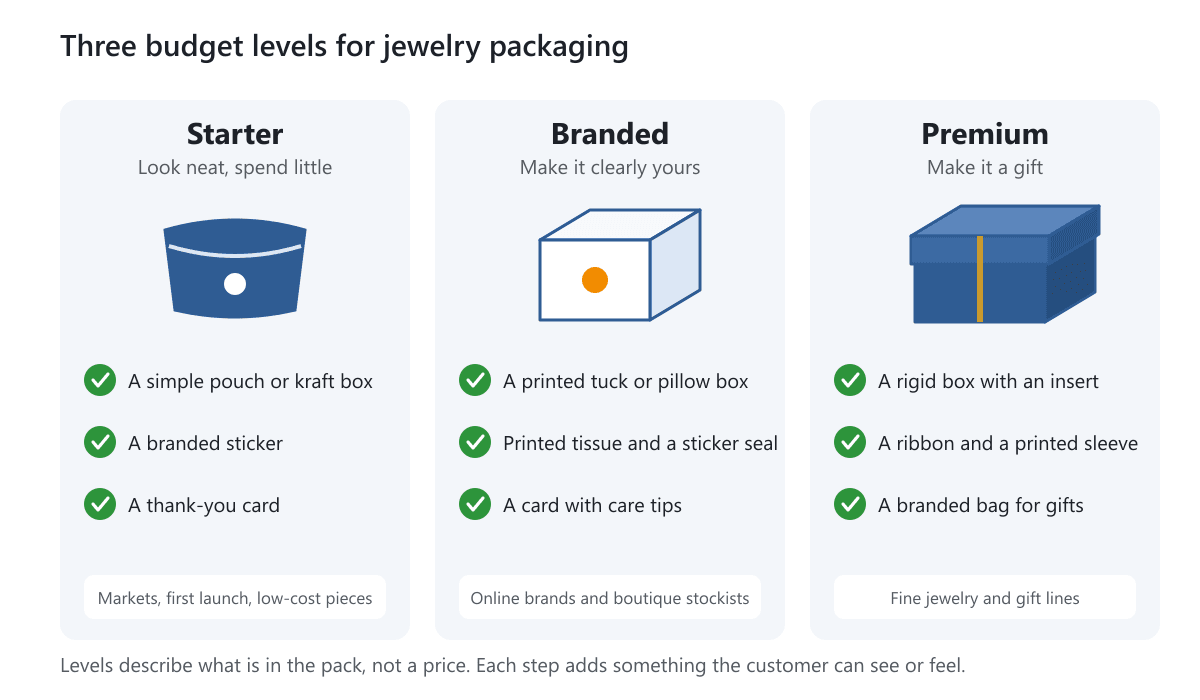
Most small brands do not choose one idea. They build a pack in layers, and each layer adds something the customer can see or feel. Here are three levels. They describe what is in the pack, not a price, because prices depend on size, quantity and finishes.
| Level | What is in the pack | Best for |
|---|---|---|
| Starter | A simple pouch or kraft box, one branded sticker, a thank-you card | Markets, a first launch, low-cost pieces |
| Branded | A printed tuck or pillow box, printed tissue paper, a sticker seal, a care card | Online brands and boutique stockists |
| Premium | A rigid box with an insert, a ribbon, a printed sleeve, a branded bag for gifts | Fine jewelry and gift lines |
Moving up a level does not mean changing everything. A common path is to start with a pouch and a sticker, then print your own box when orders grow, and later add a rigid box for a gift line.
Inserts, Pads and Cards That Hold the Piece
An insert is the part inside the box that holds the jewelry in place. Without one, rings roll, chains tangle and earrings scratch. Even a plain box feels more expensive with a good insert.
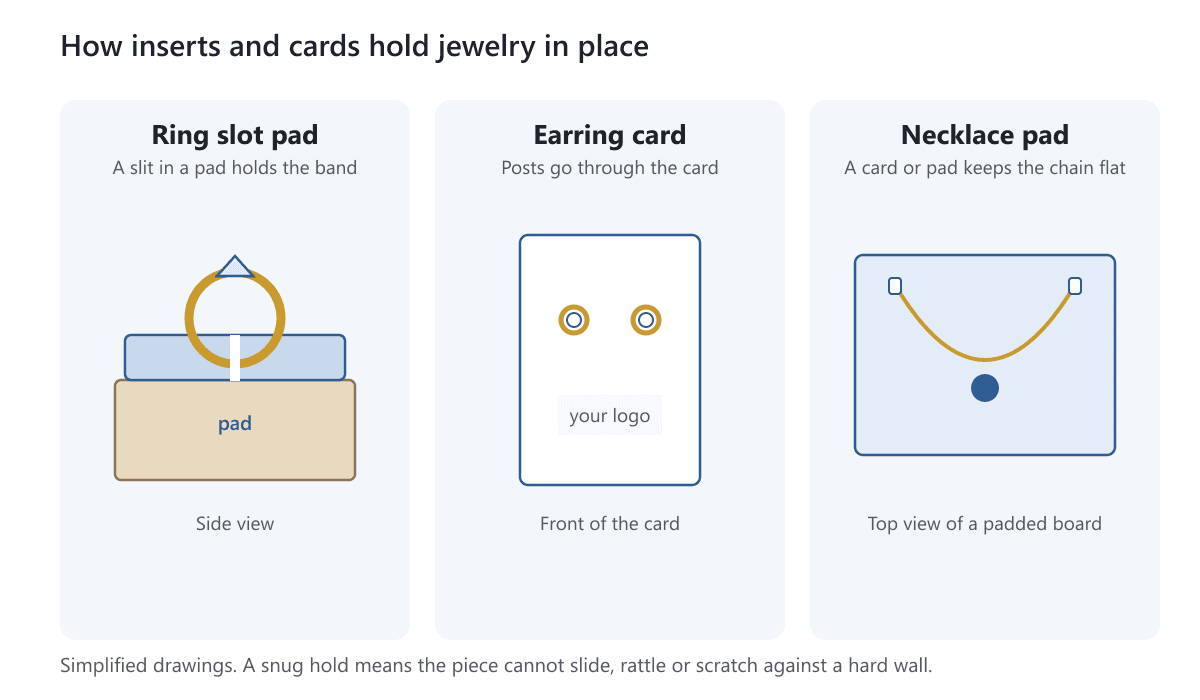
- Ring slot pad. A slit in a soft pad holds a band upright and a stone visible.
- Earring card. The posts go through small holes in a card, and the card slides into the box.
- Necklace pad or card. A board with slits or notches keeps the chain flat and untangled.
- Cotton or felt pad. A soft layer under the jewelry cuts scratches and rattling.
Inserts need to fit the box. Our box inserts are made to your size, and our guide to packaging inserts explains the types.
Silver and some other metals tarnish in air and moisture. An anti-tarnish strip or a sealed pouch inside the box slows this down. If you sell silver, mention it in your care card.
Branding on a Budget
Branding does not have to mean printing every box. These small items carry your name at a low cost.
- Stickers. A round sticker with your logo seals tissue, closes a box and brands a plain pouch. Minimum 500 units.
- Tissue paper. Custom tissue paper shows your brand as soon as the box is opened. Our guide to putting tissue paper in a gift bag shows how to arrange it.
- Cards and thank-you notes. A small card with care tips and a discount code brings customers back.
- Hang tags and swing tags. A tag carries the price, size or story on the piece itself.
- A ribbon or string. A single color of ribbon in your brand shade is a small cost and very visible.
Pick a short list of colors and keep to it. A box, tissue and sticker in the same two colors look like one design. To refresh the look for a holiday, change a sleeve or a sticker rather than the box: see our guide to seasonal packaging without reprinting boxes.
How to Keep the Cost Down
- Use standard sizes where you can. A common box size is cheaper than an odd one.
- Print one or two colors. Fewer colors and fewer finishes lower the price.
- Pick one finish. A matte coating with a foil logo looks premium without extra effects.
- Order one box for several pieces. A box that fits all your rings is cheaper than five sizes.
- Order in sensible quantities. Larger orders lower the price per unit, but only if you will use them. Our guide to packaging costs explains how quantity and size change the price.
- Start small and test. Use a sample before you order a large run.
Remember the minimums when you plan. Our rigid boxes have a low minimum and most other boxes start from 50 or 100 units and inserts, and stickers, labels, cards and hang tags start from 500 units. Each product page states its own minimum.
Shipping Jewelry Without Overspending
Jewelry is small and light, so postage depends on size as much as weight. A smaller pack is often cheaper to send, but the cost depends on your carrier, so check their rules.
- Use a padded or flat mailer for light pieces in a small box.
- Use a small corrugated mailer for heavier or more fragile pieces. Our mailer boxes start at 100 units.
- Do not oversize. Extra space means filler, extra weight and a bigger parcel.
- Cushion the inner box so it cannot move in the outer mailer.
- Add a card and a sticker on the outside of the inner box rather than the mailer, so the customer meets your brand first when they open it.
Our guide to choosing the right box for your product compares box types by use.
Sustainable Choices, Kept Honest
Many jewelry buyers care about waste. Some simple choices help, and none of them needs a big claim on the box.
- Right-size the pack. Less material and less filler is the easiest saving.
- Choose paper over plastic where you can. Plain paper and cardboard are widely collected for recycling, although rules differ by town.
- Keep it simple. Foil, laminate, plastic windows and mixed materials can make recycling harder.
- Make it reusable. A pouch, a tin or a good box that people keep means less waste.
- Ask about recycled stock. Recycled stock options are available on request for our paper products.
If you want to compare materials, our guide to eco-friendly packaging materials explains what each one is.
Common Mistakes
- Choosing a box before measuring the pieces, including clasps and stones.
- Leaving jewelry loose so it rolls, tangles or scratches.
- Using many materials and colors, so the pack looks busy.
- Making the pack grander than the product.
- Forgetting postage: a deep box or a heavy insert can push a parcel into a higher price.
- Not testing a pack with real shipping.
- Ordering a large run before checking a sample.
- Skipping care or return information in the pack.
Checklist
- Pieces measured, with clasps and stones.
- Box or pouch size chosen, with room for an insert.
- Insert or pad planned for each piece.
- Brand colors and one finish chosen.
- Sticker, tissue, card or tag chosen to match.
- Shipping method and parcel size checked.
- Sample packed, shaken and opened as a customer would.
Next Step
Tell us what you are packing, the size and the quantity, and we recommend a box and extras to fit your budget. We offer free design support, reply within 1 business day and include shipping in the quote. Request a free quote, see our samples or browse the jewelry box styles.
Frequently Asked Questions
What is the lowest-cost way to package jewelry?
A simple pouch or a kraft box with a branded sticker and a thank-you card. These cost little per unit, are light to post and look neat. Add tissue paper or a printed sleeve when you want to move up a level.
What size box do I need for a ring?
Start from about 2 x 2 x 1.25 inches inside, then adjust for the ring's width and stone height. Measure the piece, add a little clearance and an insert, and check the fit with a sample.
How do I make cheap jewelry packaging look expensive?
Use a good insert, a matte finish, one foil logo, tissue paper and a ribbon in your brand color. Keep the design simple and choose a few colors. Fit and finish matter more than the number of effects.
What is the minimum order for custom jewelry boxes?
It depends on the box. Rigid boxes have a low minimum and most other boxes at 50 or 100 units. Stickers, cards and hang tags start at 500 units. Each product page states its own minimum.
How do I stop jewelry scratching in a box?
Hold each piece still with an insert, a slit pad or a card, and add a soft layer such as cotton or felt. Keep pieces from touching each other, and put chains in a pouch or on a card so they cannot tangle.
Is it cheaper to ship jewelry in a box or a mailer?
A padded or flat mailer is usually lighter and cheaper for small pieces in a small box. Heavier or more fragile pieces need a corrugated mailer. Check your carrier's size and weight rules, and test a packed parcel.
Can I get packaging for jewelry with my own logo?
Yes. We make printed boxes, sleeves, tissue paper, cards, stickers and tags, and free design support is included. Send your size and quantity with a quote request, and we reply within 1 business day.
Written by the PacksDo Team
We make custom printed packaging, from boxes and mailers to bags, labels and inserts. Questions about this guide? Ask us.