In this article
A custom soap box is sized to the bar plus about 1/8 inch on each side, and it protects the bar from knocks and dust while showing your brand. The most common choices are an open-ended sleeve, a printed tuck box and a window box. Which one is right depends on how the bar is made, how it is wrapped, how it is sold and whether it ships.
This guide is about soap boxes only. It covers bar sizes, box styles, moisture and wrapping, labeling reminders, scent and display, finishes, gift sets and shipping, with examples and a checklist. For the wider view of beauty packaging, see our cosmetic packaging boxes guide. You can also visit our soap packaging page, or read about bath bomb boxes and candle packaging, which have similar needs.
Key takeaways
- Measure the finished, cured bar. Handmade bars vary, and soap shrinks as it dries.
- Choose the style by how it is sold. A sleeve suits markets and simple retail, a tuck or window box suits shelves, and a gable box suits gift sets.
- Plan for moisture and oils. Soap can leave marks on bare board, so consider a wrap inside, and let the soap cure before boxing.
- Scent and display pull in opposite directions. Open sleeves and windows show the bar and let shoppers smell it, but they leave it less protected.
- The brand owns the label text. Ingredient and weight rules depend on the country and on what you claim. We print what you approve.
- Test with a real bar. Look at the box after a week or two, in the conditions it will be stored in.
Start With the Bar: Sizes and Shapes
Soap comes in many shapes, and handmade bars are rarely identical. A cut bar can differ by a few millimeters from the next one in the batch, and bars shrink as water leaves. Measure the finished, cured bar. Take three bars and use the biggest numbers.
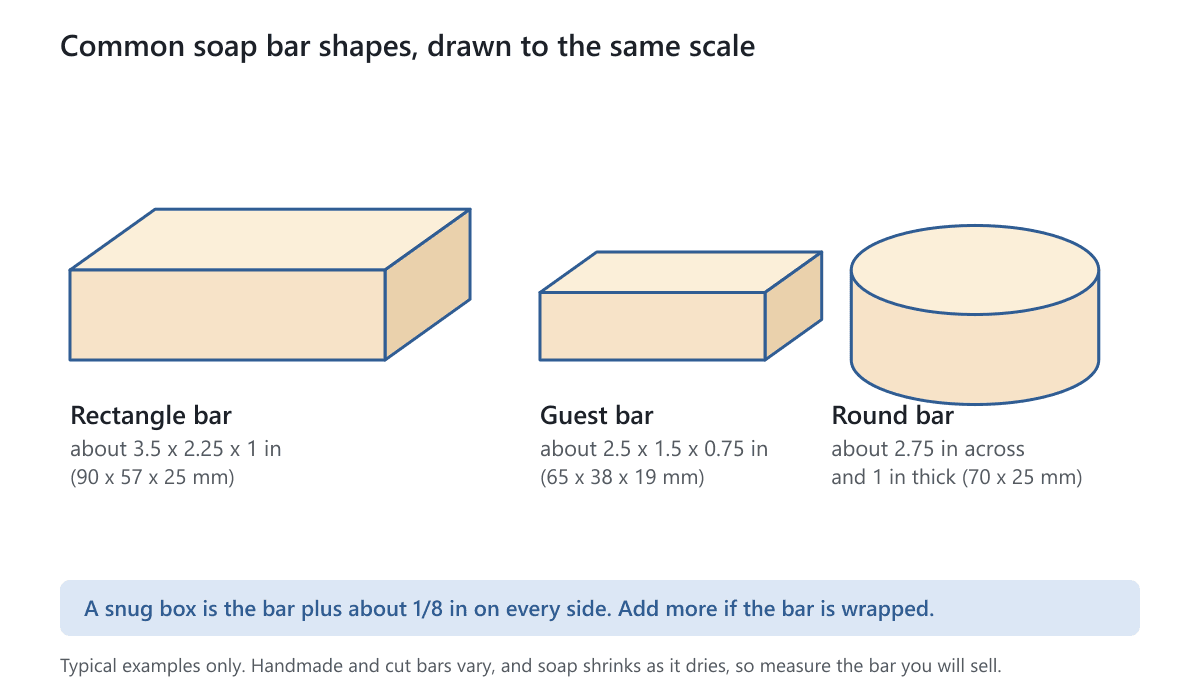
The table shows typical sizes. They are examples, not standards, and your bar may differ.
| Bar type | Typical size | Common use | Box note |
|---|---|---|---|
| Rectangle bar | 3.5 x 2.25 x 1 in (90 x 57 x 25 mm) | Retail and handmade bars | Fits a sleeve, tuck or window box |
| Guest or hotel bar | 2.5 x 1.5 x 0.75 in (65 x 38 x 19 mm) | Gift sets, samples, travel | Small boxes, often several in a set |
| Round bar | About 2.75 in across, 1 in thick (70 x 25 mm) | Handmade and shaped bars | Needs a square box or a custom shape |
| Loaf slice or irregular bar | Varies | Handmade, rustic | A little extra clearance, sometimes a window |
How Much Room to Leave
A snug retail box adds about 1/8 inch (3 mm) on each side of the bar. If the bar is wrapped, add the thickness of the wrap. For the rectangle bar in the table, a snug inside is 3.5 + 0.25 = 3.75 inches long, 2.25 + 0.25 = 2.5 inches wide and 1 + 0.25 = 1.25 inches high. Leave a little more if the bar varies, or if you want a visible air gap. Our measuring guide explains inside and outside dimensions.
Round bars do not fit square corners, so there is wasted space. A pillow box, or a custom shaped box such as a round or hexagonal one, can use that space better.
Box Styles for Soap
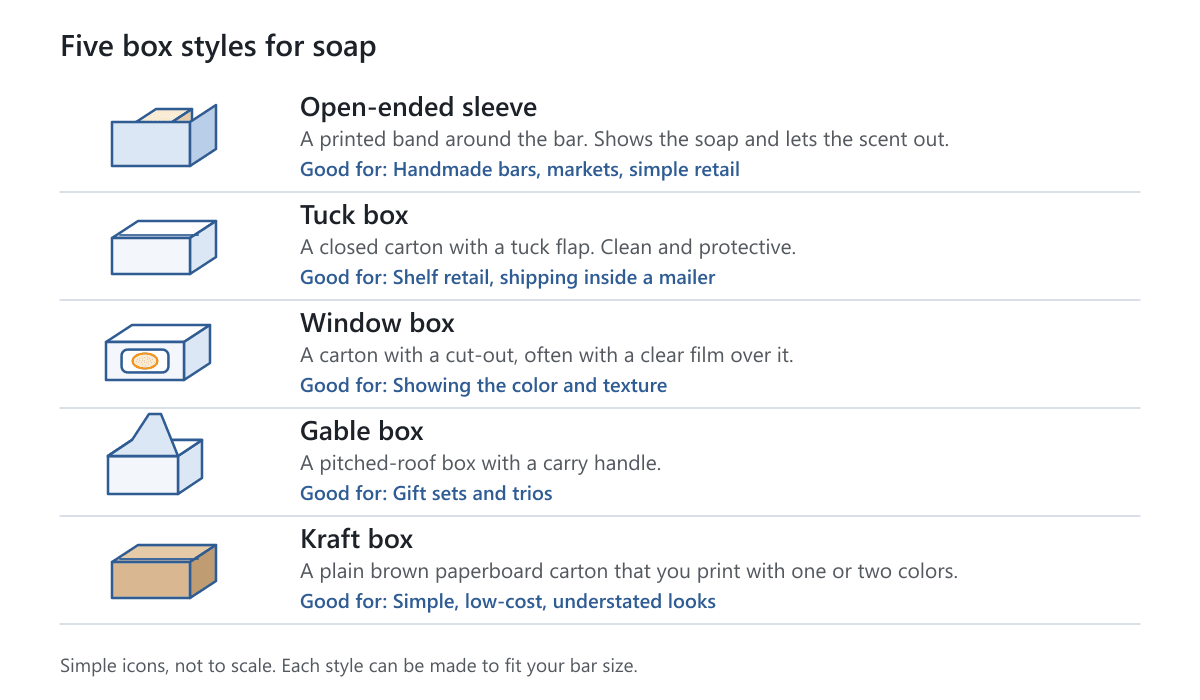
Five styles cover most soap packaging. They differ in protection, how much of the bar is visible, and cost.
Sleeves
A packaging sleeve is a printed band that wraps around the bar. Both ends stay open, so the soap can be seen and smelled. It is the lightest and lowest-cost option, and a favorite for handmade bars. It protects the bar less, because the ends and the bar surface stay exposed.
Tuck Boxes
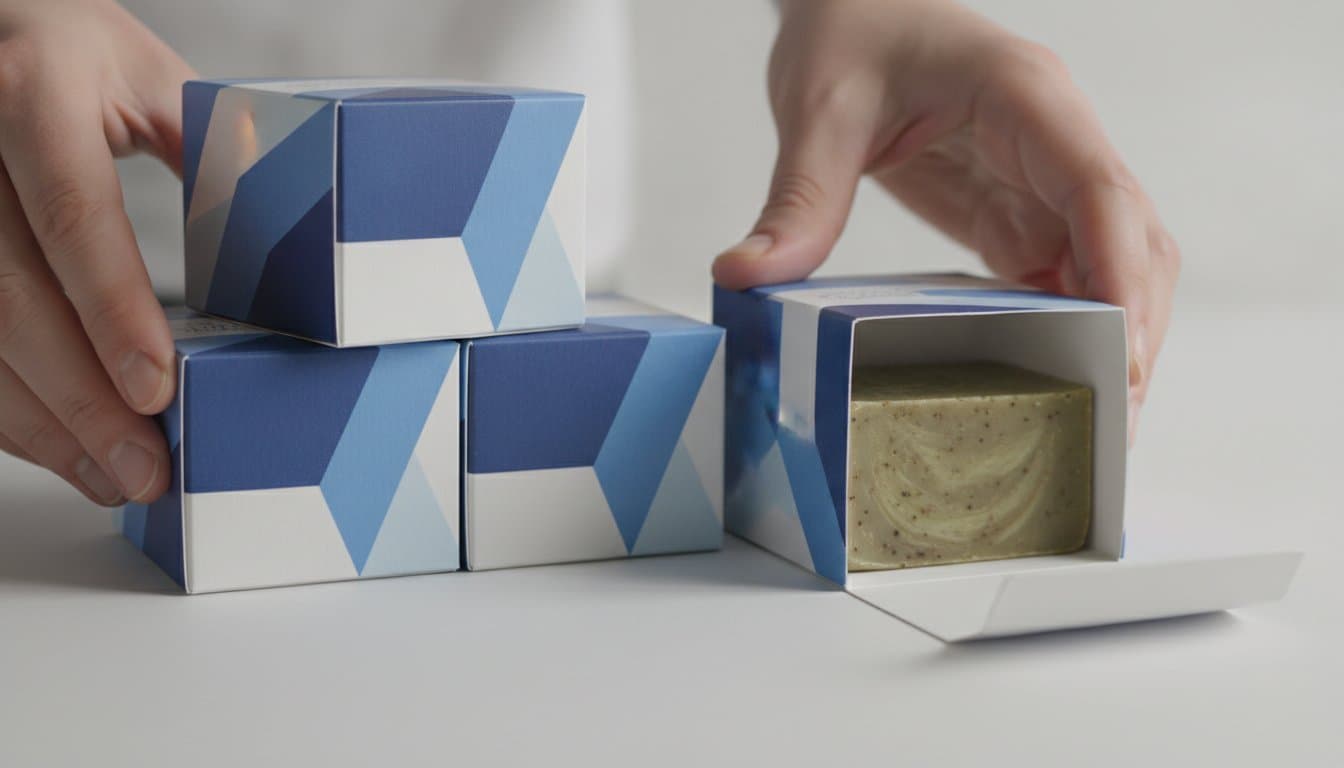
A tuck box is a closed folding carton. It keeps out dust and fingers, prints on every panel and ships flat. It is the standard choice for shelf retail. Ask for the style that opens the way you prefer. Our straight tuck end and reverse tuck end pages show the two common types.
Window Boxes
A window box has a cut-out, often covered with a clear film (window patching). The shopper sees the color and texture of the bar. Keep in mind that a window exposes the bar to light, and that the film is a separate material. Our tuck boxes can include a window.
Gable Boxes
A gable box has a pitched roof and a carry handle, like a small gift bag. It suits a set of two to four bars, or a soap with a dish or a cloth.
Kraft Boxes
Brown kraft paperboard has a plain look that takes one or two ink colors well. It is a simple, low-cost option. We do not describe a box as natural or organic because of its color. Any such claim about your soap is yours to make and prove.
Moisture, Oils and Wrapping Inside the Box
Soap holds water and oils. In humid air a bar can sweat, and a fresh bar can give off oil. Paperboard soaks up both, so a bare bar in a plain carton can leave a dark mark on the inside, and in a sealed box a damp bar can sit in its own moisture.
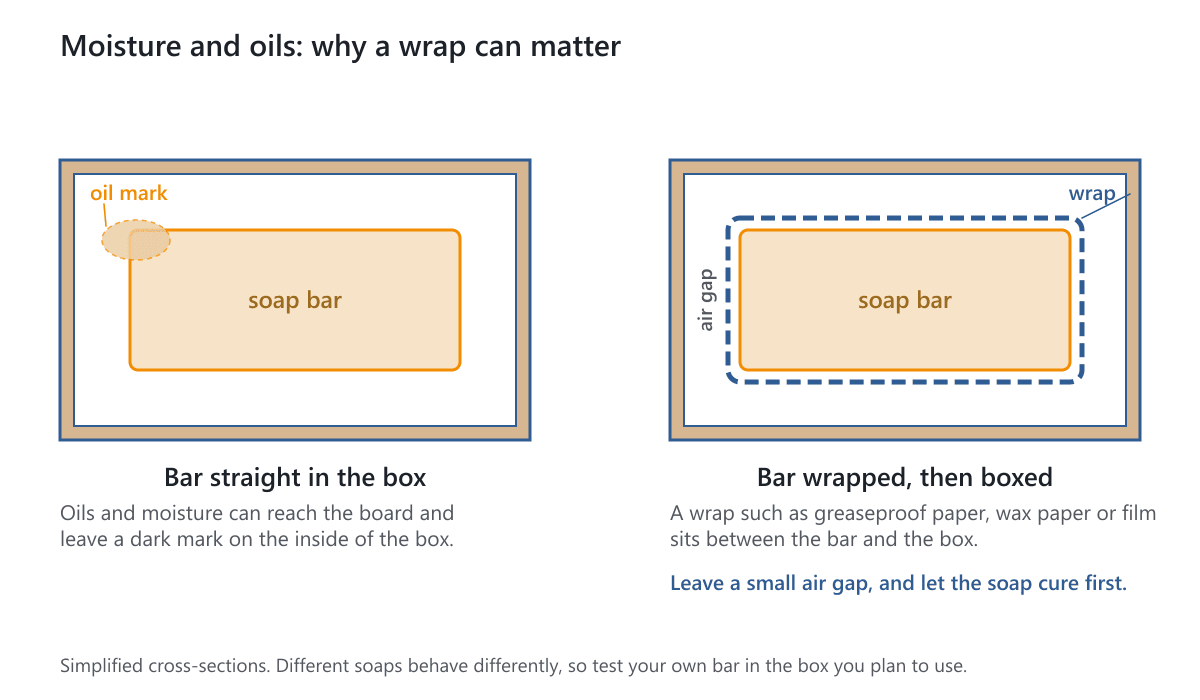
These habits help, whatever box you choose.
- Cure first. Handmade cold-process soap typically needs several weeks to dry and harden. Boxing a fresh bar traps moisture.
- Wrap the bar. Greaseproof paper, wax paper, glassine or a film around the bar keeps oils off the board. You can request custom greaseproof paper in your size. Tell us if the wrap will touch the soap directly, and we confirm options.
- Leave a small air gap. A snug box with no air can trap moisture.
- Keep the box dry. Store the boxed bars away from damp, and ship them dry.
- Test it. Leave a boxed bar in a humid room for a week and open it.
A coating on the outside of the box, such as varnish or lamination, makes the surface wipe clean and resist scuffs. It does not seal the inside of the box. See varnish vs lamination for the difference.
Tissue paper can add a soft layer and a gift look, but it does not stop oils. See our tissue paper page if you want a printed wrap around the bar for decoration.
Scent and Display
Shoppers like to smell soap, and a scented bar sells itself in the hand. That creates a trade-off. An open sleeve or a window with no film lets the scent out, which helps sales in a shop and fades the bar over time. A closed box keeps the scent in and the dust out, but the shopper cannot smell it.
- For markets and shops with testers: an open sleeve, with a sample bar out for sniffing.
- For shelves without testers: a closed tuck box with the scent name and notes printed on the front.
- For online sales: a closed box, since the shopper cannot smell it, and clear scent and ingredient information.
- For a window: place it where the best part of the bar shows, such as a swirl or an embedded color.
Soap that is strongly scented can also scent the box. If you pack different scents together, keep them in sealed boxes or wraps so they do not mix.
Labels and Required Text
The brand is responsible for the text on a soap box. We print the artwork you approve, and we do not check it against regulations. The rules depend on the country, and on what the product claims.
In the US, a product that is only soap, sold only as soap, is generally treated differently from one that makes cosmetic claims such as moisturizing. The label rules can differ between the two, so check which applies to you, and what your market requires. Terms such as natural, organic and handmade can have rules of their own, so be sure you can support any you use.
What to Plan Space For
- Product name and what it is, for example bar soap.
- Net weight, often shown in more than one unit, such as ounces and grams.
- Ingredients. Many makers list them even where the rules differ, and shoppers expect them.
- Company name and address, and a website or contact.
- Warnings or directions, if they apply.
- Barcode and batch code, if you sell through retailers.
Batch codes and scent names can go on a sticker or label, so you can use one printed box for several scents. Stickers and labels start at 500 units, so plan the sticker order with the box order. Tell us at the start which text must appear and which changes between batches.
Finishes and Print Choices
Soap boxes are often simple, and a simple box can look more premium than a busy one. Printing is CMYK or Pantone, see our color systems guide. A few ideas follow.
- One or two spot colors on kraft. Low cost, with an understated look.
- A matte or soft touch coating on white board. A calm, premium feel.
- Foil or embossing on the logo. A small detail goes a long way. Keep lines bold and leave space around them.
- Spot UV on a pattern. It shows best against a matte base.
- Inside print. A short note or a pattern inside a sleeve or tuck box makes the unboxing feel finished.
Send artwork with bleed if the color runs to the edge. See what bleed in packaging means.
Bundles and Gift Sets
Soaps sell well in sets of two to six. A set changes the structure. Three guest bars in a row need a long, shallow tray. Four bars in a square need a deeper box. Check the arithmetic: three guest bars lying side by side at 2.5 inches long and 1.5 inches wide, with 1/8 inch of clearance, need an inside of about 2.75 x 4.75 x 1 inches. This is an invented example, so measure your own bars.
- A tray and sleeve box shows all the bars when it opens. See tray and sleeve boxes.
- A gable box works as a ready-to-gift carry pack.
- A rigid box gives a premium feel for luxury sets. See rigid boxes.
- A divider or insert keeps bars apart and stops them rubbing. See box inserts.
If you sell soap with a candle or bath bomb, check our pages for candle packaging and bath bomb boxes for ideas on mixed sets.
Shipping Soap
Soap is dense, so even a small order is heavy. A bar in a sleeve or a thin carton is not built to travel alone. For online orders, pack the boxed bars in a mailer box or a shipping box with paper fill, so the boxes do not shift or crush. Keep the contents dry, and think about heat and humidity on the route, which can soften bars and mark boxes.
Carriers price by weight and by size, so check the outside size of the packed box. Our packaging cost guide explains how size affects the cost of packaging and shipping.
Three Example Scenarios
These are invented, to show how the choices play out. They are not customers.
A Market Stall Maker
A maker selling at markets could use open-ended sleeves in kraft board, printed in one color, with a scent sticker on each. The shopper can smell the bar, the sleeve costs little, and the maker can reuse the same sleeve for every scent.
An Online Shop
A shop shipping bars across the country could use a closed tuck box, a greaseproof wrap inside and a mailer for the order. The tuck box protects the bar and looks good in a photo, and the wrap protects the box from oils.
A Gift Trio
A brand selling three guest bars as a gift could use a tray and sleeve box, with a seasonal sleeve. Each bar is wrapped, the tray has a divider and the sleeve changes with the season.
Common Mistakes
- Boxing soap that has not finished curing.
- Measuring one bar, when bars in the batch vary.
- Leaving no wrap between an oily bar and bare board.
- Leaving no air gap in a closed box.
- Choosing a window that shows the plainest side of the bar.
- Putting the ingredients on a panel that is hidden in a gift set.
- Shipping boxed bars without an outer box.
- Using terms on the box that you cannot support.
Checklist Before You Order
- Bar size, measured when cured, and the shape.
- Wrap type, and its thickness.
- Box style: sleeve, tuck, window, gable or kraft.
- Single bars or sets, and the layout of a set.
- Scents and how they will be named: printed, or by sticker.
- Required text: name, net weight, ingredients, company details, barcode.
- Finishes and colors, with Pantone numbers if you have them.
- How it ships, and the outer box.
- Quantity for the first run.
Next Steps
Send us the size of your bar, how you wrap it, how it will be sold and how many you need. We reply within 1 business day and offer free design support. Most boxes start at 100 units, and each product page states its own minimum. Production takes 5 to 7 working days, longer for large orders, after artwork approval and payment. You can get a free quote, try a free dieline template, or order the Standard Sample Kit for $50, shipping included, to hold the box styles first.
Frequently Asked Questions
What size should a soap box be?
Measure the finished bar and add about 1/8 inch (3 mm) on each side. A typical rectangle bar of 3.5 x 2.25 x 1 inches needs an inside of about 3.75 x 2.5 x 1.25 inches, plus the thickness of any wrap. Handmade bars vary, so measure several.
What is the best box for handmade soap?
An open-ended sleeve is the most popular for markets and simple retail, because it is light, low cost and shows the bar. A closed tuck box protects better for shelves and shipping. A window box shows the bar and keeps it enclosed.
Should I wrap soap before putting it in a box?
Often yes. A wrap such as greaseproof paper, wax paper or film keeps oils off the board and slows moisture changes. Test a boxed bar over a week or two. Tell us if the wrap will touch the soap, so we can discuss options.
Do I need lamination on a soap box?
Not always. A varnish or lamination on the outside makes the surface easier to wipe and resists scuffs, but it does not seal the inside of the box. Decide by the look you want and how the box will be handled.
How do I keep the scent from fading?
A closed box and a wrap keep more scent in than an open sleeve or window. If shoppers should smell the bar, use an open sleeve and a tester, and accept that the scent fades faster. Test your own bars to see.
What must be on a soap box label?
It depends on the country and on what the product claims. Typically it includes the product name, net weight, ingredients, company name and address, and a barcode or batch code. The brand is responsible for the wording. Send us the final text and we will leave room for it.
Can I order a small quantity of custom soap boxes?
Yes. Most boxes start at 100 units, and each product page states its own minimum. Stickers and labels start at 500 units. Ask for a sample kit or a structural sample to test before a full run.
Written by the PacksDo Team
We make custom printed packaging, from boxes and mailers to bags, labels and inserts. Questions about this guide? Ask us.